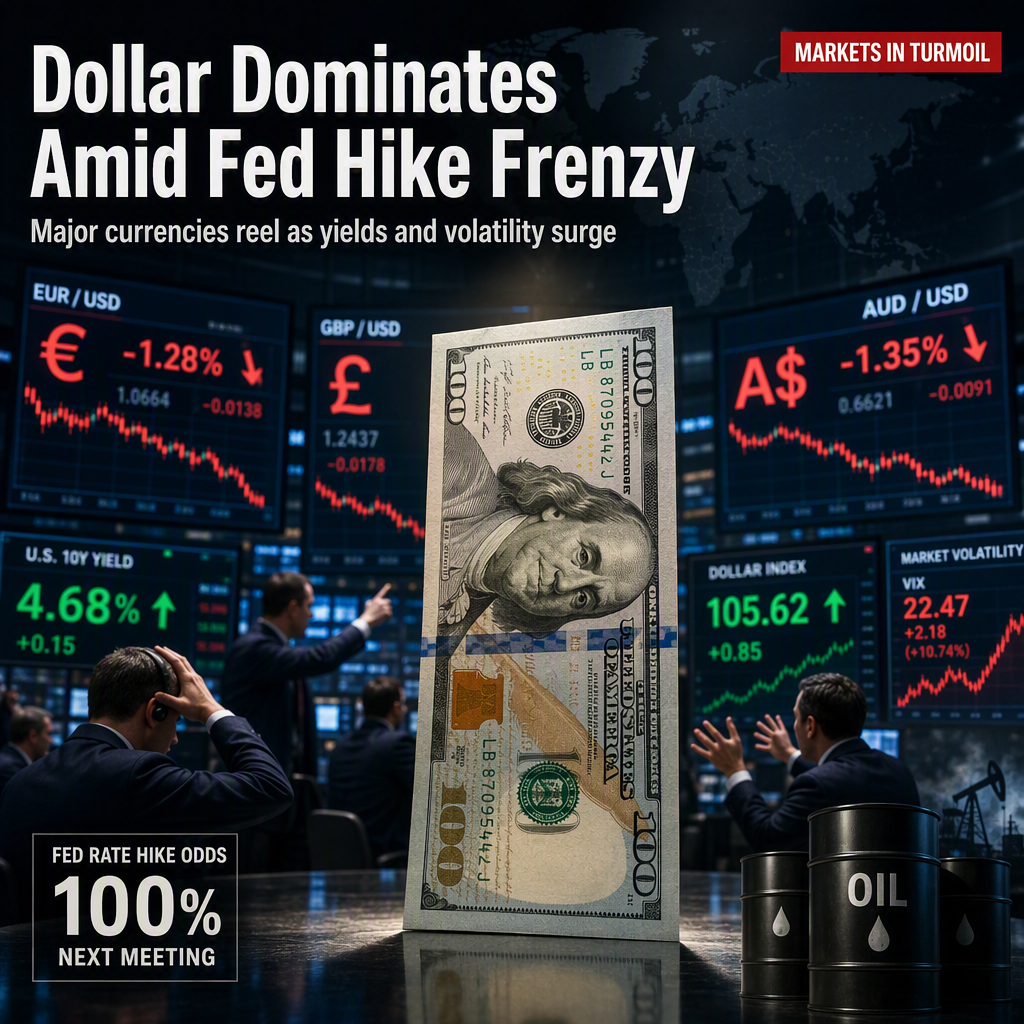
On Monday, the US Dollar strengthened against all major currencies as market sentiment soured amid a combination of factors, including a sharp selloff in technology shares, heightened geopolitical tensions in the Middle East, surging energy prices, and a significant rise in US bond yields [1][2][3]. The US Dollar Index (DXY) climbed 0.33% to reclaim the 99.00 level, closing at 99.46 [1]. The 10-year US Treasury yield touched 5% for the first time since 2023, further boosting the Dollar's appeal as a safe haven [1][2][3].
The Australian Dollar (AUD/USD) registered losses of over 0.73%, trading at 0.7118 after reaching a high of 0.7168 earlier in the session [1]. The decline was attributed to the global risk-off mood, with additional pressure from the AI sector selloff and concerns over a potential oil supply shortage following a Houthi attack on a Saudi oil pipeline, which could disrupt about 7 million barrels per day [1]. Rising inflation expectations and the anticipation of a US Federal Reserve rate hike also weighed on the Aussie, with money markets pricing in a 97.50% chance of a 25 basis point hike at the September 15-16 Fed meeting [1].
The Euro (EUR/USD) closed near 1.1550, down 0.42% and below both its 50-day and 200-day Exponential Moving Averages for the first time since late July [2]. The ECB had raised its deposit rate to 2.50% on September 10, but the Euro has declined in every session since, pressured by higher oil prices and the Dollar's strength [2]. Futures tied to the Fed's rate fully priced in a quarter-point increase on Wednesday, which would be the first US rate hike since 2023, and projected a second hike by December, with the rate near 4.55% by next July [2]. The ECB's next increase is priced at 78% for October 29, with its deposit rate seen near 3.40% by next September [2].
The British Pound (GBP/USD) also weakened, closing just below 1.3500, down 0.19% after hitting its lowest level since August 14 before recovering half of its losses by the close [3]. The Pound's decline was less pronounced than the Euro's [3]. Futures priced the Fed's Wednesday rate hike at 100%, and the overnight rate gap will temporarily favor the Dollar over the Pound for the first time since October [3]. The Bank of England's rate decision is due Thursday, with markets split on the timing of the next hike: futures price a 47% chance for Thursday and 95% by December 17 [3]. The Bank is also expected to slow its government bond sales program, reducing the annual run-off to £50 billion from £70 billion [3].
Technical analysis for AUD/USD shows the pair holding above key moving averages and trend-line supports, maintaining a mildly bullish near-term bias despite the recent pullback, with resistance at 0.7198 and support at 0.7070 and 0.7028 [1].
CONCLUSION
The US Dollar's broad-based rally, driven by surging Treasury yields and near-certain Fed rate hike expectations, has put significant pressure on the Australian Dollar, Euro, and Pound. Market participants are closely watching upcoming central bank decisions and economic data, with volatility likely to persist as monetary policy paths diverge. The immediate market takeaway is heightened Dollar strength and increased uncertainty for major currency pairs.