
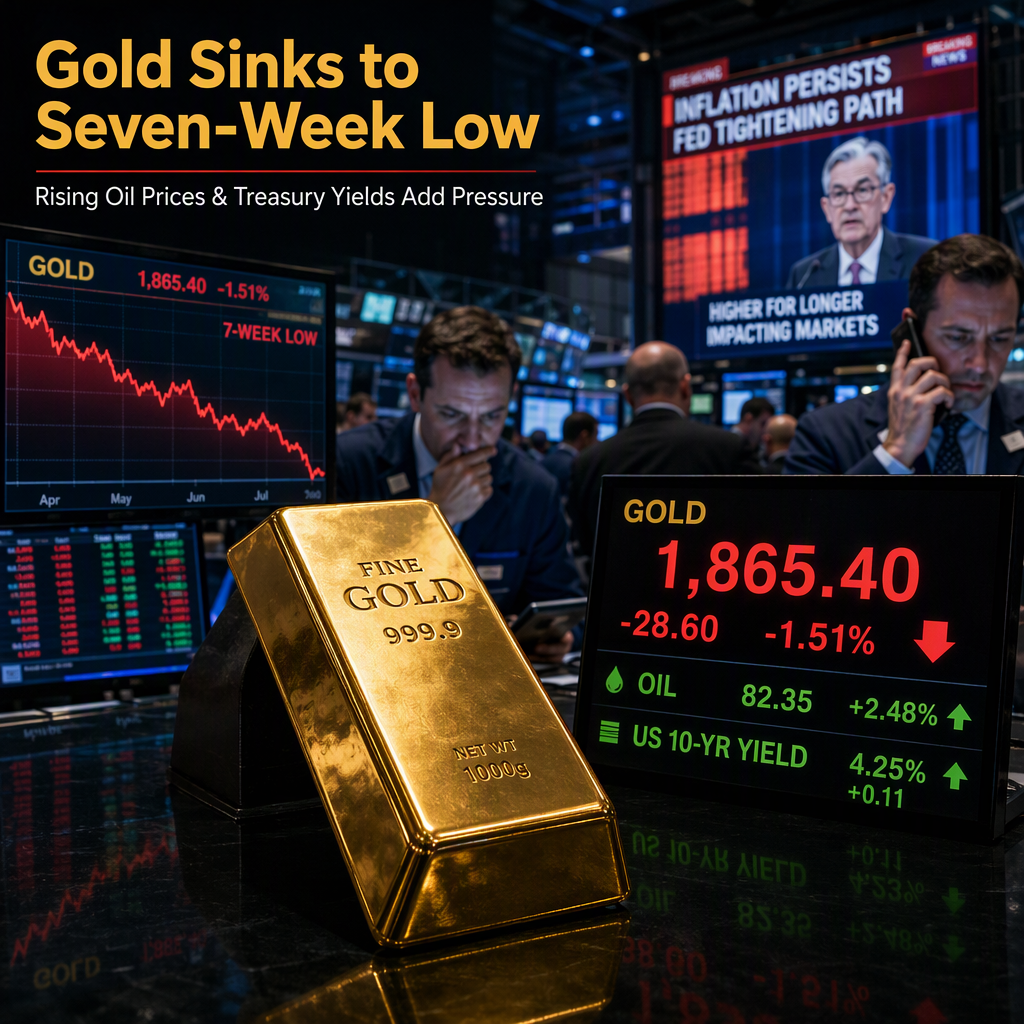
Gold has extended its decline to a seven-week low, driven by higher oil prices, firm US Treasury yields, and a stronger US Dollar, according to Christopher Wong at OCBC [1]. The break below the $4,200 level has intensified technical selling, with the near-term direction for gold closely tied to movements in oil prices and interest rates [1]. OCBC notes that the recent rise in oil prices has reinforced inflation concerns and expectations for further Federal Reserve tightening, adding to the bearish pressure on gold [1].
Technical analysis from OCBC highlights that mild bearish momentum remains intact on the daily chart, with the Relative Strength Index (RSI) falling and risks skewed to the downside [1]. Key support levels are identified at $4,100, $4,000, and $3,944 (the previous low), while resistance is seen at $4,300–$4,350 (21, 50, 100 DMAs) and $4,460 [1]. Failure to reclaim the $4,300–$4,350 range may see continued bearish pressure [1].
OCBC suggests that softer US economic data, such as core PCE or nonfarm payrolls (NFP), or some easing in yields could help gold stabilize. Conversely, another leg higher in oil and yields would likely keep downside pressure intact [1].
CONCLUSION
Gold's recent decline to a seven-week low is attributed to higher oil prices, firm Treasury yields, and a stronger Dollar, with technical selling intensifying below $4,200. The outlook remains bearish unless key resistance levels are reclaimed, and further moves in oil and yields will be critical for gold's near-term direction.