
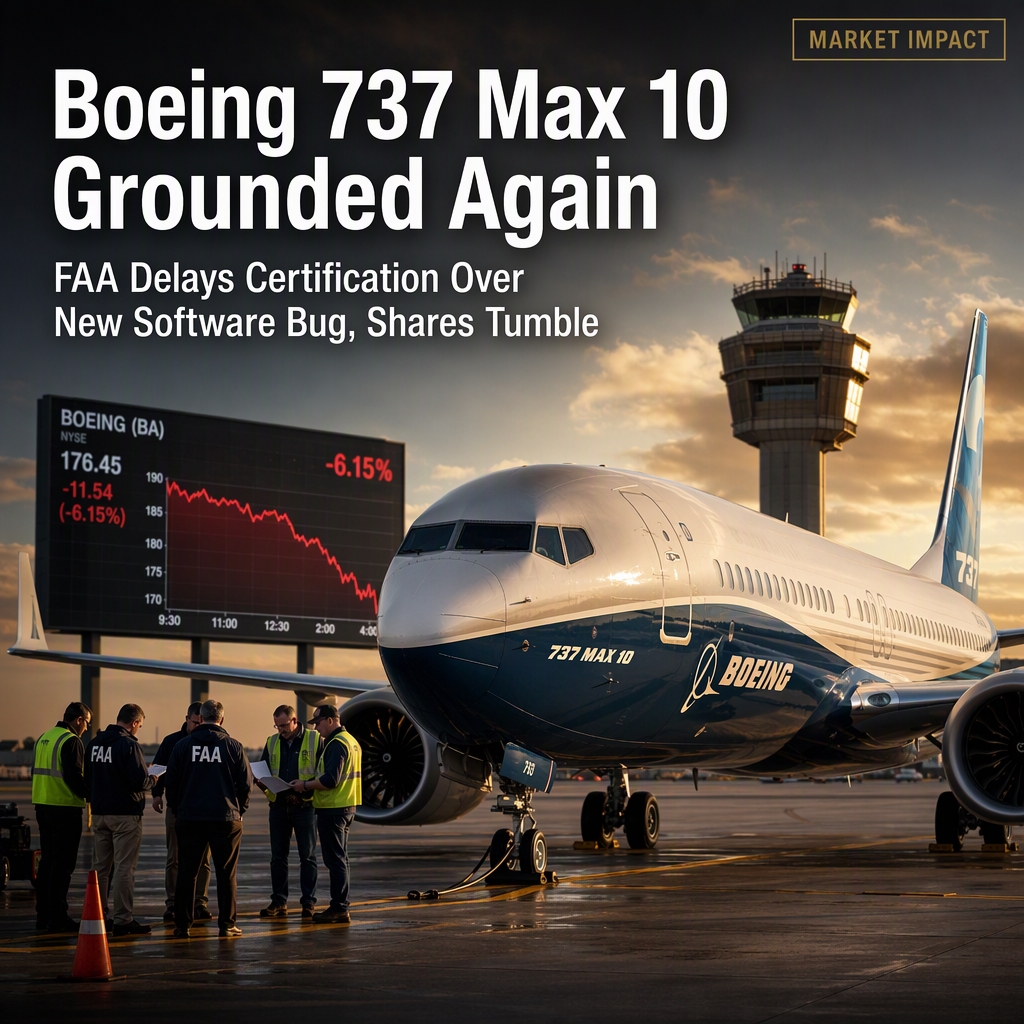
The Federal Aviation Administration (FAA) announced that it will delay certification of Boeing's 737 Max 10 aircraft due to a newly identified software bug. This issue, which Boeing flagged last month, could potentially cut off automated landing guidance if pilots are required to perform a go-around, a maneuver where an aircraft aborts its landing and attempts another approach [1]. The Max 10 is the last model in the Max family awaiting certification, and Boeing had anticipated FAA approval in the coming weeks. However, FAA Administrator Bryan Bedford stated that the agency will not certify the aircraft until it fully assesses whether the software problem constitutes a safety-of-flight issue, marking another setback for Boeing as it seeks to complete government approval for its best-selling aircraft family [1].
Boeing CEO Kelly Ortberg had previously told investors that the company expected to receive regulatory approval for the Max 10 "very soon." The company disclosed over the weekend that the software glitch could affect certain landing procedures, specifically involving the vertical navigation system during missed approaches [1]. Bedford explained that while Boeing had fixed a previous bug in the system, the new issue was introduced unexpectedly. The FAA had approved the Max 7, the smallest model in the family, just last month [1].
Following the FAA's announcement, Boeing shares fell more than 6% in afternoon trading, extending earlier losses after Bedford's comments [1]. U.S. airlines reported that they do not have any Max aircraft with the problematic software and have reverted to older versions if necessary [1]. Boeing stated, "We continue to follow the lead of the FAA as we work through the certification process" [1].
The delay in certification poses a significant challenge for Boeing, as the Max 10's entry into service is now uncertain pending the FAA's safety assessment. The market reaction underscores investor concern over ongoing certification hurdles and software reliability issues within Boeing's Max program [1].
CONCLUSION
The FAA's decision to delay certification of the Boeing 737 Max 10 due to a new software bug has led to a sharp decline in Boeing's share price and renewed scrutiny of the company's software processes. The timeline for the Max 10's approval remains uncertain, with the FAA emphasizing safety as its top priority. Investors and airlines will be closely watching for further updates on the resolution of the software issue.