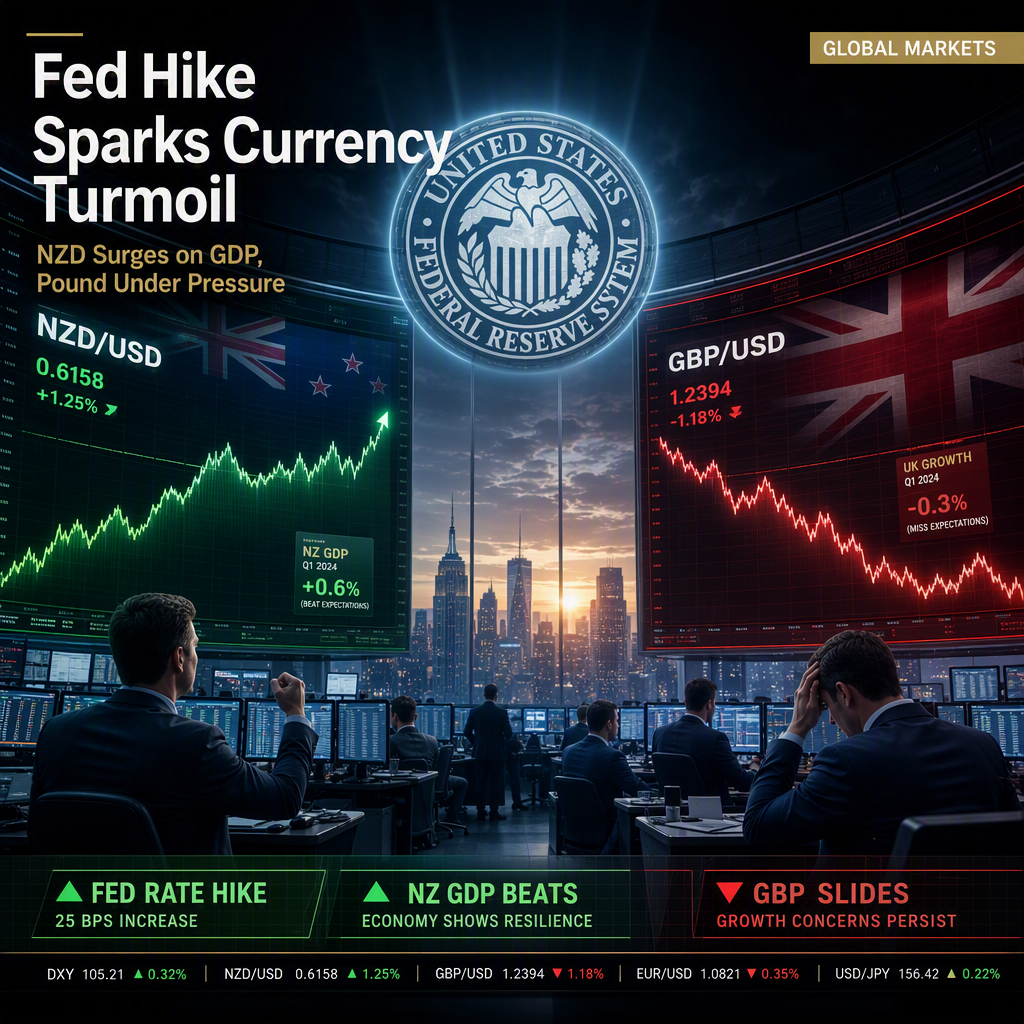
On Thursday, the New Zealand Dollar (NZD) rebounded, trading around 0.5730, up 0.35% on the day, following stronger-than-expected GDP growth data. Statistics New Zealand reported that GDP expanded by 0.2% quarter-on-quarter in Q2, beating market expectations of 0.1%, though slowing from the previous quarter's 0.9% growth. On an annual basis, GDP accelerated to 2.6%, up from a revised 1.7% previously. This resilience in economic activity provided some relief for the NZD, which had hit a two-month low the day before. The NZD was the strongest against the British Pound, gaining 0.63% on the day [1].
Meanwhile, the British Pound (GBP) extended losses after the Bank of England (BoE) held rates unchanged at 3.75% in a 6-3 vote, with three dissenters favoring a 25-basis-point hike. The BoE also announced plans to reduce UK bond purchases and annual Gilt sales of up to £20 billion. Following the decision, GBP/USD traded at 1.3381, down over 0.23%. Money markets now price in a 64% chance of a rate hike at the BoE's November 5 meeting. The GBP/USD technical outlook remains bearish, with the pair trading at 1.3343 and the Relative Strength Index (RSI) at 30, indicating downside momentum near oversold territory [2].
Both currencies reacted to the Federal Reserve's (Fed) decision on Wednesday to raise its benchmark interest rate by 25 basis points to a target range of 3.75%-4%. This was the Fed's first rate increase since 2023, justified by Chair Kevin Warsh as necessary due to persistently high inflation. The Fed's Summary of Economic Projections (SEP) dot plot suggests another rate hike by year-end, with the Fed funds rate expected to end above 4%. The PCE inflation is projected to stay at 3.7% this year and converge toward 2% by 2028. US jobless claims for the week ending September 12 fell sharply from 206K to 196K, below the 208K forecast, reinforcing the Fed's view of a solid economy and strong labor market [1][2].
The prospect of higher US interest rates continues to support the US Dollar, limiting the upside for risk-sensitive currencies like the NZD and GBP. Geopolitical tensions in the Middle East further bolster demand for the safe-haven US Dollar, tempering the positive impact of New Zealand's strong GDP and exacerbating GBP weakness following the BoE's dovish stance [1][2].
CONCLUSION
The Fed's rate hike and hawkish outlook have strengthened the US Dollar, pressuring both the New Zealand Dollar and British Pound despite positive domestic data for NZD and cautious BoE policy for GBP. Market sentiment remains cautious, with risk-sensitive currencies facing headwinds from US monetary tightening and global geopolitical tensions. Investors are closely watching upcoming UK retail sales and further Fed moves for additional direction.