
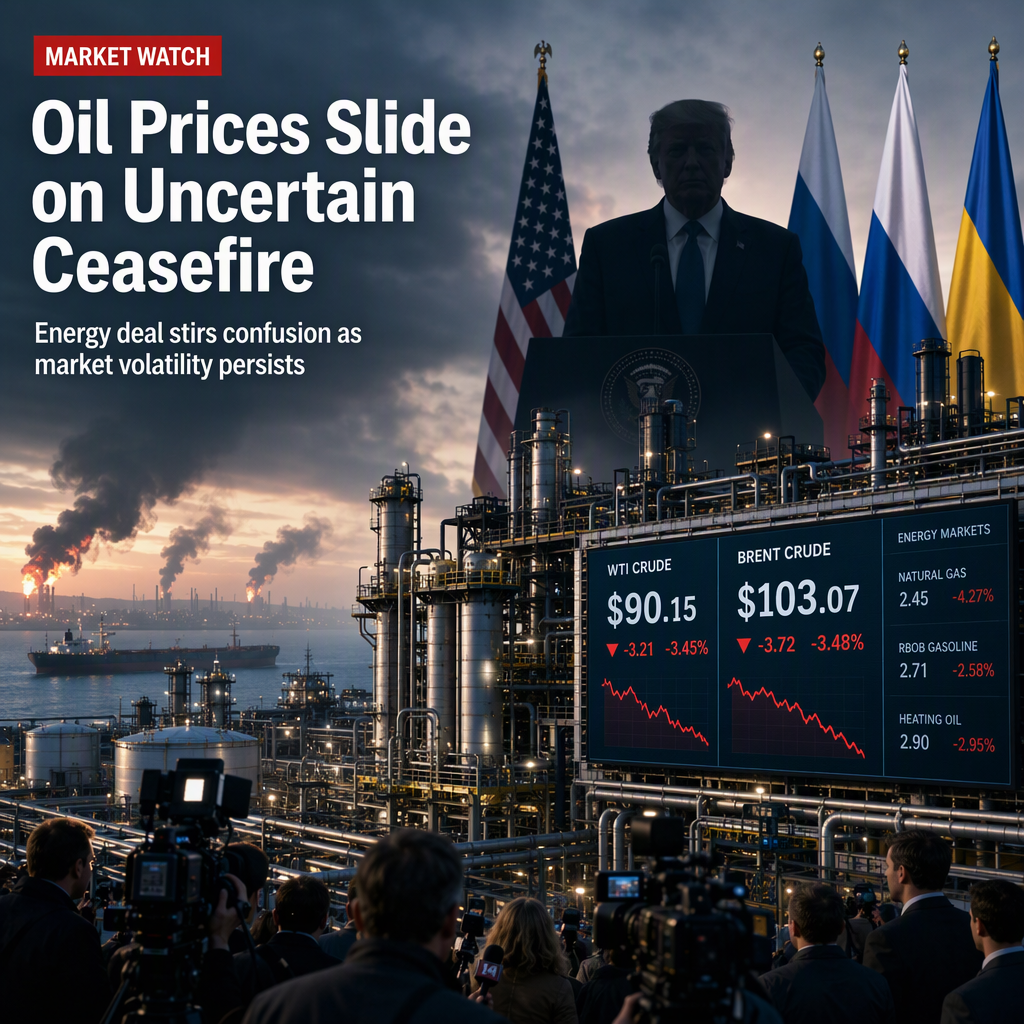
West Texas Intermediate (WTI) crude oil prices fell to around $90.15 in early European trading on Monday following U.S. President Donald Trump's announcement of an 'energy ceasefire' between Russia and Ukraine, which raised hopes for increased Russian energy supplies to the market [1][2]. Trump stated that he had reached a deal with Russian President Vladimir Putin for Russia to supply diesel to the U.S. in stages, with more than 300,000 tons to be delivered immediately, 500,000 tons in November, 1 million tons after that, and a further 3 million tons subsequently [1]. However, there is widespread confusion regarding the terms of the agreement, with Ukraine expressing surprise and indicating that their first knowledge of the deal came from Trump's social media post. Additionally, Moscow reportedly struck a power plant in Ukraine just hours after the announcement, casting doubt on the ceasefire's effectiveness [2].
Brent crude prices also moved lower, though they remained above $103 a barrel, while WTI hovered near $90 a barrel [2]. Despite the announcement, analysts and market participants are uncertain about whether Russia can supply enough diesel for the deal to impact U.S. fuel prices, with Neil Atkinson, former head of the Oil Division at the International Energy Agency, stating, 'Where the volumes to supply the Trump deal come from is a mystery, unless it comes from domestic supply, which will cripple the Russian economy' [2].
Geopolitical tensions remain high, as Yemen's Iran-backed Houthis have increased attacks on Saudi Arabia, including a deadly strike on Riyadh's King Khalid Airport, which disrupted air travel and led to event cancellations in the Saudi capital [1][2]. Trump has warned Iran and is considering joining Saudi Arabia in retaliatory actions against the Houthis [1][2]. The United Kingdom Maritime Trade Operations (UKMTO) confirmed a drone attack on a tanker near Sohar anchorage in Oman [1].
Market participants are also awaiting the American Petroleum Institute (API) crude oil stockpiles report, which could influence WTI prices depending on whether inventories show a draw or build [1]. U.S. futures are higher in early trade as investors focus on the upcoming earnings season, with major banks set to report results this week [2]. Key inflation data, including the September consumer and producer price indexes, is also due this week [2]. According to TD Securities, U.S. headline CPI is expected to have strengthened to 0.57% month-over-month in September, driven by a 9.0% rise in gasoline prices, and energy CPI is estimated to have increased by 5.3% month-over-month [1]. TD Securities warns that elevated gasoline prices are likely to keep headline CPI high year-over-year until early 2027 [1].
Technical analysis indicates that WTI remains above its 100-day simple moving average, suggesting a constructive outlook despite recent volatility [1].
CONCLUSION
Oil prices have declined following President Trump's announcement of an 'energy ceasefire' between Russia and Ukraine, but confusion and ongoing hostilities have left markets uncertain about the deal's impact. Geopolitical risks in the Middle East and upcoming U.S. inflation and earnings data are likely to keep energy markets volatile. Investors remain cautious as they await further clarity on supply, demand, and geopolitical developments.