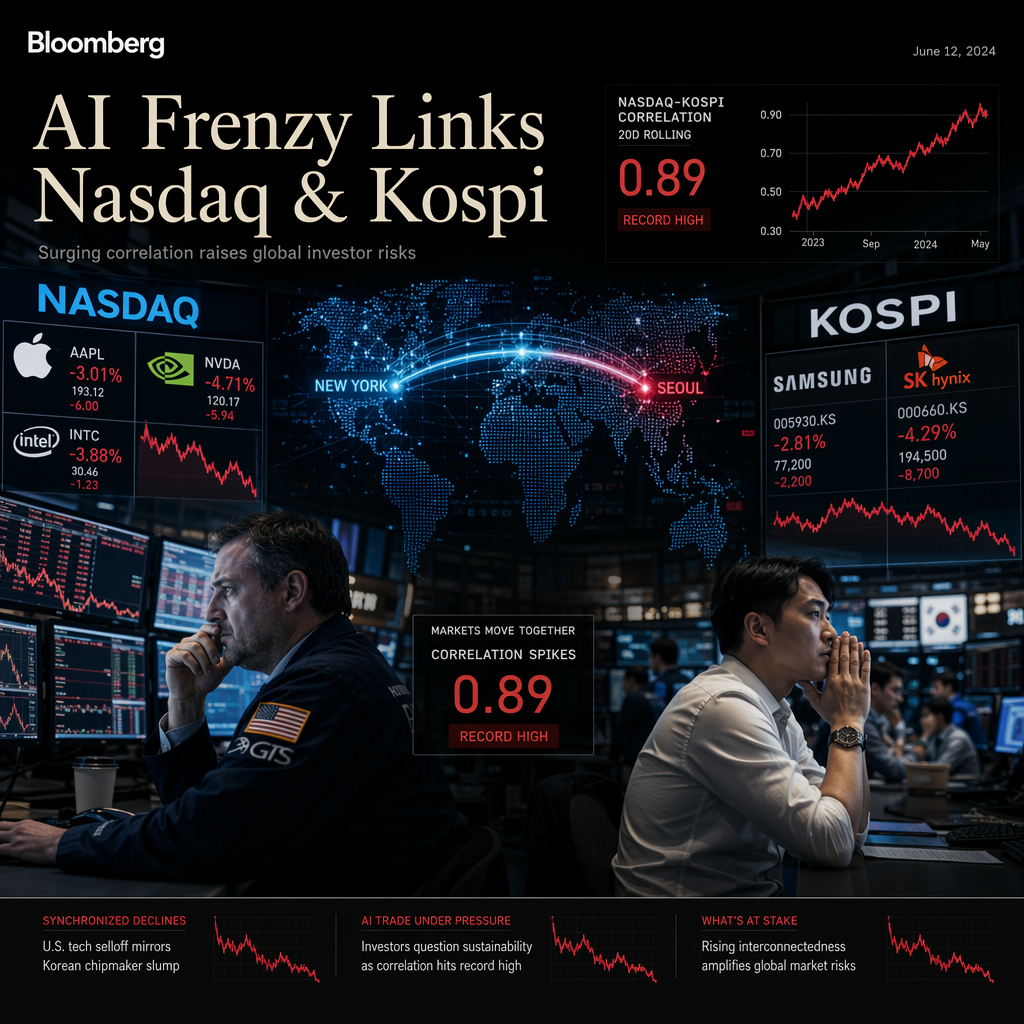
The correlation between the U.S. Nasdaq 100 and South Korea's Kospi index has surged to approximately 0.50, its highest level since 2021, as artificial intelligence spending increasingly links the fortunes of U.S. technology giants and Korean memory chipmakers such as Samsung Electronics and SK Hynix [1]. This growing relationship is attributed to the dominance of Samsung and SK Hynix, which together account for more than half of the Kospi index and are central to the AI hardware supply chain, supplying memory chips for data centers operated by U.S. tech firms [1].
According to Rolf Bulk, analyst at Futurum Group, the Kospi's rising correlation with the Nasdaq 100 is due to the index's transformation into a 'semiconductor index' [1]. Data-center demand for DRAM, a key component in AI servers, has increased from around 40% of global DRAM demand last year to more than half this year, with expectations for further growth [1]. This makes Samsung and SK Hynix early indicators of global AI trade strength, as their market reactions in Asia precede Wall Street's opening [1]. Jung In Yun of Fibonacci Asset Management emphasized SK Hynix's role as a barometer due to its exposure to high-bandwidth memory, a critical AI supply chain component [1].
Recent market movements underscore this dynamic: on July 13, the Kospi dropped over 8%, led by a 15% plunge in SK Hynix shares—a record fall—while the Nasdaq 100 subsequently closed 1.88% lower, with major U.S. tech stocks such as Micron Technology, Sandisk, and Intel declining by 4%, 12%, and 6%, respectively [1]. Peter Kim of KB Financial Group noted that the Korean memory-chip rally lagged the Nasdaq's advance, but recent volatility has led global investors to view Korea as a bellwether for AI trades [1].
Samsung's quarterly earnings guidance, typically released about two weeks before major U.S. semiconductor companies, is now seen as an early signal of AI demand trends [1]. However, analysts caution that while Korean and U.S. tech shares are moving in tandem, neither market consistently leads the other [1].
The increased correlation between the two markets reduces diversification benefits and heightens risks for investors, particularly if AI spending slows, according to analysts [1].
CONCLUSION
The surging correlation between U.S. and Korean tech stocks, driven by the AI boom and the dominance of Samsung and SK Hynix, has made Korea an early indicator for global AI market trends. While this offers investors new insights, it also raises risks by reducing diversification and increasing vulnerability to shifts in AI demand. Market participants should closely monitor both markets for signals of changing momentum in the AI sector.