
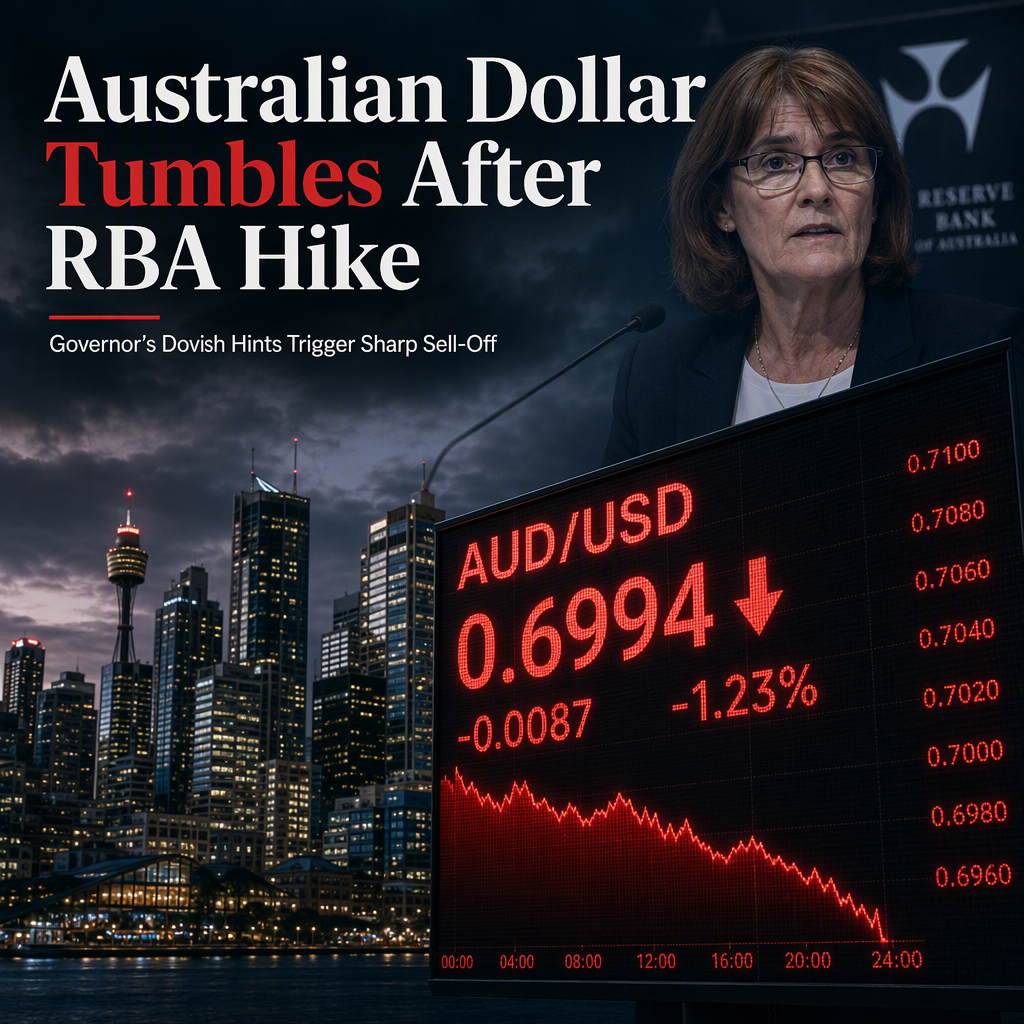
The Reserve Bank of Australia (RBA) raised its official cash rate by 25 basis points to 4.60%, marking a 15-year high and the fourth interest rate increase in 2026, as widely expected by the market [1][2]. The decision was unanimous, with the RBA statement noting that 'some of the upside risks [to inflation] flagged in August are materialising,' and reiterating readiness to 'increase the cash rate target further if needed' [1][2]. Despite the hawkish tone of the official statement, the Australian Dollar (AUD) came under immediate downside pressure, with AUD/USD breaking below the key 0.7000 psychological level and testing its 200-day moving average near 0.7030 [2].
The sell-off was primarily attributed to Governor Michele Bullock's press conference, where she signaled less urgency for additional tightening and expressed hope that the four hikes this year would prove sufficient. Bullock also confirmed that the Board considered a pause at the meeting, citing domestic housing market risks and broader global growth concerns [1][2]. Both MUFG and ING institutional strategists noted that while the RBA's policy statement retained a hawkish bias, Bullock's dovish remarks during the Q&A session drove AUD lower [2].
RBA cash rate futures are pricing in 36 basis points of tightening over the next twelve months, which limits policy divergence with the US Federal Reserve and offers some support for AUD/USD [1]. ING maintains its 0.7200 year-end forecast for AUD/USD, projecting outperformance in a broader USD-bearish environment, but acknowledges heightened near-term global risks, including housing market vulnerabilities and Middle East conflict risks [2]. MUFG focuses on immediate price softness as market expectations for subsequent tightening are reassessed [2].
Australia’s strategic exposure to commodities linked to energy, AI, and defense remains an important long-term tailwind for the AUD, according to Brown Brothers Harriman [1]. However, future price direction for AUD/USD remains tightly bound to incoming inflation data and central bank guidance, as highlighted by Lee Hardman at MUFG [2].
CONCLUSION
The RBA's rate hike to 4.60% initially supported AUD/USD, but dovish signals from Governor Bullock triggered a sharp sell-off below 0.7000. While the central bank maintains a hawkish stance, market confidence has been tempered by concerns over domestic and global risks. Near-term AUD/USD direction will depend on inflation data and further RBA guidance.