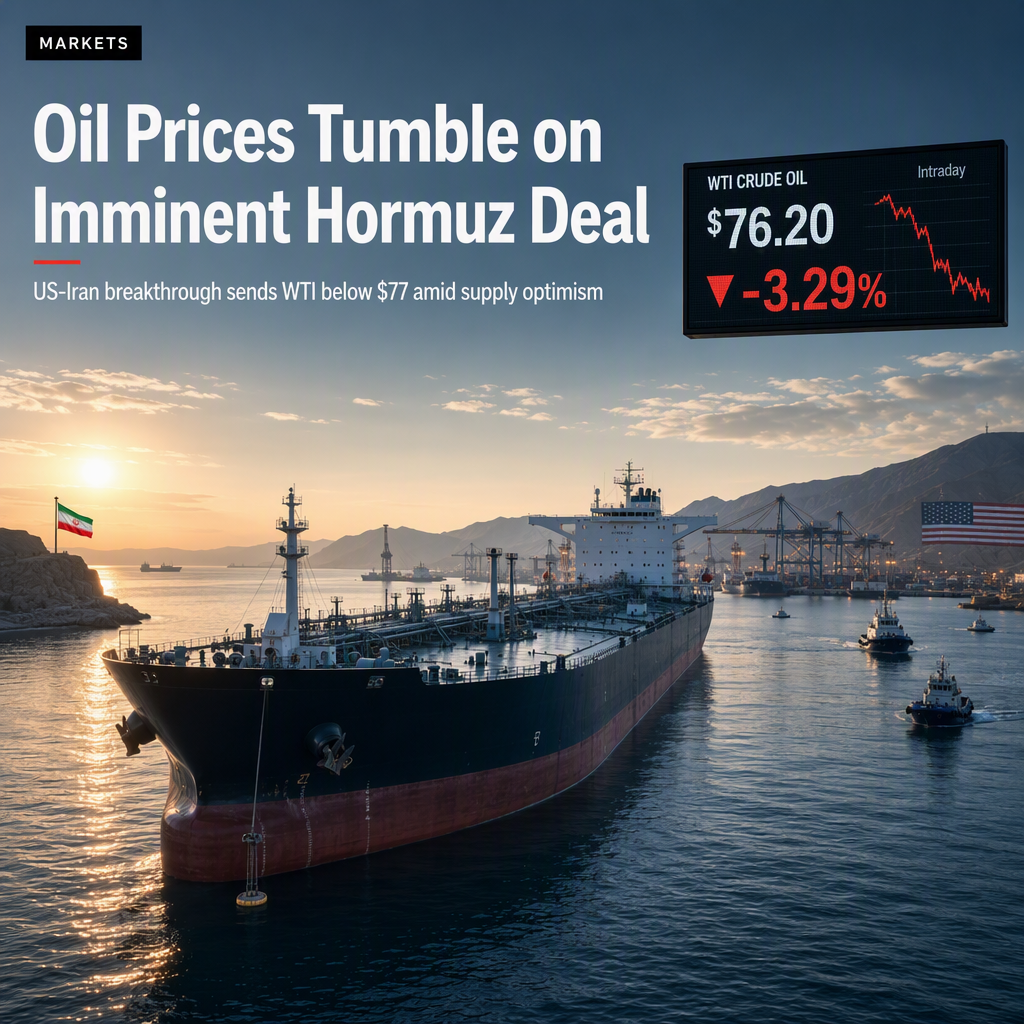
US Treasury Secretary Scott Bessent announced in a CNBC interview that a deal with Iran to reopen the Strait of Hormuz could be finalized as soon as Tuesday or Wednesday [1]. Bessent expressed optimism that energy prices would 'settle back down' following the potential agreement [1].
The market responded rapidly to Bessent's comments. West Texas Intermediate (WTI) Oil prices dropped 3.29% on the day, trading around $76.20 per barrel at the time of reporting, after reaching a more than three-week low of $75.68 [1]. This sharp decline reflects market anticipation of increased oil supply and reduced geopolitical risk in the region if the Strait of Hormuz is reopened [1].
The article also provides context on the significance of WTI Oil as a benchmark for global oil prices and outlines the key factors influencing oil prices, including supply and demand dynamics, geopolitical events, OPEC decisions, and US Dollar fluctuations [1]. However, the immediate market movement was directly tied to the news of the potential Hormuz deal and Bessent's statements [1].
No forward-looking analyst opinions beyond Bessent's expectation for energy prices to stabilize were included in the article [1].
CONCLUSION
The prospect of a US-Iran deal to reopen the Strait of Hormuz led to a sharp decline in oil prices, with WTI falling over 3% on the day. Market sentiment turned positive on expectations of eased supply constraints and lower energy prices if the deal is finalized.