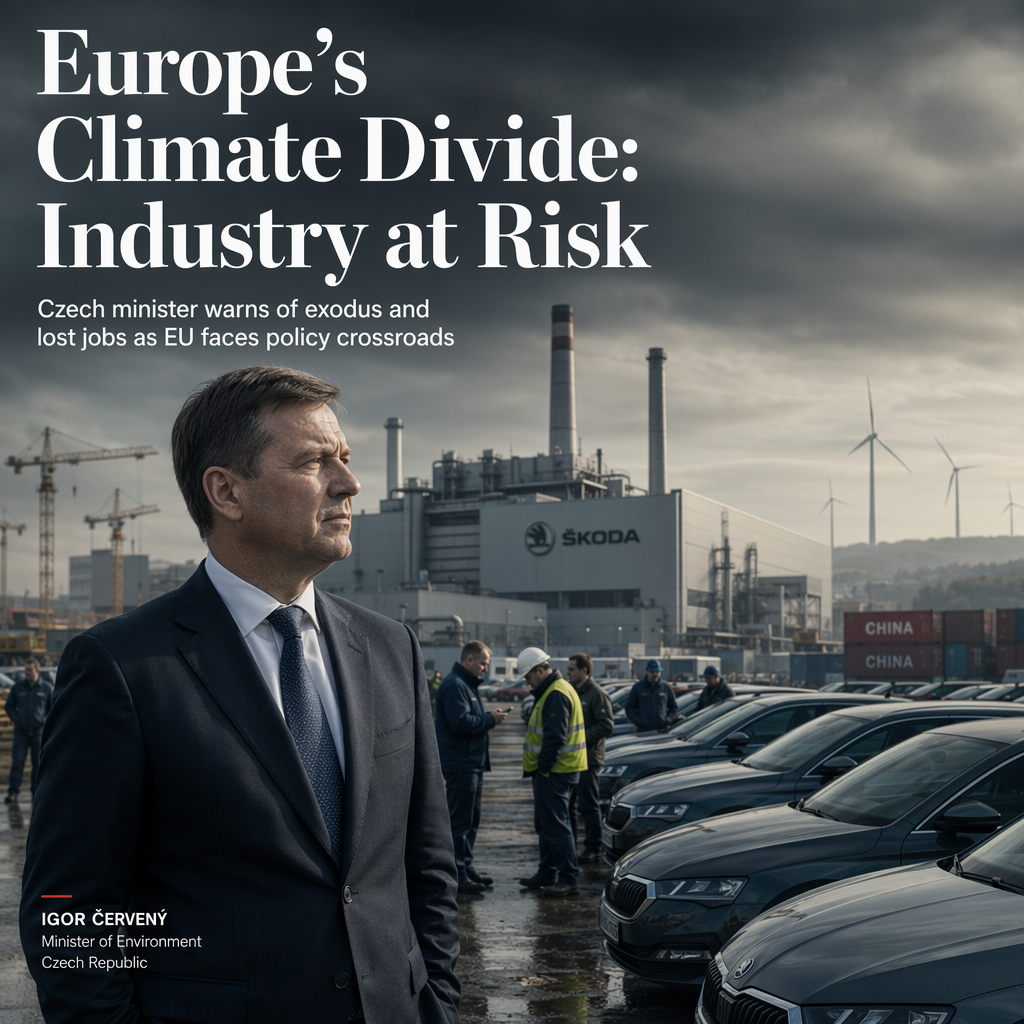
Czech Environment Minister Igor Červený has issued a warning that Europe's aggressive climate agenda could severely damage its industrial base unless leaders adjust their approach and respond to economic concerns voiced by voters. In an interview during his visit to the United Nations High-Level Political Forum on Sustainable Development, Červený stated, 'If we don’t change the course, we will probably crush the industry,' highlighting the pressure on European manufacturers, especially in the automotive sector, and noting that many companies are relocating production abroad, particularly to China and other regions [1].
Červený emphasized that the exodus of companies would result in lost tax revenue and jobs for European governments. He advocated for a 'win-win' solution that balances environmental protection with the need to maintain industry and employment, criticizing what he described as a focus on 'green ideology' at the expense of economic realities. He also noted that resistance to the current climate policy approach is spreading beyond the Czech Republic to countries such as Poland, Slovakia, Hungary, Germany, and some Scandinavian nations [1].
The Czech Republic, along with other European governments, has been urging Brussels to relax aspects of the Green Deal, including delaying the implementation of the new carbon market for buildings and road transport and seeking changes to emissions-trading rules, which Prague argues are increasing energy costs and undermining industrial competitiveness [1].
In contrast, European Commissioner for Environment Jessika Roswall reaffirmed the EU's commitment to the 2030 Agenda during the same U.N. forum, calling for accelerated climate action, increased investment in renewable energy and low-carbon technologies, and broader support for a green transition. Roswall warned that progress on the 2030 Agenda is being threatened by conflict, inequality, and the 'triple planetary crisis of climate change, pollution and biodiversity loss' [1].
CONCLUSION
The debate highlights a growing divide within Europe over the pace and structure of climate policies, with some governments warning of industrial decline and others urging continued commitment to ambitious environmental goals. Market participants may view the ongoing policy uncertainty as a medium-term risk to European industrial competitiveness and investment planning.