
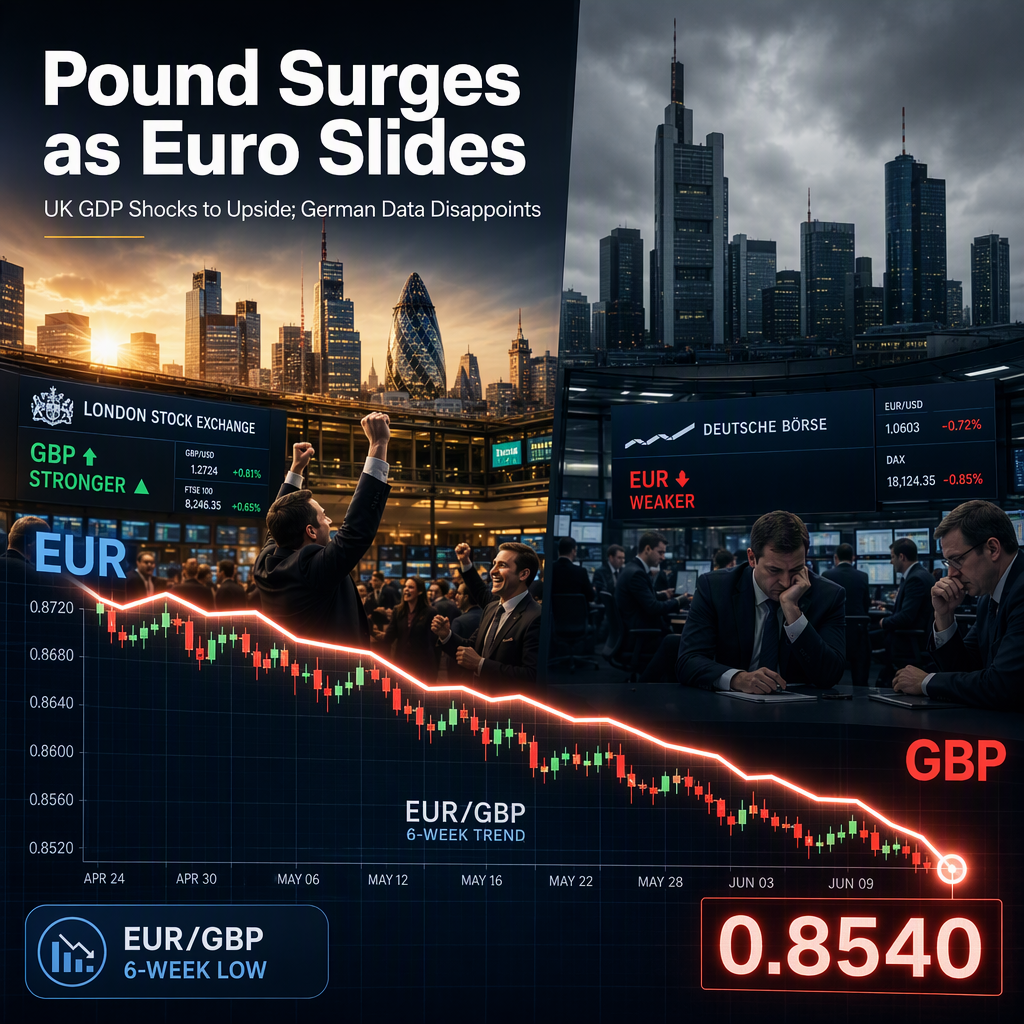
The Euro (EUR) fell sharply against the British Pound (GBP) on Wednesday, with the EUR/GBP pair dropping 0.3% intraday to reach six-week lows at 0.8540, and trading at 0.8546 at the time of reporting. This decline was attributed to stronger-than-expected UK economic data and disappointing figures from Germany. The final UK Gross Domestic Product (GDP) for the second quarter showed growth of 0.5% quarter-on-quarter and 1.4% year-on-year, both exceeding previous estimates of 0.4% and 1.2%, respectively. Additionally, the UK's Current Account deficit narrowed to GBP 19.932 billion in Q2 from a downwardly revised GBP 21.12 billion in Q1, outperforming market expectations of a GBP 25.6 billion shortfall. These positive UK data points have reinforced recent hawkish commentary from Bank of England officials regarding potential interest rate hikes [1].
In contrast, German economic data weighed on the Euro. Retail Sales in Germany contracted by 0.4% in August, following a 2.5% decline in July. While the German unemployment rate remained steady at 6.4%, the Unemployment Change figure rose to more than twice the market consensus, further pressuring the Euro [1].
Technical analysis indicates a strong bearish tone for EUR/GBP, with the pair having fallen 0.6% so far this week and breaking below the ascending channel. Intraday momentum indicators, such as the 4-hour Relative Strength Index (RSI) at 25, suggest deeply oversold conditions, while the MACD remains negative. Despite the oversold status, the trend remains negative, with potential resistance at the 0.8560 area and further resistance at the September 29 high of 0.8585. Support is seen at the 0.8530-0.8540 area, with the July 17 high at 0.8515 as the next target for bears if the decline continues [1].
The British Pound was the strongest performer against the Australian Dollar among major currencies on the day, and gained 0.29% against the Euro [1].
CONCLUSION
Stronger-than-expected UK GDP and a narrowing current account deficit have boosted the Pound, while weak German data has pressured the Euro, driving EUR/GBP to six-week lows. Technical indicators suggest the pair is oversold, but the overall trend remains bearish. Market participants are watching for a potential corrective bounce, but resistance levels may cap any recovery.