
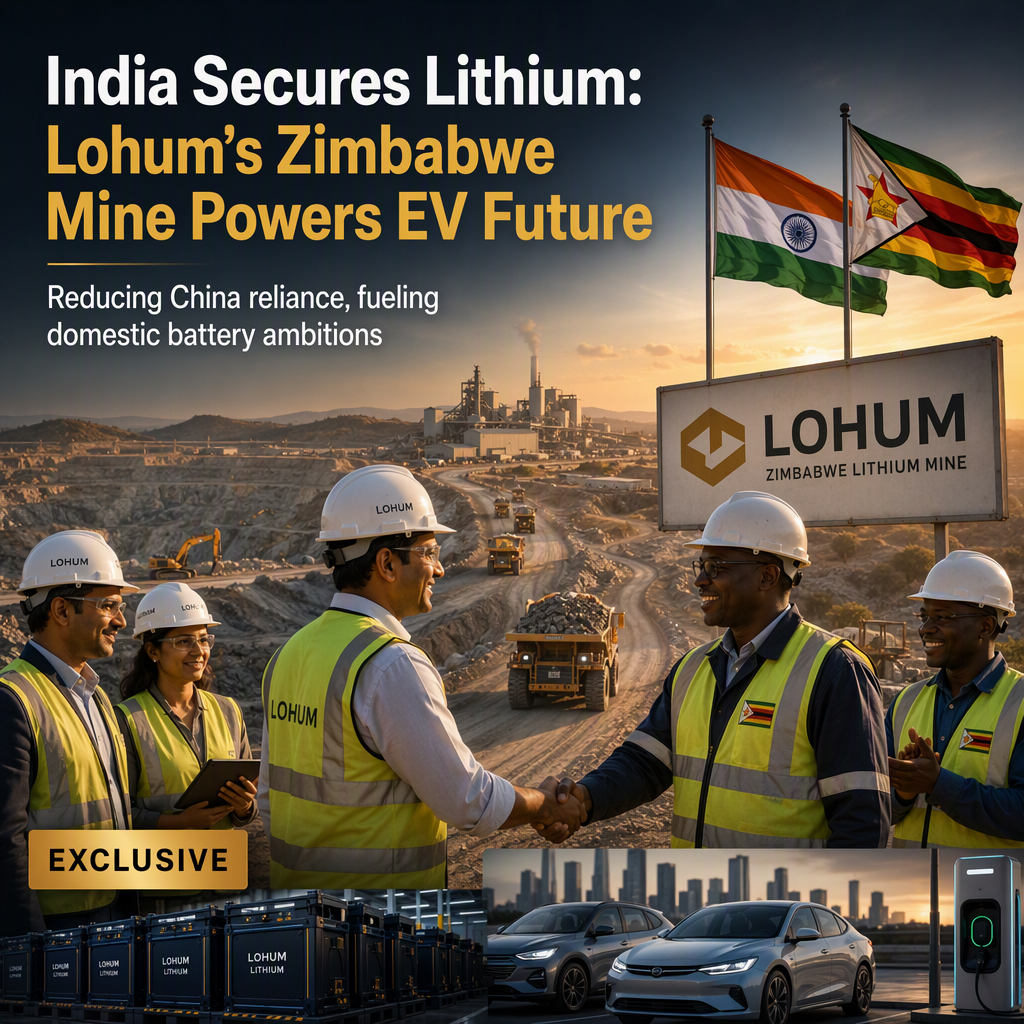
Lohum, a critical minerals company based in India, has inaugurated its lithium mining operations in Zimbabwe, marking the first time an Indian business has begun overseas lithium mining activities, according to founder and CEO Rajat Verma [1]. The company plans to establish 30,000 metric tons of annual domestic lithium carbonate refining capacity, with the explicit goal of targeting the rapidly growing Indian electric vehicle (EV) market [1].
Rajat Verma emphasized that setting up lithium processing capacity in Zimbabwe is a strategic move to reduce India's reliance on China for critical raw materials. He stated, 'Setting up lithium refining in Zimbabwe gives us direct access to raw materials, which is essential for the Indian market as we try to decrease our dependency on imports from China' [1]. Lohum intends to leverage its Zimbabwean mining operations to supply its Indian refining business, aiming to become a reliable supplier for India's EV sector and battery manufacturers, which currently depend on external sources for lithium [1].
The company's strategy reflects a broader trend among Indian firms to secure critical materials and mitigate supply chain vulnerabilities and geopolitical risks. By building both upstream (mining) and downstream (refining) capabilities, Lohum positions itself as a key player in the domestic battery materials supply chain [1]. The new refining capacity is expected to provide essential inputs for battery production, supporting India's ambitions to expand its electric vehicle market [1].
Lohum's entry into overseas mining and its plans for significant refining capacity are seen as pivotal steps in supporting the local EV ecosystem, which is anticipated to experience substantial growth in the coming years [1].
CONCLUSION
Lohum's launch of lithium mining operations in Zimbabwe and its plans for large-scale refining capacity in India represent a significant move to secure critical battery materials for the domestic EV market. This initiative is expected to reduce India's reliance on imports, particularly from China, and strengthen the country's position in the global electric vehicle supply chain.