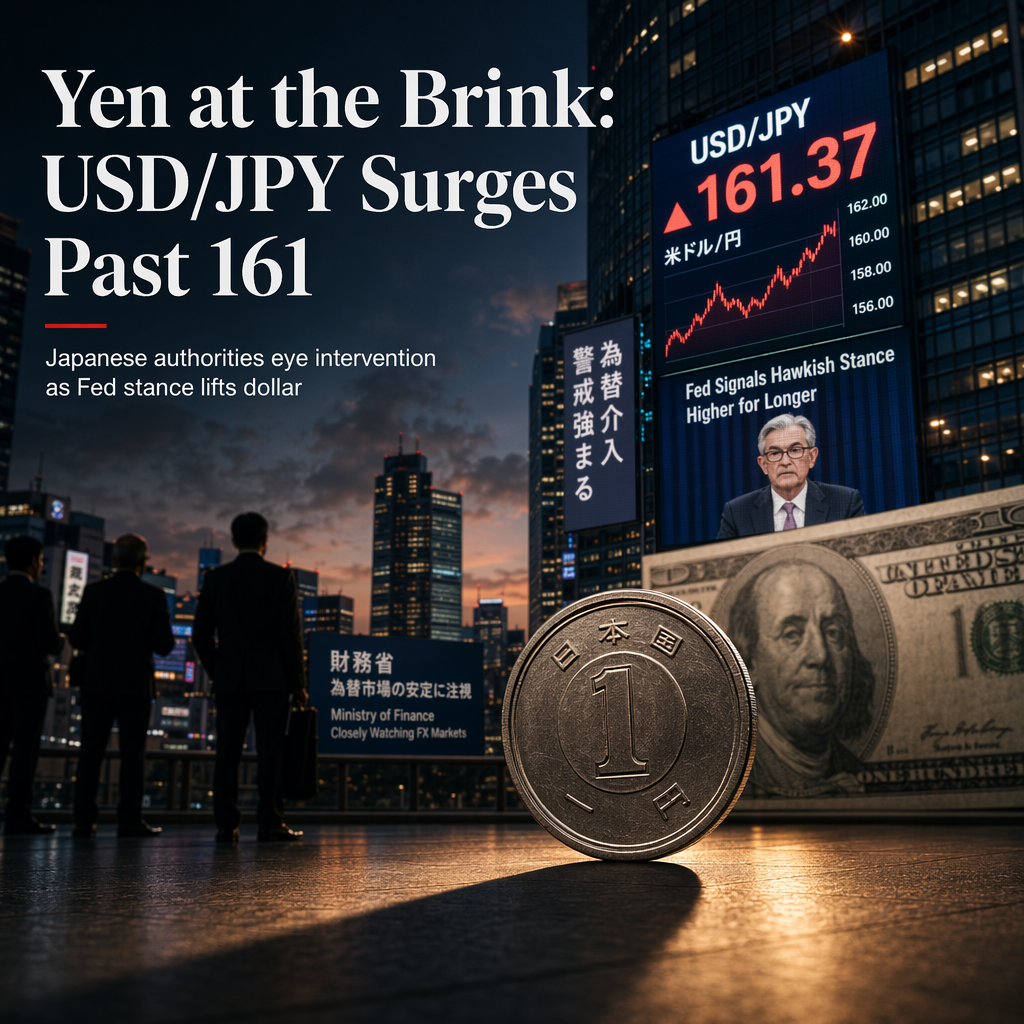
The Japanese Yen has come under renewed pressure, with USD/JPY breaking above 161 and closing at 161.37, levels that previously triggered official intervention by Japanese authorities [1][2][7]. This surge follows the US Federal Reserve's hawkish hold, which pushed the US Dollar to its highest in more than a year and reinforced bets on further rate hikes, keeping front-end yields elevated and supporting the Dollar [2][4][6][7]. Despite a recent Bank of Japan rate hike, speculative JPY short positions remain elevated, and Japan's tolerance for further Yen weakness appears nearly exhausted, raising the likelihood of renewed intervention and stronger rhetoric from authorities [1][2][7]. In late April-May, Japanese authorities intervened to sell USD/JPY to the tune of USD73bn [1]. ING strategists highlight that today's US holiday creates a lower-liquidity backdrop, a window during which Japanese authorities have previously shown a preference to intervene, with upside risks toward 162–163 if authorities stay sidelined [7].
The broader market context is shaped by the Fed's hawkish shift, with the US Dollar index (DXY) closing at a one-year high at 100.85 (+0.76%) [4]. Risk sentiment improved modestly as markets digested resilient US data, including firm labor and spending signals, reinforcing the higher-for-longer narrative [2][3][4]. Analysts from ING and MUFG caution that while the Dollar's momentum is strong, this may not mark the start of a new broad Dollar bull cycle, and the likelihood of actual Fed rate hikes remains low despite market pricing [6][7]. Markets are keen to fully price two hikes by December, with 39bp currently priced in, and volatility risks remain elevated as US data releases and Fedspeak could prompt aggressive repricing [7].
Falling oil prices have also played a role in easing inflationary pressures and supporting oil-sensitive Asian currencies, including the Yen [1][5][6]. Brent crude has declined to around USD76 following an interim US–Iran agreement that reopened the Strait of Hormuz, although disagreements remain over nuclear and other key issues [5]. The IEA Monthly Report projects an oversupplied crude market into 2027, with shipments through the Strait of Hormuz increasing from 9.6 mb/d in May to around 12 mb/d in early June [6]. MUFG notes that if the US-Iran deal holds, the disinflation impetus from energy could be considerable by year-end and into 2027, further reducing the likelihood of Fed rate hikes [6].
Forward-looking statements from analysts suggest that Japanese authorities may deploy both rhetoric and further market interventions to curb Yen depreciation [1][2][7]. ING points to the possibility of intervention during the US holiday, while MUFG expects EUR/USD to gain later in 2026 as US inflation peaks and the ECB could see the benefit of hiking again [6].
CONCLUSION
The Japanese Yen is trading at intervention-sensitive levels as USD/JPY surges past 161, driven by Fed hawkishness and resilient US data. Market participants are closely watching for potential Japanese intervention, especially amid low liquidity during the US holiday. Falling oil prices and the US-Iran deal provide some relief to Asian currencies, but volatility risks remain elevated as markets await further guidance from central banks.