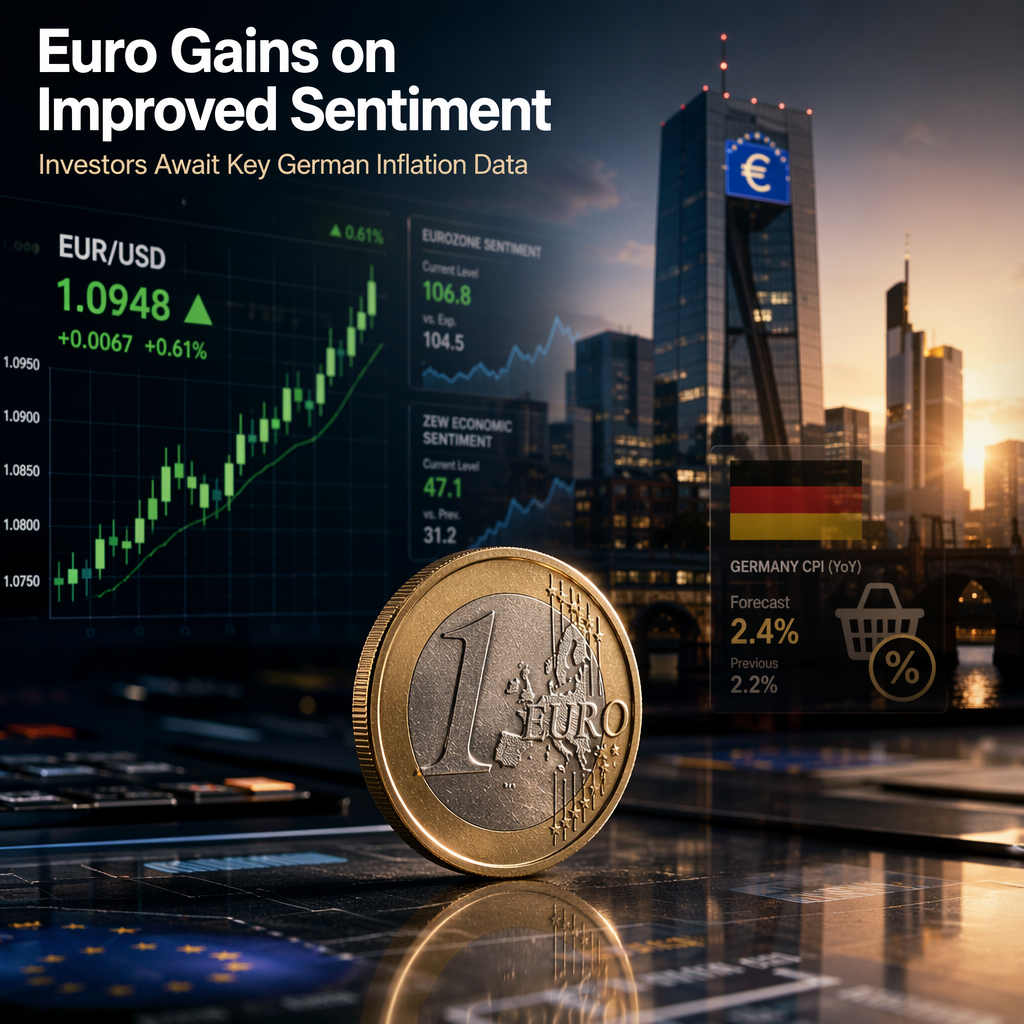
The Euro strengthened against the US Dollar, with EUR/USD rising above 1.1420 during the American session on Monday, as investors responded to mixed sentiment data from the Eurozone and anticipated upcoming German inflation figures [1]. The Eurozone Business Climate index for June registered at -0.38, which was weaker than the previous revised reading of -0.27. However, the Economic Sentiment Indicator improved to 95.0, surpassing expectations of 94.3 and rising from a revised 93.7, providing support for the Euro [1].
Market participants are now focused on Germany’s preliminary Harmonized Index of Consumer Prices (HICP) inflation data. The previous reading showed German HICP inflation slowing to 2.7% year-on-year in May from 2.9% in April, with the next flash estimate scheduled for release on Tuesday. A higher-than-expected inflation print could bolster the Euro by reinforcing expectations that the European Central Bank (ECB) may need to maintain a restrictive policy stance for a longer period [1].
Additionally, German Retail Sales data is being closely watched for insights into household demand. The last available figure for April indicated a 0.3% month-on-month decline, which was less severe than the 0.5% drop anticipated by analysts, though it still pointed to weak consumer momentum [1].
From a technical perspective, EUR/USD is trading at 1.1421, above the 20-period Simple Moving Average (SMA) at 1.1376 and a horizontal support at 1.1415, suggesting a mildly constructive tone. The Relative Strength Index (RSI) at 58 indicates improving bullish momentum, but not yet overbought conditions, leaving the pair with a neutral-to-slightly bullish near-term bias. Key resistance is noted at 1.1434 and the 100-period SMA at 1.1494, while support levels are seen at 1.1415, 1.1401, and 1.1381 [1].
CONCLUSION
The Euro's recent gains are underpinned by better-than-expected Eurozone sentiment data and anticipation of key German inflation figures. Market participants are watching for further signals from upcoming German data, which could influence ECB policy expectations and the Euro's near-term direction.