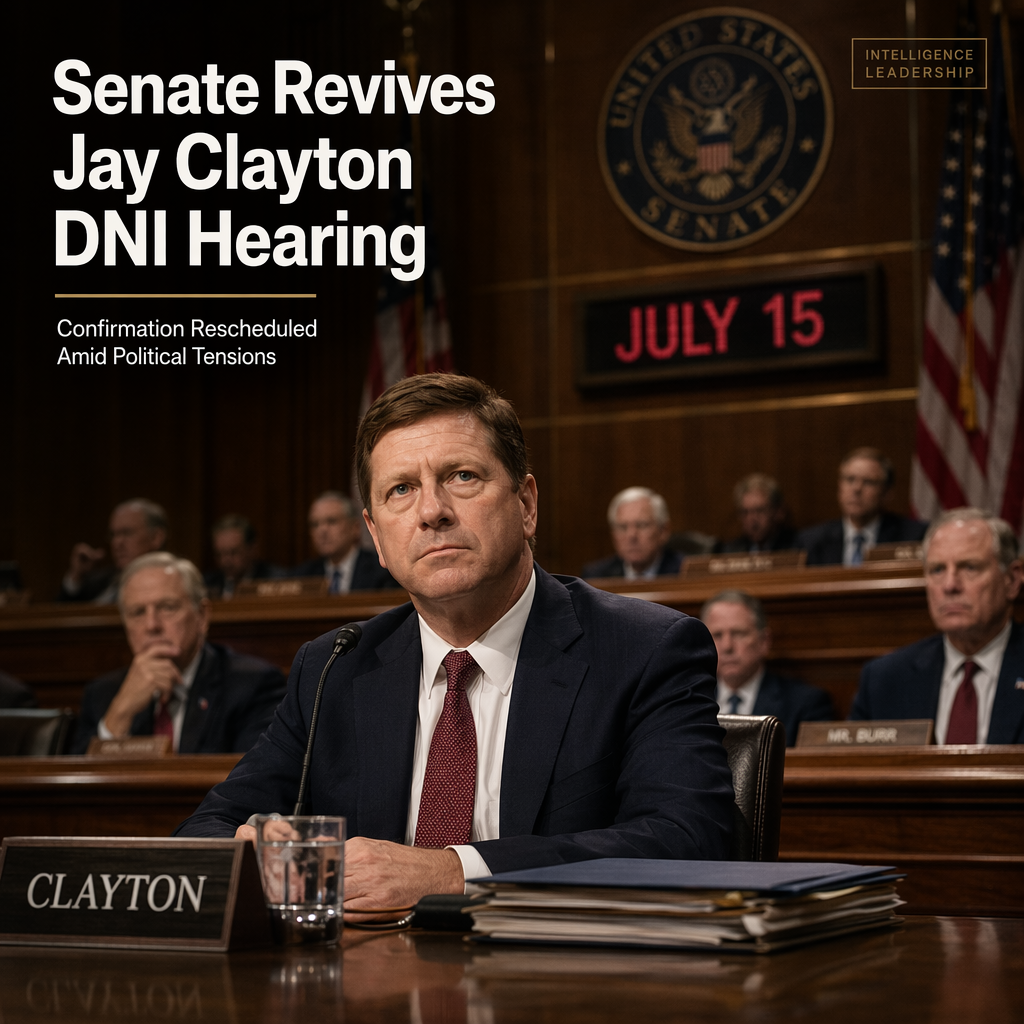
The Senate Intelligence Committee has set a new confirmation hearing date for Jay Clayton’s nomination to be director of national intelligence, following a postponement initiated by President Donald Trump. The hearing is now scheduled for July 15, nearly a month after the original June 17 date was abandoned at Trump’s request due to disagreements with Democrats and other legislative frustrations, including the expiration of Section 702 of the Foreign Intelligence Surveillance Act (FISA) and insufficient support for the SAVE America Act, a voter ID bill backed by Trump [1].
Trump had previously insisted that Clayton’s nomination should not proceed until James McDonald, a partner at Sullivan & Cromwell and former federal prosecutor, was confirmed to replace Clayton as U.S. attorney for the Southern District of New York. However, the White House has not yet sent McDonald’s nomination to the Senate, and there has been no immediate comment from the administration regarding the new hearing date or any further objections from Trump [1].
Jay Clayton, who was appointed as U.S. attorney for the Southern District of New York last year after his Senate nomination stalled, previously served as chair of the Securities and Exchange Commission during Trump’s first term, confirmed by a 61-37 Senate vote. Clayton was also a partner at Sullivan & Cromwell prior to his government service [1].
Several prominent Democrats have expressed support for Clayton’s nomination. Sen. Mark Warner, D-Va., the ranking member of the Intelligence Committee, and Rep. Jim Himes, D-Conn., the top Democrat on the House Intelligence Committee, have both spoken positively about Clayton’s qualifications and commitment to public service. Meanwhile, Bill Pulte was named acting national intelligence director in early June, succeeding Tulsi Gabbard, who stepped down due to her husband’s cancer diagnosis. Pulte’s appointment has drawn concern from both Democrats and some Republicans over his lack of national security experience and his role in compiling information for investigations into Trump’s perceived political adversaries [1].
CONCLUSION
The Senate Intelligence Committee’s decision to reschedule Jay Clayton’s confirmation hearing marks a renewed effort to fill the director of national intelligence role after political delays. While Clayton has received bipartisan praise, the process remains subject to political maneuvering and unresolved nominations. The outcome of the July 15 hearing will be closely watched for its implications on intelligence leadership and legislative priorities.