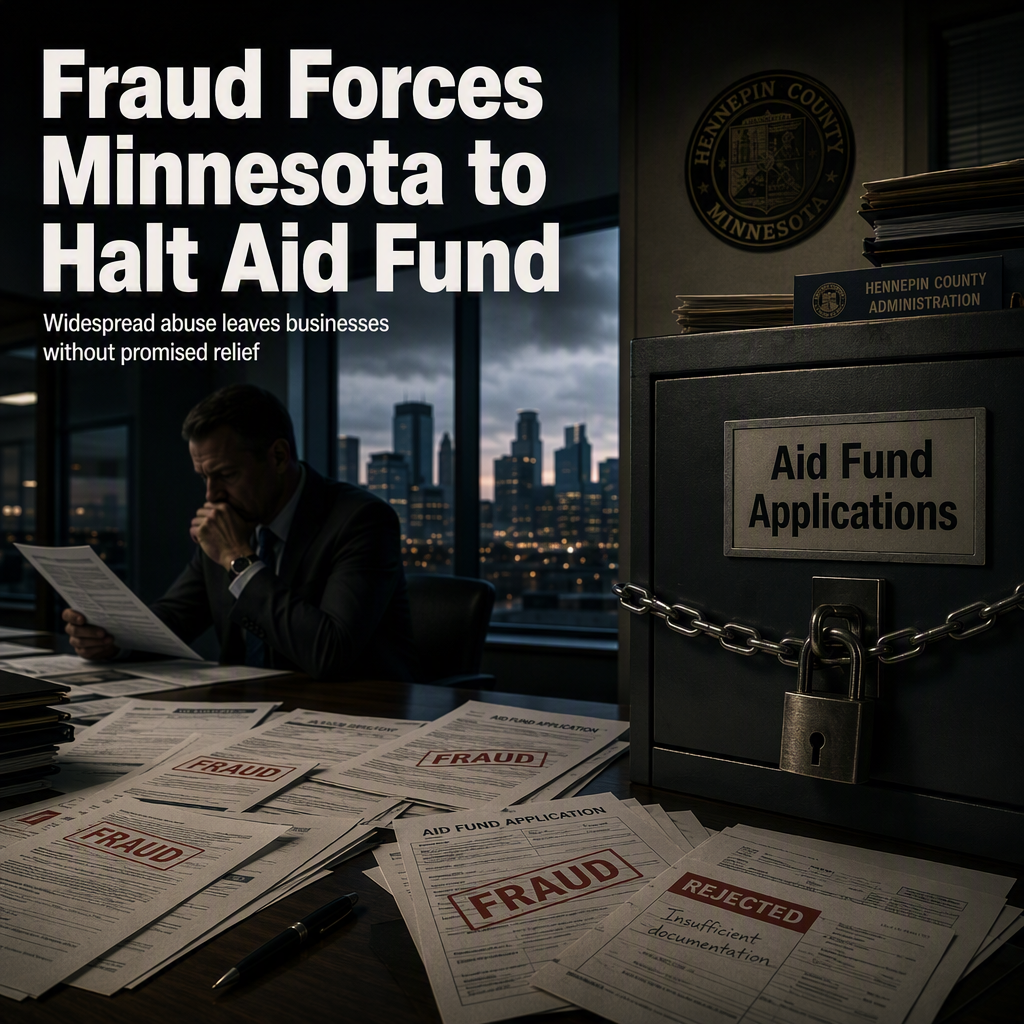
Hennepin County in Minnesota has terminated a program intended to assist businesses affected by the Trump administration’s immigration enforcement efforts, specifically Operation Metro Surge, due to extensive fraud concerns [1]. The county board had initially approved $2 million in funding, but only about $500,000 was distributed to 82 applicants after more than 200 out of roughly 300 applications were flagged for potential fraud [1]. County officials discovered that many applications contained false information, some seemingly fabricated by AI and submitted for multiple businesses, while other applicants were found not to exist during site visits [1].
Commissioner Jeff Lunde described the applications as overwhelmingly fraudulent and noted, "Until we get it where people fear things, then they're gonna keep doing it" [1]. The program was halted after officials observed declining legitimate results, with Lunde stating, "So we just stopped processing at that point" [1]. The fraud issue has been linked to broader concerns in Minnesota, where members of the Somali community have been accused and, in some cases, convicted of using non-existent or inactive businesses and nonprofits to divert funds from government programs [1].
The immigration enforcement operation also drew national attention following the fatal shooting of U.S. citizens Renee Good and Alex Pretti by federal agents in Minneapolis in January [1]. Governor Tim Walz has acknowledged his responsibility to address fraud in the state, emphasizing that "any amount of fraud is too much and undermines the very programs that do so much to raise our quality of life" [1]. However, Walz has pushed back against attempts to blame the Somali community exclusively, stating, "What is not helpful is the president of the United States demonizing an entire community" [1].
Neither Hennepin County nor Governor Walz's office responded to requests for comment regarding the program's shutdown [1].
CONCLUSION
The shutdown of Minnesota's anti-ICE aid fund highlights significant fraud concerns, with only a fraction of allocated funds reaching legitimate businesses. The event underscores the challenges of administering relief programs amid heightened scrutiny and political tensions, and may prompt further reforms or oversight in state aid distribution.