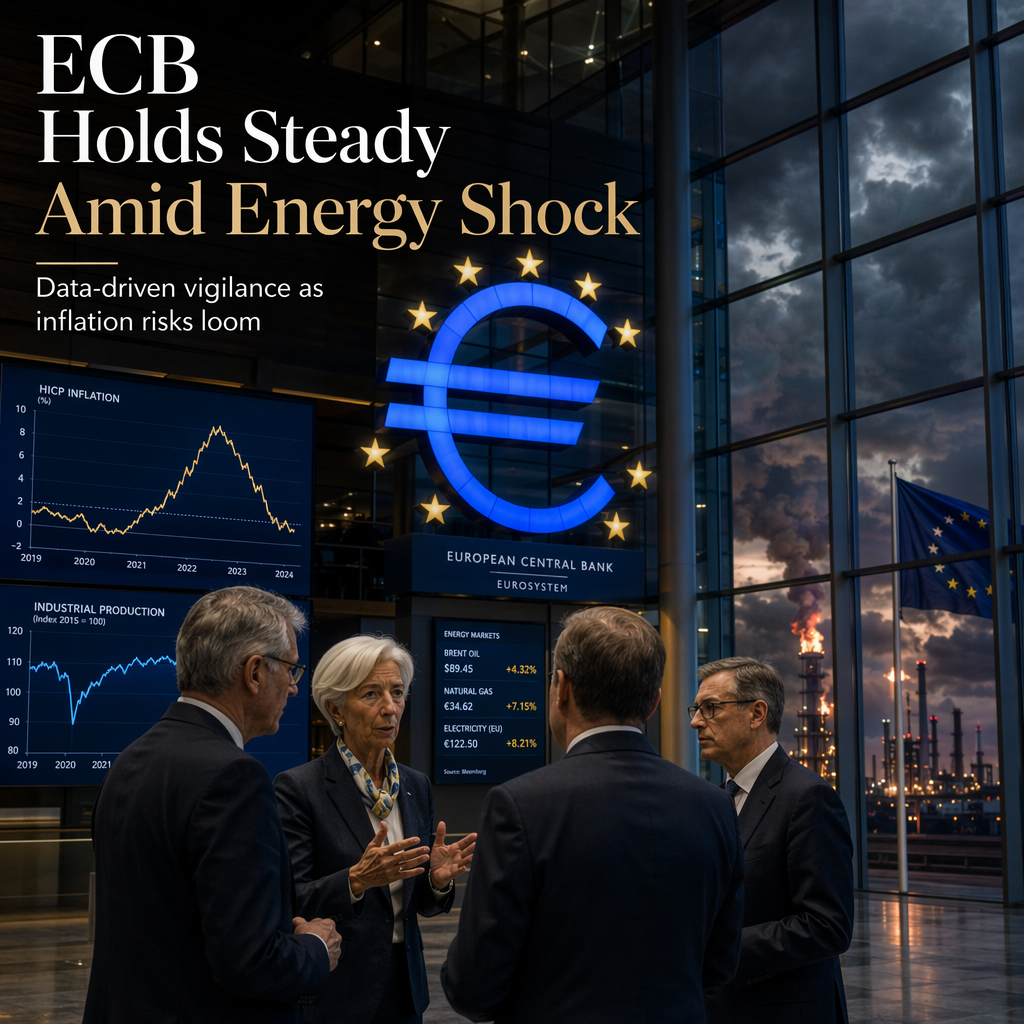
European Central Bank (ECB) officials Piero Cipollone and Martin Kocher have emphasized the central bank's focus on preventing the recent energy shock and ongoing Middle East uncertainty from fueling broader inflation across the Eurozone, according to BNY’s Geoff Yu [1]. Both officials noted that while the ECB is observing the direct impact of higher energy prices and some indirect passthrough to production costs, there are currently no significant second-round effects from wages or corporate pricing behavior [1]. Kocher reinforced this view, stating that second-round inflation is not evident at this time, but stressed that policy must remain responsive to inflation expectations amid heightened uncertainty [1].
The ECB is maintaining a data-dependent approach, keeping its options open regarding future interest rate decisions. The central bank is prepared to act if inflation expectations become less anchored, with the possibility of holding or raising rates still on the table [1]. Bundesbank President Joachim Nagel echoed the need for vigilance on inflation expectations, underscoring the cautious stance among ECB policymakers [1].
Recent economic data showed that Euro area industrial production fell by 0.2% month-on-month and 1.2% year-on-year in May, based on initial estimates [1]. In the broader European Union, output declined by 0.1% month-on-month and 0.3% year-on-year [1]. The monthly decrease followed gains in April and was attributed to weaker production of intermediate and durable consumer goods, partially offset by increases in energy, capital goods, and non-durable consumer goods output [1]. On a yearly basis, capital goods and energy production rose, but sharp declines in non-durable and durable consumer goods weighed on overall activity [1].
No explicit market reactions or analyst forecasts beyond the ECB officials’ statements were provided in the source article.
CONCLUSION
The ECB is closely monitoring inflation risks stemming from energy shocks and geopolitical uncertainty, maintaining a cautious and data-driven policy stance. While industrial production data points to some economic weakness, ECB officials see limited evidence of second-round inflation effects and remain vigilant on inflation expectations. The central bank is keeping all policy options open as it navigates ongoing uncertainty.