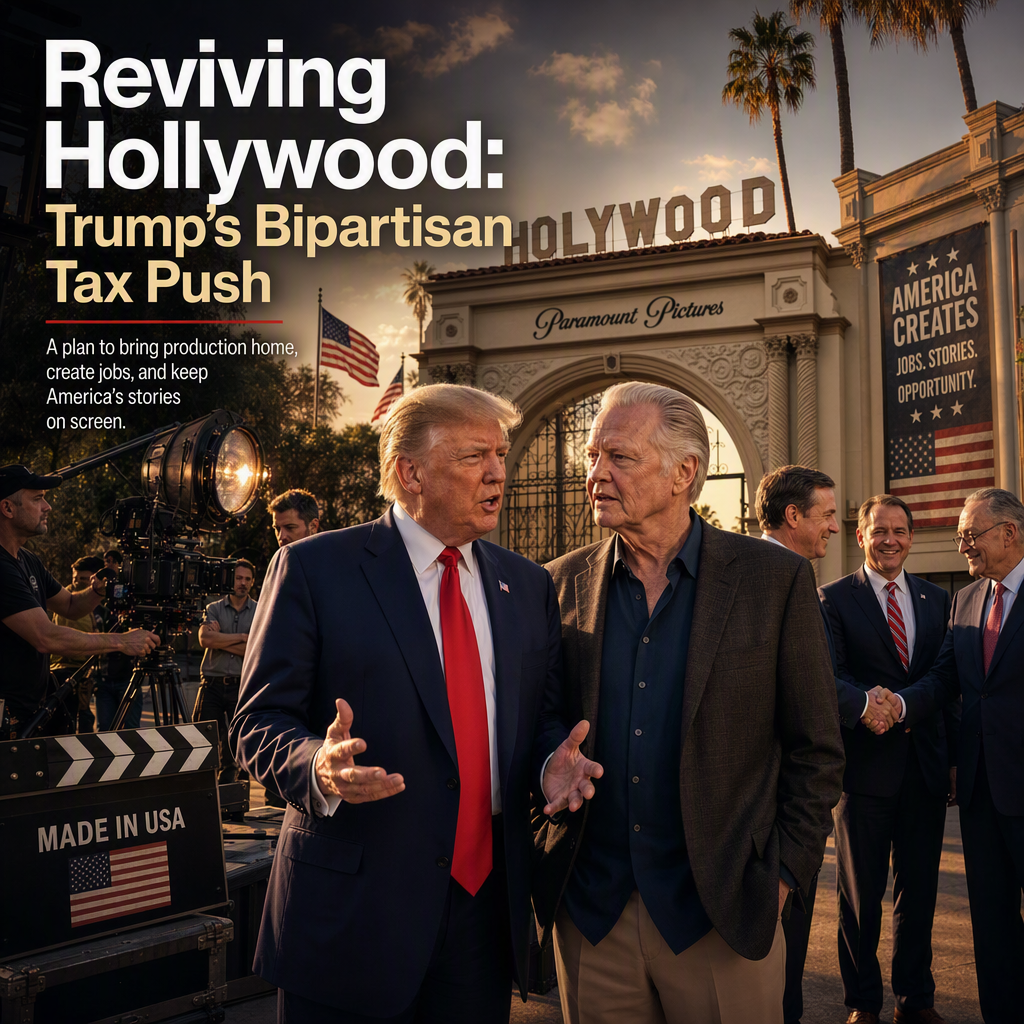
President Donald Trump announced on Monday a call for bipartisan federal tax incentives aimed at supporting the domestic TV and movie industry, which has experienced significant business migration overseas in recent years [1]. Trump stated on Truth Social that meetings are being arranged with leaders from both political parties to advance this initiative, emphasizing the need for bipartisan cooperation due to substantial financial losses in California and other predominantly Democratic states [1].
Trump's proposal was influenced by actor Jon Voight, described as his 'Hollywood ambassador,' who has played a role in shaping the administration's entertainment industry policy during Trump's second term [1]. Trump previously met with Voight in May 2025 before proposing tariffs on foreign-produced films, but the current focus is on tax credits rather than tariffs [1].
The announcement received immediate and broad support from both Democratic lawmakers and industry leaders. Senator Adam Schiff (D-Calif.) expressed strong agreement with Trump, urging Congress to swiftly pass a federal film tax incentive to restore lost jobs to the U.S. [1]. Representative Laura Friedman (D-Calif.) also praised the measure, highlighting her ongoing efforts with Jon Voight, unions, studios, and producers to advocate for a national film and television tax credit [1]. Friedman reiterated that the U.S. should not lose jobs to countries like Canada, the UK, or Australia, and that the best crews should remain in America [1].
Industry support was further underscored by Charles Rivkin, CEO of the Motion Picture Association, who stated that the organization applauded Trump's backing of tax incentives, describing a federal incentive as a landmark step for the industry [1].
CONCLUSION
President Trump's call for bipartisan federal tax incentives to support the U.S. film and TV industry has garnered strong support from both political parties and industry leaders. The initiative is seen as a significant move to bring back jobs and production to the United States, with stakeholders urging swift legislative action.