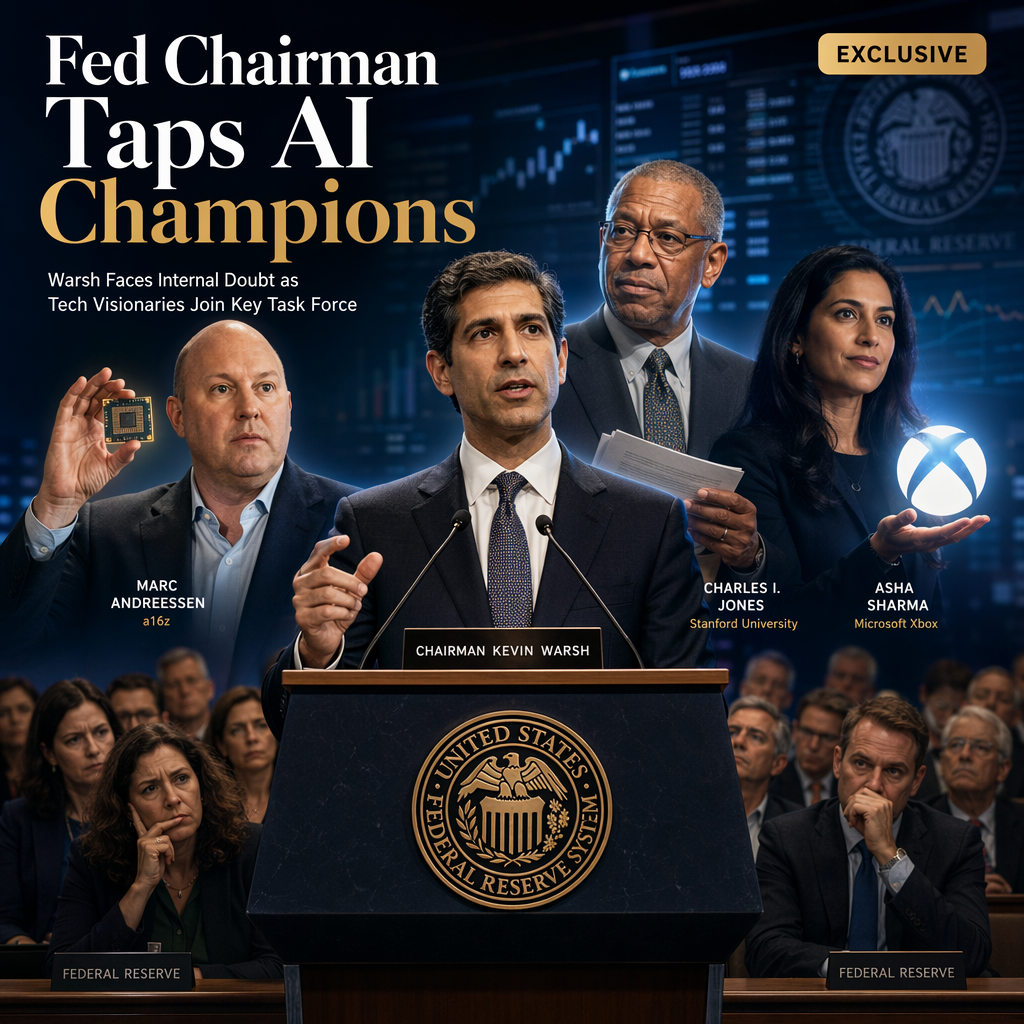
Federal Reserve Chairman Kevin Warsh announced the formation of five new task forces aimed at advising the central bank on policy and institutional changes, with a particular focus on artificial intelligence (AI) through a dedicated AI task force. The AI task force will be led by three external advisors: venture capitalist Marc Andreessen, economist Charles I. Jones, and Xbox CEO Asha Sharma, all of whom are known for their optimistic views on the economic potential of AI. Warsh personally selected these members, aligning with his own bullish stance on AI's transformative impact on growth and productivity [1].
The formal charge of the AI task force is to 'assess the economic impact of new general-purpose technologies, including artificial intelligence, to inform the Federal Reserve's policy judgments.' Warsh has publicly stated that AI adoption is 'perhaps as important a change in the economy and business and households that we've had in my adult lifetime,' emphasizing its significance during his first news conference as chairman in June 2026. He previously indicated in 2025 that advancements in AI could justify interest rate cuts by the Fed, as AI-driven growth might not be accompanied by rising inflation [1].
Despite the enthusiasm from Warsh and the task force members, there is noted skepticism within the Federal Reserve regarding the potential gains from AI. Recent internal discussions at the Fed have reflected doubts about the extent of AI's economic benefits, highlighting a divide between Warsh's vision and the prevailing sentiment among central bank staff [1].
The appointment of high-profile AI advocates such as Andreessen, Jones, and Sharma signals Warsh's intent to bring outside, technology-focused perspectives into the Fed's policy deliberations. Andreessen, in particular, has been a vocal proponent of AI, famously stating, 'We've turned sand into thought,' in reference to the silicon used in AI chips. Jones has recently taken leave from Stanford University to join The Anthropic Institute, further underscoring his commitment to AI's economic implications [1].
CONCLUSION
Chairman Warsh's selection of prominent AI advocates for the Federal Reserve's new task force underscores his commitment to integrating AI-driven perspectives into monetary policy. However, internal skepticism at the Fed suggests that the impact of these appointments on policy may depend on the task force's ability to demonstrate tangible economic benefits from AI. The market should watch for future Fed statements or policy shifts influenced by the task force's findings.