
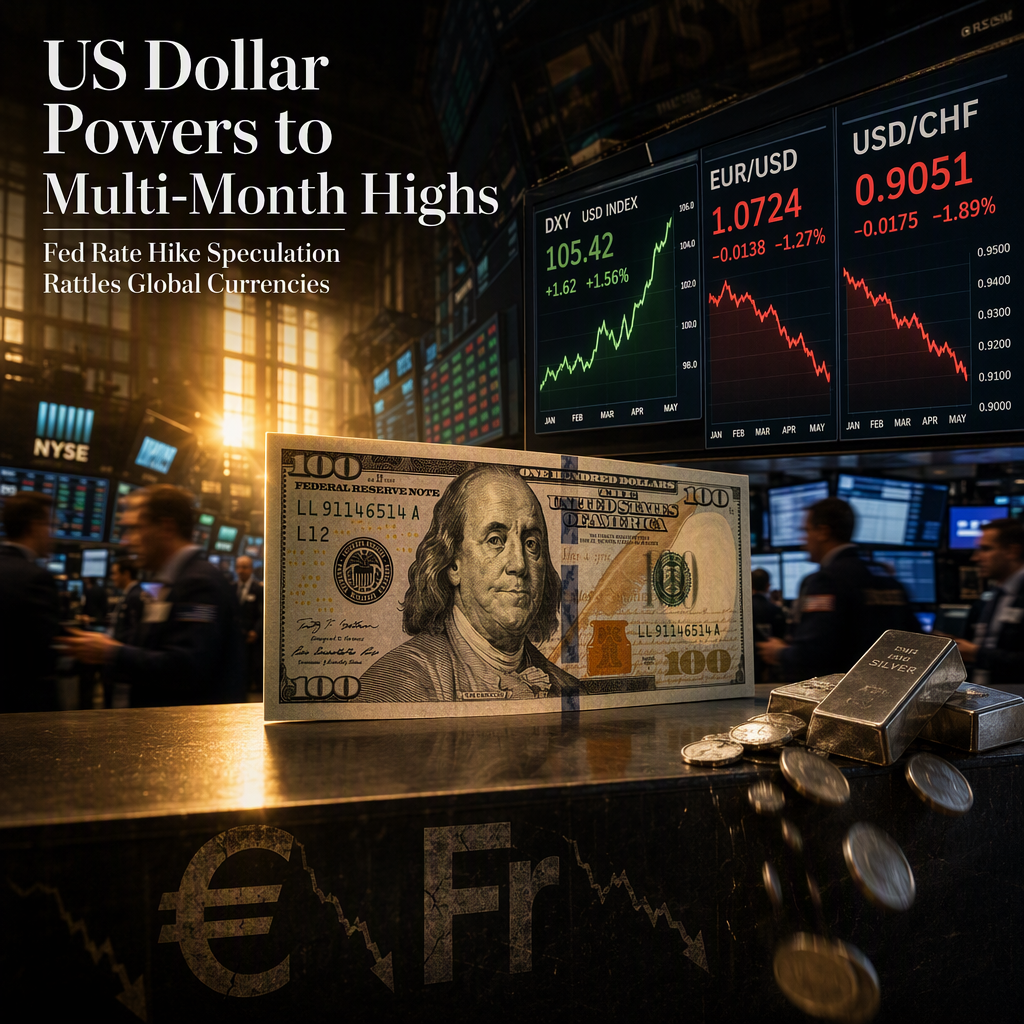
The US Dollar (USD) continued its broad-based rally on Wednesday, strengthening against major currencies and reaching multi-month highs amid rising expectations for further Federal Reserve (Fed) interest rate hikes. The EUR/USD pair traded near 1.1330, close to its lowest level since May 2025, as the Euro came under pressure for the third consecutive day. This weakness was exacerbated by dovish comments from European Central Bank (ECB) President Christine Lagarde, who pushed back against market bets for another rate hike in October, undermining the shared currency [1]. Meanwhile, the US Dollar Index (DXY) hovered near 101.40, poised for its largest monthly gain in 14 months, supported by hawkish remarks from Fed officials and elevated US Treasury yields. Chicago Fed President Austan Goolsbee and Fed Governor Michael Barr both signaled that persistent inflation may require additional policy tightening, with Barr specifically warning that further rate increases are likely needed to slow inflation [3]. Market pricing reflected these sentiments, with the CME FedWatch Tool indicating a 47.1% chance of a Fed rate hike in October and a 92.5% probability of an increase in December [3].
The USD/CHF pair extended its winning streak for the sixth consecutive session, trading near a 16-month high of 0.8358. This move was driven by the firming outlook for US rate hikes, as traders priced in a 68% probability of a hike in October and a 95% chance of a 25-basis-point increase in December [2]. Despite Switzerland's economic strength—evidenced by the KOF Leading Indicator rising to 109.1 in September, its highest in six years—the Swiss Franc remained weak, with the Swiss National Bank (SNB) maintaining its policy rate at 0.0% [2]. Technical indicators for USD/CHF showed a bullish bias, though overbought conditions suggested the rally could be stretched [2].
In the precious metals market, Silver (XAG/USD) hovered near an eight-week low around $61.00, down 0.70% for the day. The metal's bearish bias persisted below key technical levels, with traders awaiting the US PCE Price Index and final Q2 GDP print for further direction. The Relative Strength Index (RSI) remained weak at 35, and any rebounds were expected to face resistance near $61.80-$62.25, while a break below $60.00 could open the door to further declines [4].
The EUR/JPY cross also reflected Euro weakness, slipping below 178.00 and trading around 177.70 for the fourth straight day of losses. Technical analysis indicated a persistent bearish outlook, with the pair at risk of falling toward the lower boundary of its descending channel at 176.90 and potentially to an 11-month low of 175.70. The Japanese Yen outperformed other G10 currencies, buoyed by renewed FX warnings from Japanese officials, which underpinned JPY strength on the crosses [5].
Looking ahead, market participants are focused on upcoming US economic data, including the ADP employment report and the PCE Price Index, both due later on Wednesday. The US Nonfarm Payrolls report on Friday is seen as a key event risk, with consensus expecting a 90,000 job addition in September and the unemployment rate to remain at 4.1% [2][3]. Analysts at OCBC noted that a stronger-than-expected employment report could reinforce expectations of further Fed tightening, keep Treasury yields elevated, and provide additional support for the USD [3].
CONCLUSION
The US Dollar's rally is being driven by heightened expectations for further Fed rate hikes, as reflected in both market pricing and hawkish Fed commentary. This has resulted in significant pressure on major currencies such as the Euro and Swiss Franc, while also weighing on precious metals like Silver. With key US economic data releases on the horizon, market sentiment remains bullish on the USD, and further volatility is expected depending on the strength of upcoming labor and inflation reports.