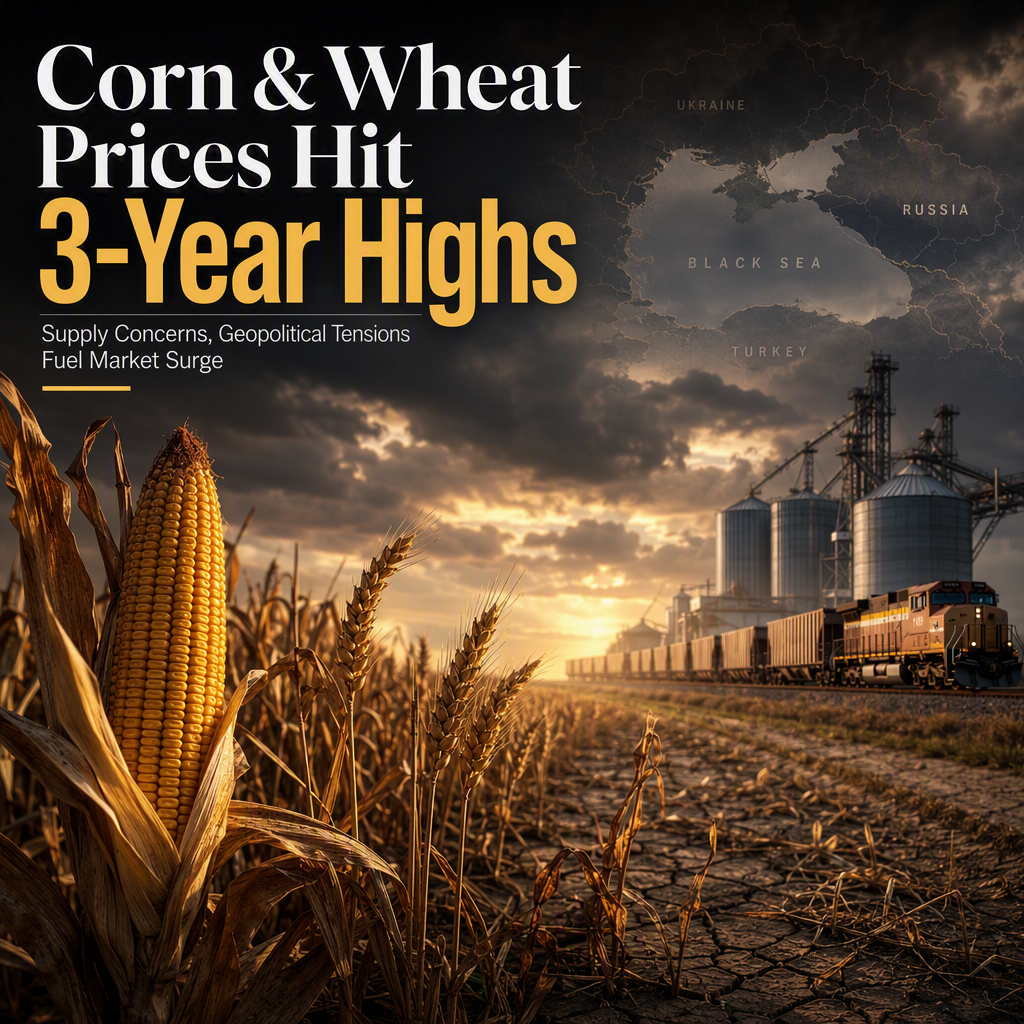
Corn and wheat prices have surged to their highest levels in more than three years, driven by distinct market forces for each crop [1]. Wheat futures settled 3.1% higher at 784 cents per bushel on Friday after reaching a high of 790.25 cents, marking the highest price since February 14, 2023, when it traded at 797.5 cents [1]. Wheat posted a 12.1% gain for the week, its largest weekly increase since March 2022, and is up more than 54.5% year-to-date, primarily due to escalating Russia-Ukraine tensions in the Black Sea region [1].
Corn futures closed 0.6% higher at 536.5 cents per bushel, after hitting a high of 541.25 cents, the highest since July 28, 2023 [1]. Corn gained 5.5% for the week and is up 15.6% in August, on track for its best monthly performance since April 2021, when it rose 19.31% [1]. Year-to-date, corn is up 21.8%, fueled by tighter U.S. supply expectations, strong demand, and constrained Ukrainian exports [1].
Market analysts attribute corn's rally to mounting concerns over U.S. crop supply and a weak outlook. William Osnato, Barchart director of commodity data research and analysis, noted that the market consensus has shifted toward expecting less supply than previously anticipated at the start of August [1]. The U.S. Department of Agriculture's August World Agricultural Supply and Demand Estimates (WASDE) report lowered corn yield estimates by 2.3 bushels per acre to 180.7, despite projecting the second-largest harvest on record [1]. Additionally, disappointing field observations from the Pro Farmer's Crop Tour and extreme July heat, coupled with excessive June rainfall and the development of corn fungal diseases, have further impacted the crop's outlook [1].
Jim McCormick, co-founder and COO at AgMarket.Net, emphasized that concerns about the U.S. crop have become more significant as global supplies remain tight. He stated, "We thought the world was going to be bailed out by the U.S. supply. Now the U.S. supply is becoming questionable, and the market's moving up into a rationing mode" [1]. Other factors, such as extreme high temperatures and drought in Europe throughout the summer, have also significantly impacted corn production in the region [1].
CONCLUSION
Corn and wheat prices have reached multi-year highs due to a combination of supply concerns, adverse weather, and geopolitical tensions. Market participants are closely watching U.S. crop conditions and global supply dynamics, with analysts warning that further disruptions could continue to drive prices higher. The market has entered a rationing mode as uncertainty over supply persists.