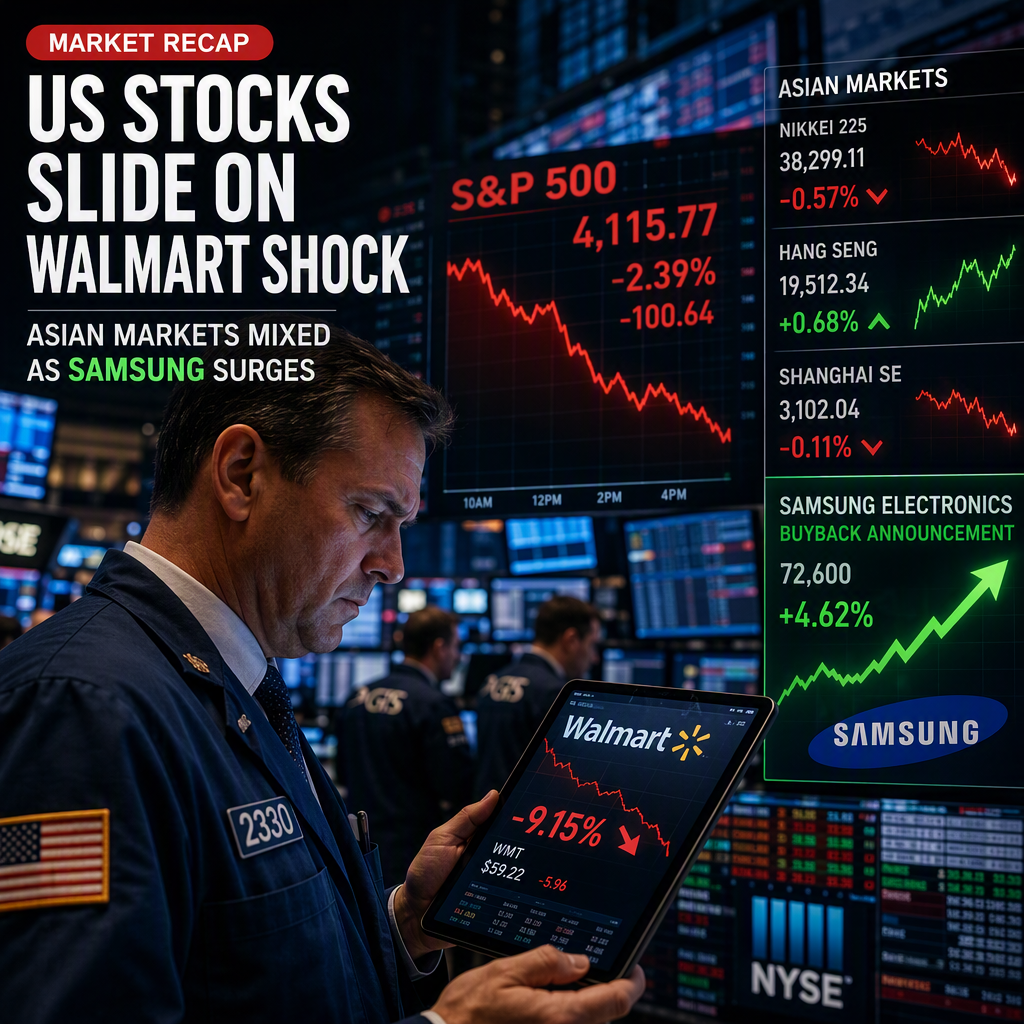
Deutsche Bank strategists observed a sharp decline in United States equities, with the S&P 500 falling by 0.87%, marking its largest drop in August so far. The Nasdaq lost 1.00%, and the Magnificent Seven declined by 1.11%. This selloff was attributed to the reversal of earlier gains in fixed income markets and disappointing earnings from Walmart, whose shares plunged 9.15% after reporting its slowest US sales growth since 2020 at +2.6% year-over-year. These results have raised concerns about the resilience of US consumers, especially given the backdrop of high energy prices, rising interest rates, and a low saving rate [1].
European equities also struggled, with the Stoxx 600 down 0.12%, DAX falling 0.42%, and CAC 40 dropping 0.57%. The FTSE 100 managed a marginal gain of 0.04%. Overnight, sentiment improved modestly, as US equity futures edged higher: the S&P 500 rose 0.06% and the NASDAQ gained 0.20%. Asian markets traded mixed, with the Nikkei underperforming at -0.30%, while the Hang Seng advanced 0.72% and the CSI 300 rose 0.52% [1].
Korea's KOSPI index climbed 0.89%, following a significant 5.89% surge the previous day. This rally was supported by a 2.10% gain in Samsung Electronics, after Bloomberg reported the company plans to announce a new package of dividends and a buyback of up to 110 trillion won ($79 billion) [1].
The mixed performance across global markets reflects ongoing investor concerns about consumer strength in the US and the impact of macroeconomic factors such as energy prices and interest rates. The modest improvement in overnight sentiment suggests some stabilization, but the underlying issues remain unresolved [1].
CONCLUSION
US equities experienced a notable selloff driven by weak Walmart earnings and concerns about consumer resilience, while Asian markets showed a mixed but generally positive recovery. The announcement of a substantial dividend and buyback plan by Samsung Electronics provided a boost to Korea's KOSPI. Overall, market sentiment remains cautious amid persistent macroeconomic challenges.