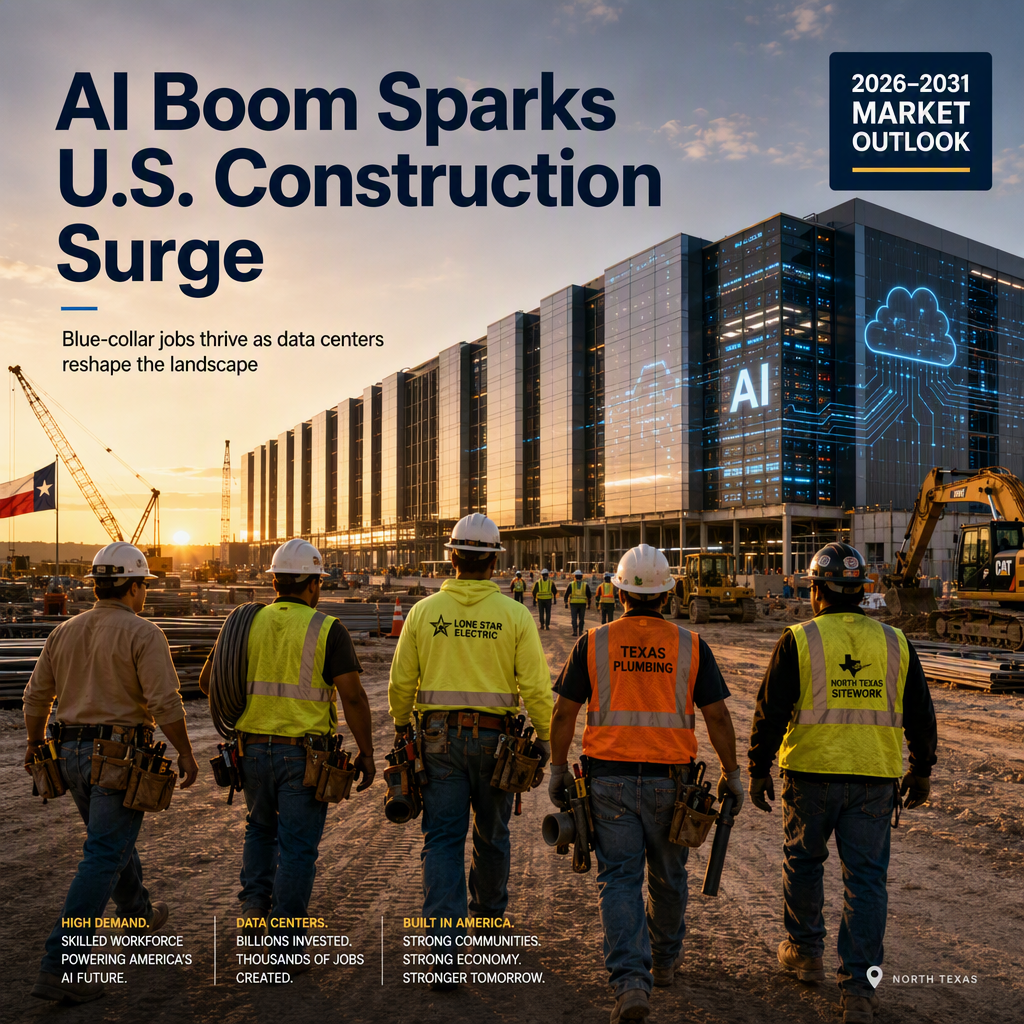
The rapid expansion of artificial intelligence infrastructure in the United States is driving a significant boom in blue-collar employment, as construction firms race to build data centers, power systems, and related facilities essential for AI technology to function [1]. This surge is creating heightened demand for skilled trades such as electricians, plumbers, heavy-equipment operators, and logistics workers, who are needed at every stage of these large-scale projects [1]. According to Cole Renken, general manager of Merlo America, the U.S. division of Merlo Group, careers in the trades now offer stable income and lifestyle opportunities, with the AI-driven construction boom bringing renewed attention to these professions [1].
A report from Merlo America, developed with BiltData.ai, projects that U.S. construction spending will rise from $2.22 trillion in 2026 to $2.85 trillion by 2031 [1]. Industrial construction, which includes factories and data centers, is expected to reach $684 billion by 2031, accounting for 24% of total U.S. construction spending [1]. Much of this growth is attributed to the infrastructure required for AI, cloud computing, and 5G, with data centers emerging as a major driver of construction and industrial activity [1].
The development of data centers is particularly robust in Texas, with North Texas ranked as the top global market for the industry [1]. Brittany Kaiser, CEO of Alpha Compute, emphasized that data centers provide long-term employment opportunities, requiring workers not only for initial construction but also for ongoing equipment installation, operations monitoring, maintenance, and future expansions [1]. She described data centers as "a constant construction project," supporting hundreds or thousands of jobs over many years [1].
The market implications are significant, as the AI infrastructure boom is expected to sustain high demand for skilled trades and drive substantial increases in construction spending over the next decade [1].
CONCLUSION
The AI infrastructure boom is reshaping the U.S. construction landscape, creating sustained demand for blue-collar jobs and driving projected increases in construction spending through 2031. Data centers, especially in regions like North Texas, are at the heart of this trend, offering long-term employment and economic growth opportunities.