
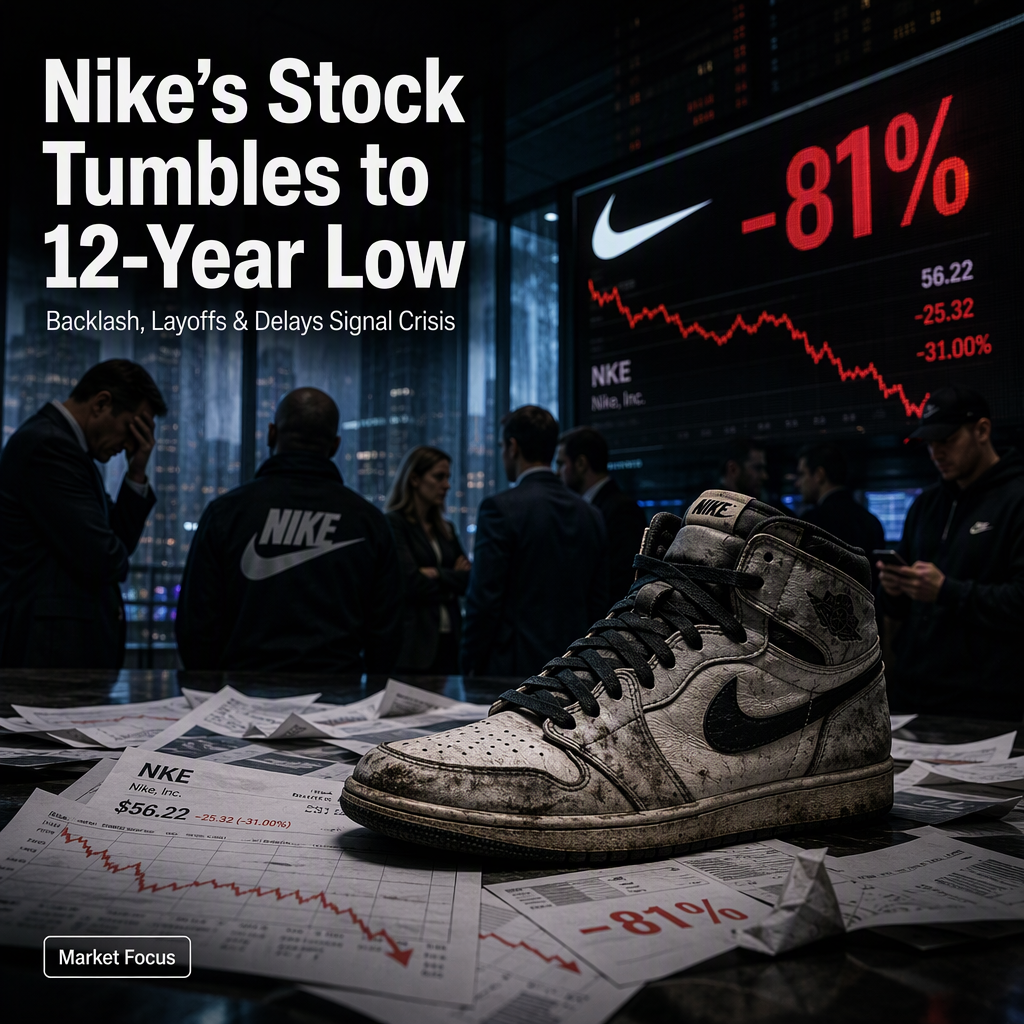
Nike's stock price closed at $33.87 per share on October 1, marking its lowest point in over 12 years, just one day after CEO John Donahoe sent an 860-word memo to employees emphasizing a renewed focus on sport and acknowledging the need for further progress to secure long-term success [1]. The company, which exited the S&P 100, expects additional layoffs in 2027 after already reducing staff twice in 2024 [1]. Nike's stock has fallen 81% from its all-time closing high of $177.51 per share in November 2021 [1].
The decline has been linked to Nike's high-profile social campaigns, including its partnership with Colin Kaepernick for the 30th anniversary "Just Do It" campaign in 2019, and the "For Once, Don't Do it" ad in 2020 addressing racism following George Floyd's death [1]. In 2023, Nike collaborated with Dylan Mulvaney, a female-identifying male, to promote women's leggings and sports bras, despite controversy surrounding Mulvaney's previous partnership with Bud Light [1]. Nike has also featured Pride and LGBTQ messaging in its branding and corporate initiatives [1].
Shareholders recently rejected a transparency proposal questioning Nike's DEI (Diversity, Equity, and Inclusion) commitments, highlighting ongoing concerns about the company's direction [1]. Another notable issue was the delayed release of Caitlin Clark's signature sneaker, which was unveiled on June 18, 2026, with an October release date. Sports writers have criticized Nike for prioritizing the debut of A'ja Wilson's sneaker over Clark's, despite Clark ranking first in WNBA jersey sales and Wilson fifth [1].
Market observers and sports writers suggest that Nike's focus on identity politics and social messaging may have contributed to its financial struggles, as the company appears to be reassessing its strategy to better align with consumer preferences [1].
CONCLUSION
Nike's stock has experienced a dramatic decline, attributed to controversial social campaigns and delayed product launches. The company is facing ongoing layoffs and shareholder scrutiny, signaling a period of significant reassessment and strategic change. Market sentiment remains negative, with high impact on Nike's financial outlook.