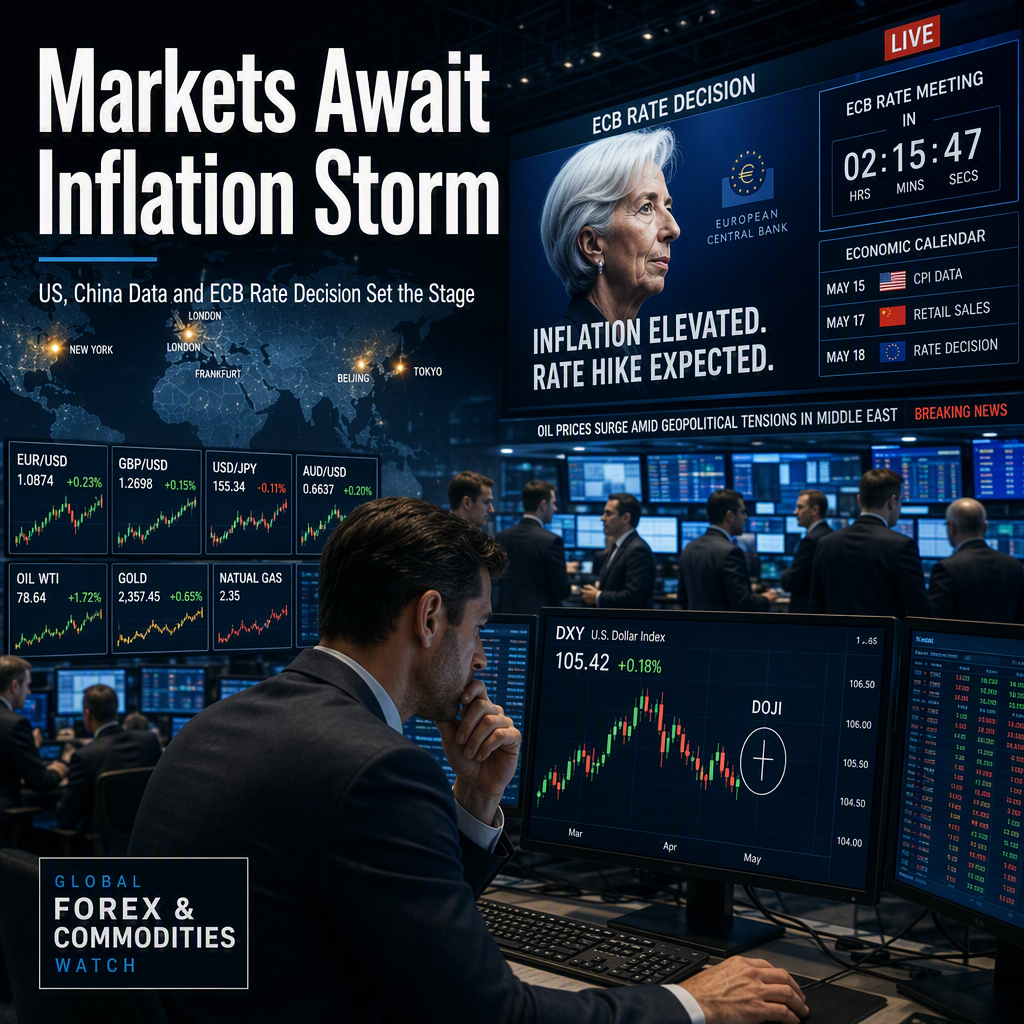
Forex markets remained subdued at the start of the week, with the US Dollar Index (DXY) holding near 99.00 on Tuesday and closing at 98.82, reflecting indecision among traders as indicated by a 'doji' candlestick formation [1]. Investors are closely watching upcoming US inflation data, specifically Thursday and Friday's Producer Price Index (PPI) and Consumer Price Index (CPI) reports, which are expected to influence market direction [1].
The EUR/USD pair breached the 1.1600 level, supported by overall US Dollar weakness and anticipation of a speech by European Central Bank (ECB) President Christine Lagarde. The market is focused on the ECB monetary policy meeting scheduled for Thursday, with money markets fully pricing in a 100% probability of a quarter-point rate hike [1].
GBP/USD climbed to 1.3561 before retreating to around 1.3539, following comments from Bank of England officials. Governor Andrew Bailey attributed higher energy prices to the US-Iran war, while Megan Greene expressed concern about the persistence of elevated oil prices. Alan Taylor advocated for maintaining 'moderately restrictive' rates, and Dave Ramsden described the domestic inflation outlook as relatively benign. The market awaits UK GDP figures on Friday [1].
USD/JPY weakened, falling below 153.00 after a suspected intervention by Japanese authorities, before recovering. US Treasury Secretary Scott Bessent is urging Japan to tighten policy, and the pair's future movement is expected to be influenced by US inflation data and the US 10-year Treasury yield. Traders are also monitoring Japan's Machine Tool Orders [1].
AUD/USD reached its daily high after RBA Deputy Governor Hauser stated that a rate hike will be debated at the next meeting. While the Australian economic calendar is light, upcoming Chinese inflation data could impact the currency, ahead of the release of Australian Consumer Inflation Expectations for September [1].
Oil prices, specifically West Texas Intermediate (WTI), hit a six-week high due to escalating hostilities, including Houthi attacks on Saudi Arabia. Investment banks are increasingly concerned that the conflict could extend until 2027. Meanwhile, gold prices edged lower, trading below $4,400 per troy ounce, as investors await US inflation data and higher interest rates support higher bond yields [1].
CONCLUSION
Markets are in a holding pattern as traders await key inflation data from the US and China, as well as the ECB's anticipated rate hike. Currency pairs and commodities are reacting to geopolitical tensions and central bank signals, with volatility expected to increase once the upcoming economic data is released.