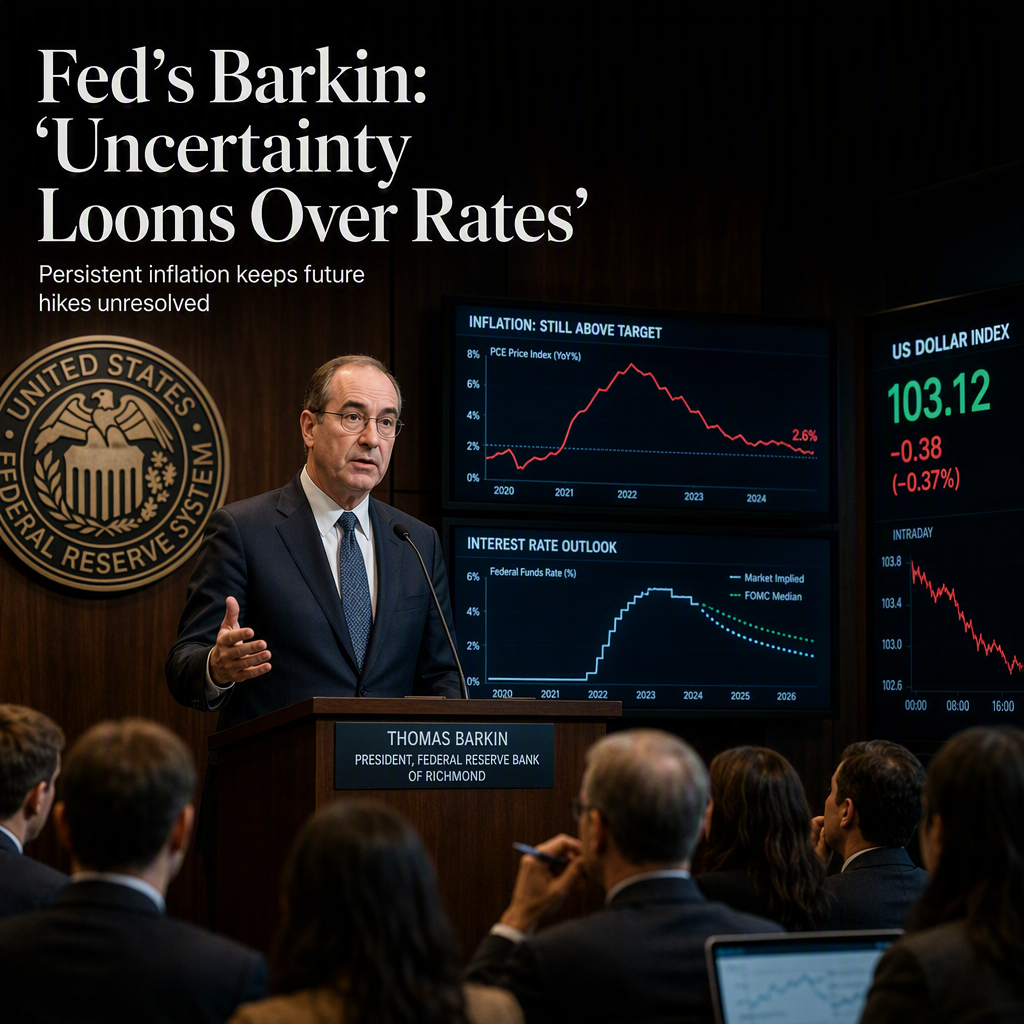
Richmond Federal Reserve President Thomas Barkin emphasized ongoing uncertainty regarding the US inflation outlook and the future direction of monetary policy, stating that it remains an open question whether the current level of interest rates is sufficiently restrictive to return inflation to the Fed’s 2% target or if further tightening may be necessary [1]. Barkin noted the resilience of the US economy, citing strong employment, household spending, and business investment, all of which have continued to withstand high interest rates and economic uncertainty [1].
Barkin highlighted that while there are reasons to believe price pressures could ease—such as modest compensation pressure and the likelihood that tariff, oil, and other shocks will subside—there are also arguments that inflation may be more persistent, potentially requiring either weakening demand or an additional rate increase to achieve the Fed's target [1]. He did not explicitly state whether he believes rates will need to rise, but mentioned that 'many' at the Fed feel the current level is restrictive enough to bring inflation down [1].
On the labor market, Barkin observed that employment remains strong, supporting household spending, and that those owning homes or equities have seen 'remarkable' growth in wealth [1]. He also noted that artificial intelligence is enabling firms to experiment with reducing headcount, but strong earnings have so far limited layoffs [1]. Business investment appears 'impervious' to interest rates, costs, or uncertainty, with companies concluding they cannot afford to delay investments despite ongoing uncertainty [1].
In terms of market reaction, the US Dollar Index (DXY) remained under pressure, declining by 0.13% on Thursday and trading around 99.85 at the time of writing [1].
CONCLUSION
Fed President Barkin’s remarks underscore the ongoing uncertainty about whether current interest rates are sufficient to bring inflation down to target levels. While the US economy shows resilience, markets remain cautious, as reflected in the modest decline of the US Dollar Index. The path of future rate hikes remains data-dependent and unresolved.