
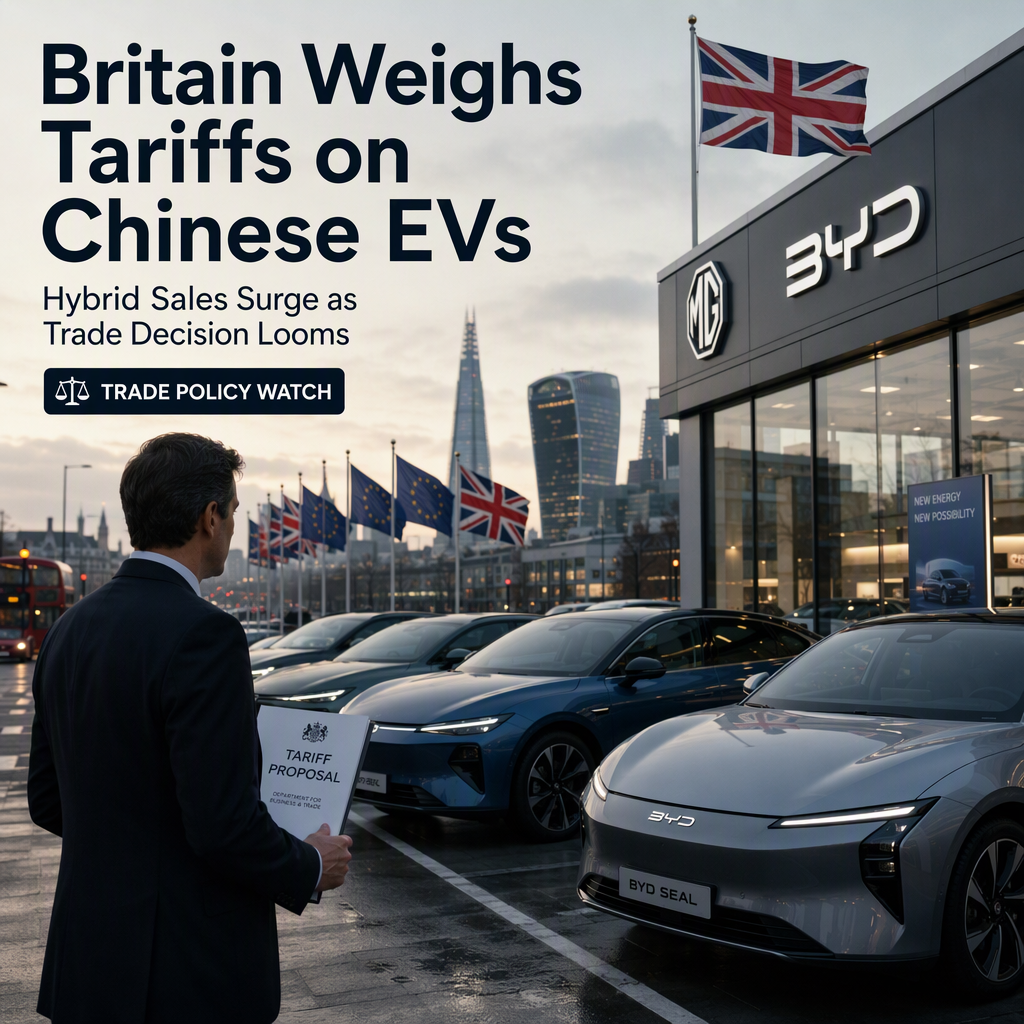
Britain is facing a pivotal decision regarding the imposition of tariffs on Chinese electric vehicles (EVs), as Chinese automakers rapidly gain market share in the country and hybrid sales surge [1]. Unlike the United States, which has effectively shut out Chinese EVs with a 100% tariff, and the European Union, which imposes manufacturer-specific duties of up to 35.3% in addition to a standard 10% import duty, the U.K. currently only applies a 10% standard import duty on Chinese EVs, making it one of the largest overseas markets without additional China-specific tariffs [1].
The U.K. government is considering whether to align its trade policy with the EU, following reports that Business Minister Jonathan Reynolds may match the EU's levy on Chinese EVs to avoid negative impacts from the EU's 'Made in Europe' proposals, which could hurt domestic companies selling into the EU [1]. The EU's Industrial Accelerator Act aims to protect European industries by prioritizing European-made goods, and an EU official has indicated that London would need to raise tariffs on Chinese EVs to avoid barriers under this legislation [1].
The decision is complicated by Prime Minister Andy Burnham's desire to reset relations with the EU post-Brexit and the risk of potential retaliation from Beijing. The Chinese Embassy in London has expressed "serious concern" about the possibility of new tariffs, stating opposition to any discriminatory practices and warning that China will respond accordingly [1].
Chinese car brands have made significant inroads in the U.K. market, with registrations of Chinese automakers across both battery-electric and hybrid powertrains rising sharply, according to analysis by JATO Dynamics [1]. Analysts caution that tariffs alone may not be sufficient to curb China's advance, as Chinese brands benefit from advantages in cost, supply chains, and product development [1]. The U.K. government has reiterated that no tariffs have been imposed yet and that it continues to engage closely with industry to ensure its approach reflects both sector and national interests [1].
CONCLUSION
Britain's decision on whether to impose EU-style tariffs on Chinese EVs is finely balanced, with significant implications for trade relations, domestic industry, and market dynamics. Chinese automakers' rapid growth in the U.K. underscores the challenge, and any move toward higher tariffs could provoke a response from Beijing. The market awaits further clarity as the government consults with industry stakeholders.