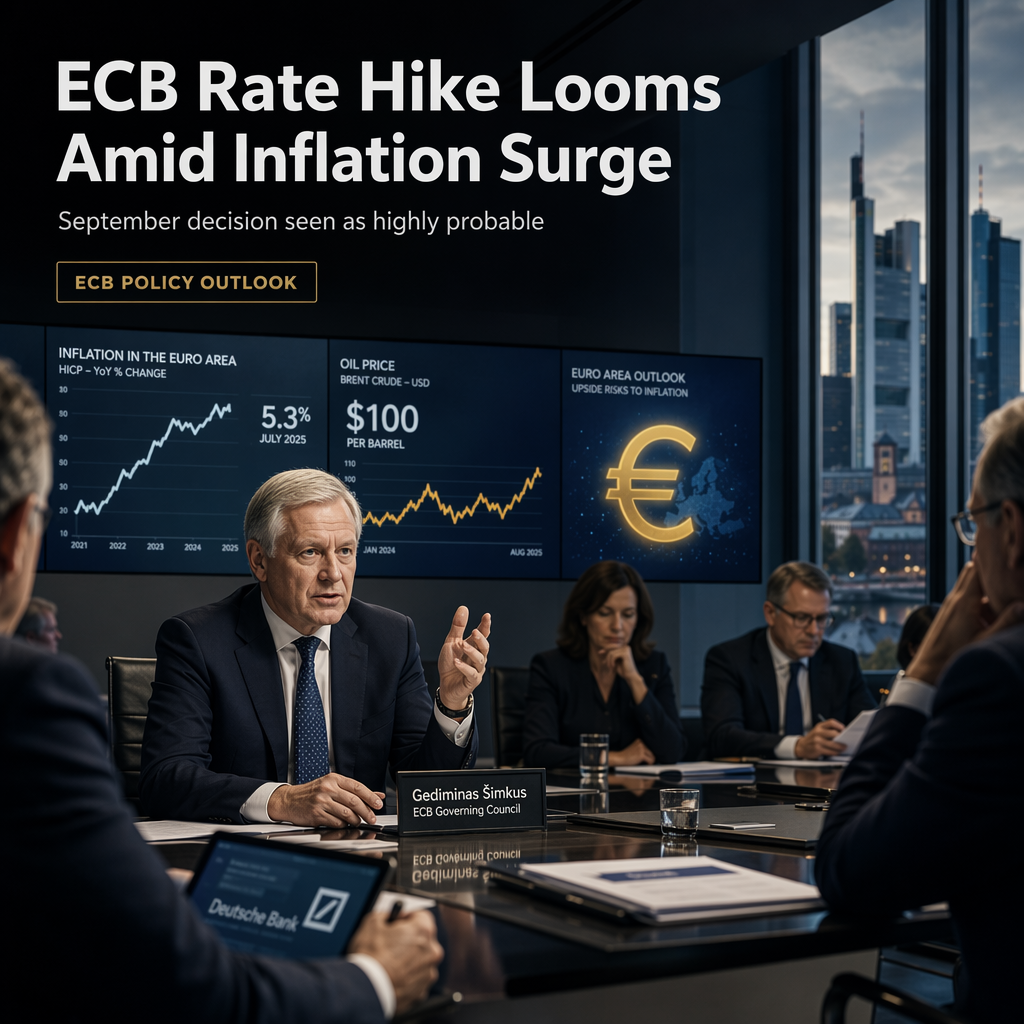
European Central Bank (ECB) Governing Council member Gediminas Simkus stated on Friday that the probability of an interest rate hike in the near term is higher than maintaining the current rate, expressing a hawkish bias on monetary policy. Simkus emphasized that the inflationary environment has intensified, with inflation expected to remain above target for an extended period. He also noted that $100 oil prices would have repercussions on inflation but ruled out fears of second-round effects from higher inflation. Simkus added that there is 'no value in rushing with a decision now' and that additional inflation data will be available in September, reinforcing the likelihood of a rate hike at that time [1].
Deutsche Bank strategists echoed this sentiment, observing that the ECB kept its deposit rate at 2.25% in its latest policy decision, while maintaining guidance that leaves the door open for further tightening. Deutsche Bank now sees a September rate increase to 2.50% as highly likely, with the risk of an additional hike if energy prices remain persistently high or if evidence of second-round effects emerges. The ECB's communication, including President Lagarde's press conference, indicated that the outlook remains broadly unchanged from the June baseline, which anticipated three hikes in the current cycle. Lagarde also stated that the ECB's reaction function is 'very well understood' by markets, suggesting no intention to counter market expectations for further hikes [2].
Following Simkus's remarks, the Euro (EUR) experienced a slight recovery, with EUR/USD trading 0.1% higher near 1.3325 at press time [1]. Both sources highlight the ECB's continued focus on inflation risks, particularly those stemming from elevated energy prices, and suggest that the central bank is prepared to act if inflationary pressures persist or intensify [1][2].
Forward-looking statements from both Simkus and Deutsche Bank indicate that the ECB is likely to raise rates in September, with the possibility of further hikes contingent on future inflation data and energy price developments [1][2].
CONCLUSION
Both ECB officials and market analysts see a September rate hike as highly probable, driven by persistent inflation concerns and the potential impact of high energy prices. The ECB's communication has reinforced market expectations for further tightening, resulting in a modest strengthening of the Euro. The central bank's next moves will depend on upcoming inflation data and energy market trends.