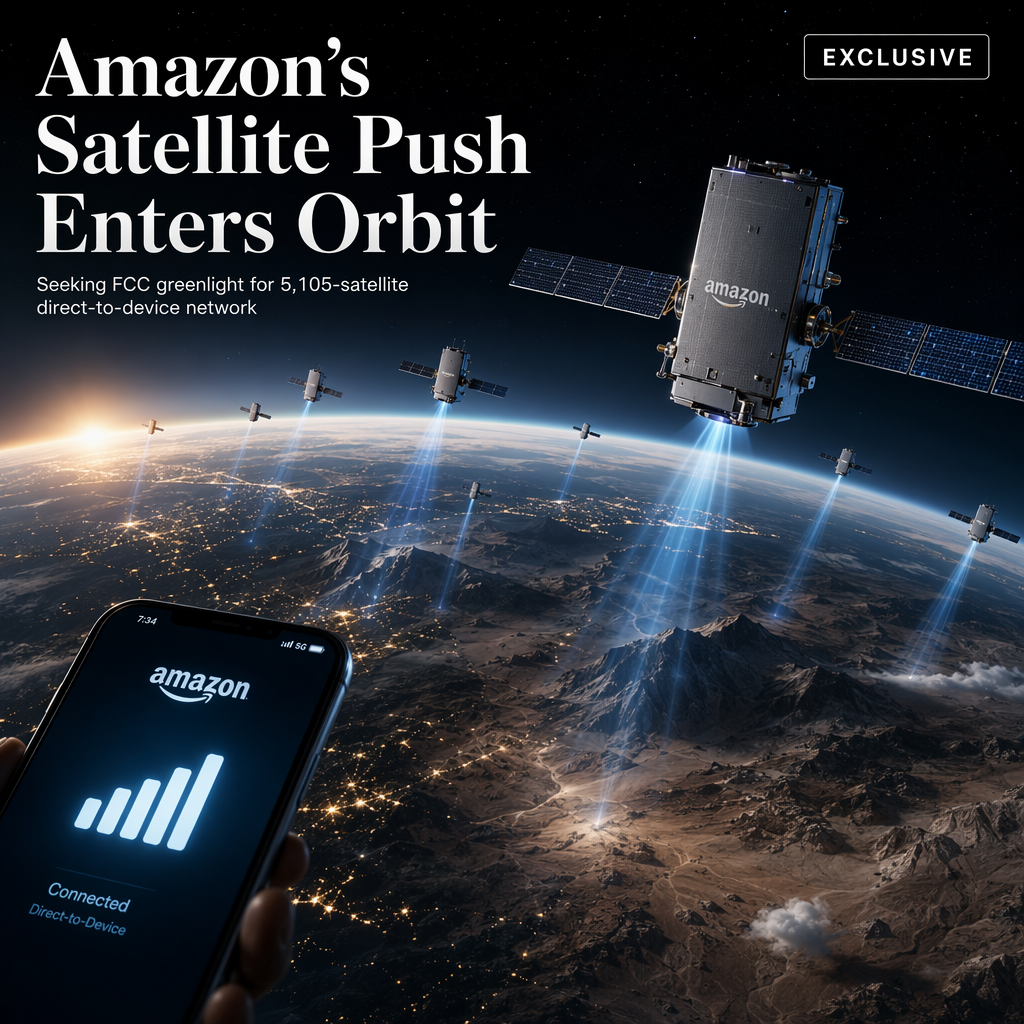
Amazon has filed an application with the Federal Communications Commission (FCC) seeking approval to launch up to 5,105 satellites as part of a new direct-to-device (D2D) internet network, aiming to provide connectivity directly to smartphones and other devices without relying on traditional cell towers [1]. This initiative will leverage assets from Globalstar, which Amazon announced plans to acquire in April for approximately $11.6 billion [1]. The company expects the Globalstar acquisition to close in 2027, with deployment of the D2D network beginning in 2028 [1].
The proposed D2D network will combine Amazon's existing infrastructure with Globalstar's satellites and spectrum, targeting users who are currently 'unserved or underserved' by existing wireless providers [1]. Additional applications include supporting emergency operations such as search and rescue, and extending connectivity to remote worksites, fleets, and supply chains that are difficult for terrestrial networks to reach [1]. Amazon stated, 'Amazon looks forward to delivering on the promise of D2D connectivity, including to the millions of people living, traveling and working in places beyond the reach of existing networks today' [1].
Amazon has been building out its low Earth orbit (LEO) internet-from-space network since April of the previous year, aiming to compete with SpaceX's Starlink, which currently operates a constellation of more than 10,000 satellites [1]. Amazon now has over 390 satellites in orbit and recently indicated that this is sufficient to begin 'initial service' later this year [1]. Last month, the FCC granted Amazon a waiver on a requirement to deploy 1,600 of its first-generation satellites by July 30, but the company is still required to launch all 3,232 satellites of its planned constellation by July 2029 [1].
The D2D network will compete directly with SpaceX's Starlink Mobile service, which offers direct-to-cell service via T-Mobile in the U.S. and has acquired wireless spectrum licenses from EchoStar to support its network [1].
CONCLUSION
Amazon's pursuit of FCC approval for a 5,105-satellite D2D network marks a significant escalation in the competition for global satellite internet services. With the planned acquisition of Globalstar and a targeted deployment beginning in 2028, Amazon is positioning itself to challenge SpaceX's dominance in the sector and expand connectivity to underserved regions.