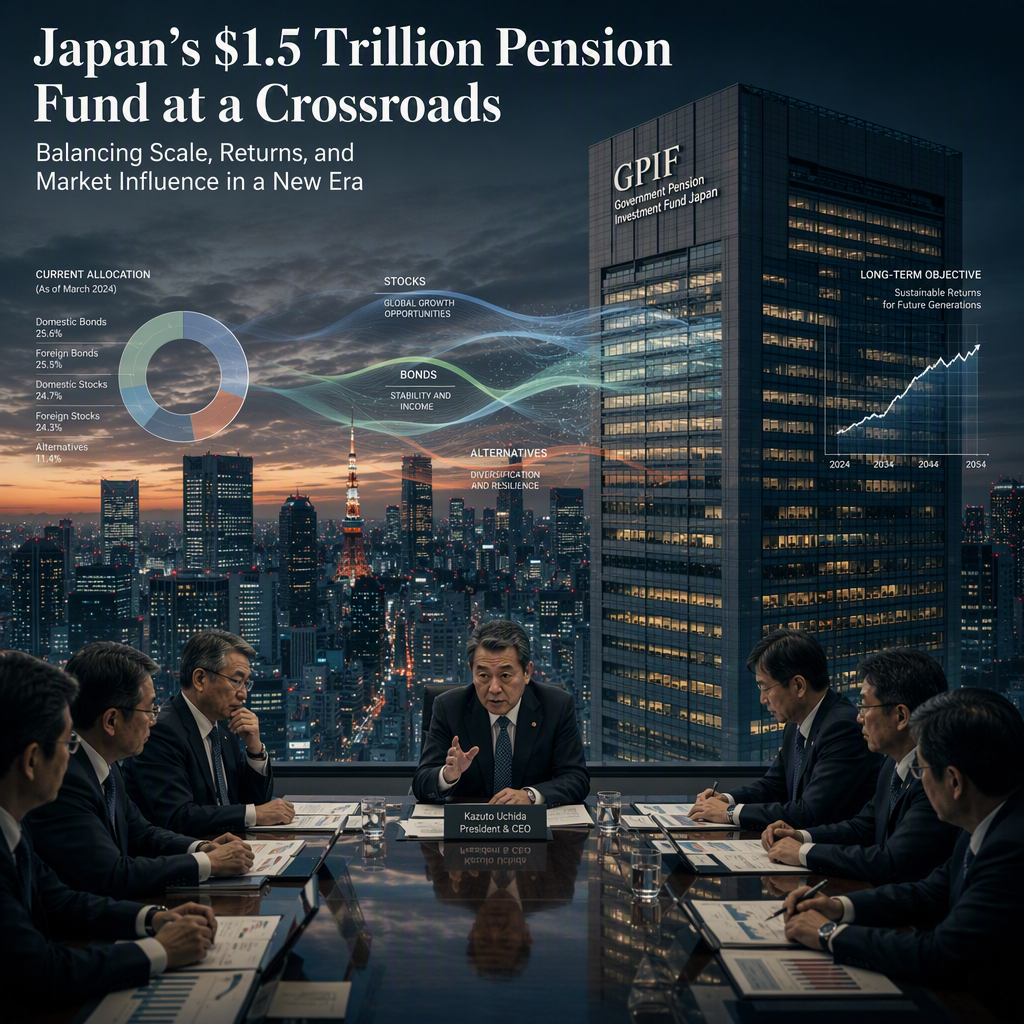
Japan’s Government Pension Investment Fund (GPIF), the world’s largest public pension fund with assets exceeding 224 trillion yen (approximately $1.5 trillion), is grappling with the difficulties of outperforming the market two decades after its founding [1]. As the dominant institutional investor in Japan, GPIF’s sheer size has become a double-edged sword, making agile investment decisions challenging and raising concerns about its ability to generate sufficient returns for future pension obligations [1].
GPIF President Kazuto Uchida is spearheading efforts to make the fund more nimble in its investment strategy [1]. However, recent remarks by Finance Minister Satsuki Katayama, who suggested that GPIF should increase its holdings of Japanese government bonds (JGBs), have sparked debate within financial circles [1]. Critics argue that a greater allocation to bonds could further weigh on returns, particularly given Japan’s persistently low interest rates [1].
Despite these challenges, GPIF reported a record gain of $150 billion in the past year, largely attributed to strong performance in AI-related equities [1]. Nonetheless, observers note that smaller Japanese pension funds—sometimes referred to as 'dolphins' compared to the GPIF 'whale'—have occasionally outperformed GPIF due to their ability to pursue alternative strategies and react more swiftly to market developments [1].
Market analysts highlight that GPIF’s massive trades can move markets, which limits its investment options and can result in suboptimal entry and exit points [1]. There is ongoing discussion about whether GPIF should further diversify into alternative assets such as private equity and infrastructure to enhance returns and manage risk [1]. As global financial markets evolve, the pressure is mounting for GPIF to balance its mandate for stable, long-term growth with the realities of its scale and Japan’s demographic challenges [1]. The debate over asset allocation, risk management, and the fund’s broader influence on both Japanese and international markets is expected to intensify in the coming years [1].
CONCLUSION
GPIF’s size presents both opportunities and significant challenges, as it seeks to balance stable returns with the constraints of its market influence and Japan’s economic environment. Ongoing debates about asset allocation and diversification underscore the fund’s pivotal role in shaping market dynamics and its need for strategic agility moving forward.