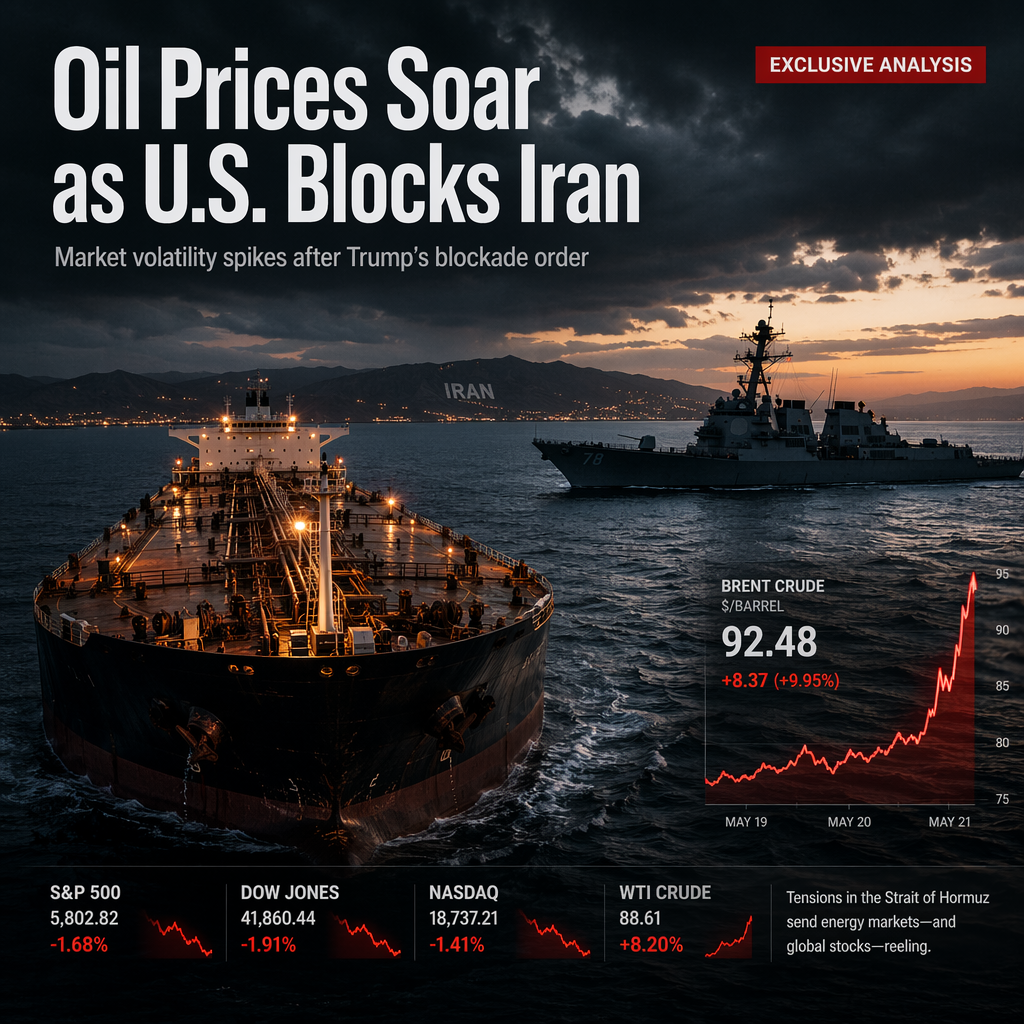
Oil prices surged more than 5% after President Donald Trump announced on social media that the United States would resume its blockade on Iran and seek to be “reimbursed” for assisting ships transiting the Strait of Hormuz [1]. U.S. crude oil rose to over $75 per barrel, while international Brent crude climbed to $80 per barrel, both marking a 5% increase [1]. This sharp rise in oil prices halted the recent declines in U.S. gasoline prices [1].
The stock market responded negatively to the news, with the S&P 500 falling 0.5% and the Nasdaq hitting its lowest level of the day, extending its earlier losses [1]. President Trump stated that the reimbursement would be “at the rate of 20% on all cargo shipped,” though the mechanism for this was not immediately clear [1]. Energy and shipping companies have previously rejected similar proposals from Iran, which had suggested ships pay a toll to pass through the Strait of Hormuz [1].
The U.S. Treasury Department warned that any payments to Iran for passage through the Strait could expose entities to sanctions violations, labeling such payments as “maritime extortion” [1]. The blockade, referred to by Trump as “THE IRANIAN BLOCKADE,” is a U.S. naval action preventing ships from entering or exiting Iranian ports, but it does not stop non-Iranian commercial vessels from transiting the waterway [1].
This escalation follows continued U.S. strikes on Iranian targets in retaliation for Iranian military attacks on multiple commercial vessels, including incidents involving projectiles and drones on Sunday night [1]. The Strait of Hormuz is a critical chokepoint, previously accounting for the transit of 20% of the world’s energy supplies [1]. Chevron CEO Mike Wirth stated in May that the company would not pay Iran any fee to transit the region, warning that such a precedent could have global repercussions for freedom of navigation in international waterways [1].
CONCLUSION
President Trump's decision to reimpose the blockade on Iran has triggered a sharp rise in oil prices and a negative reaction in equity markets. The move raises concerns about energy supply disruptions and the potential for broader impacts on international shipping and trade. Market participants are closely watching for further developments and clarifications on the proposed reimbursement mechanism.