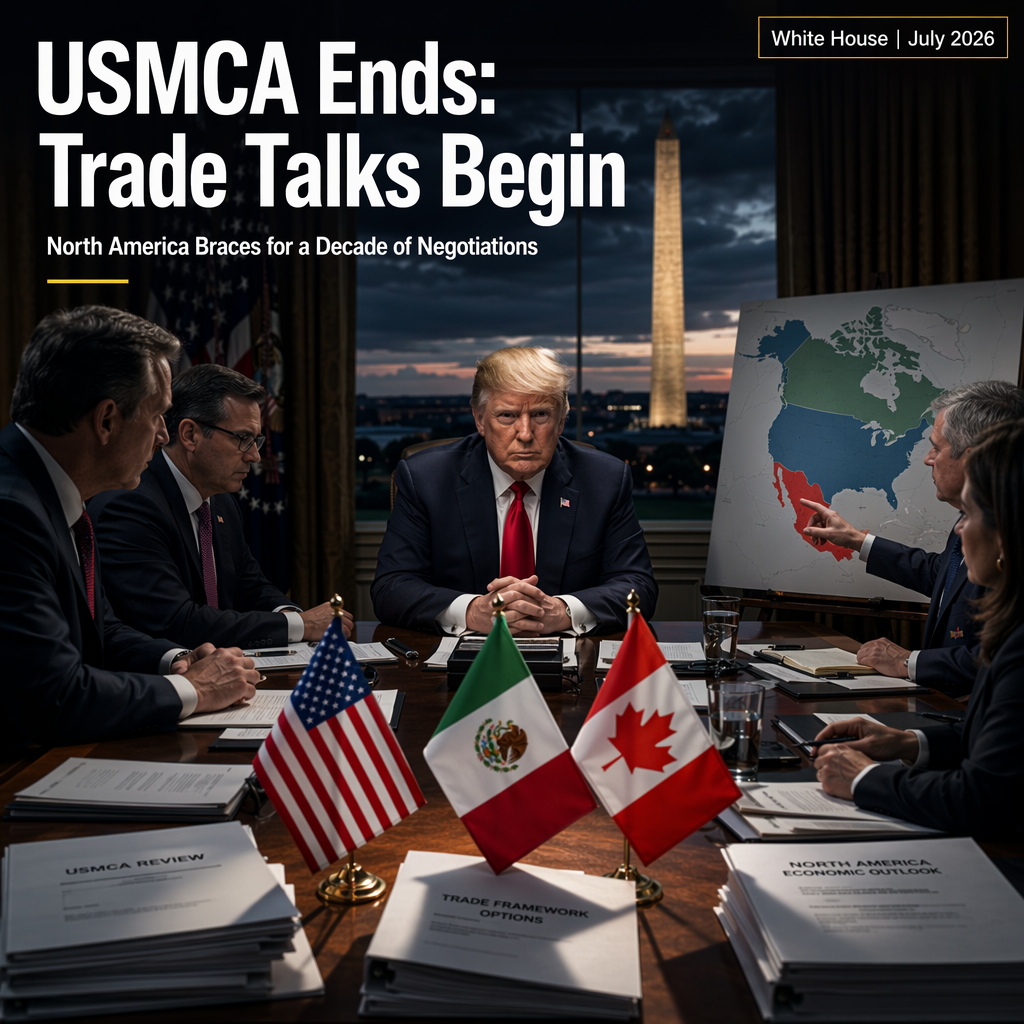
On July 1, 2026, the Trump administration announced that it will not renew the United States-Mexico-Canada Agreement (USMCA), marking a significant shift in North American trade policy six years after the deal first took effect [1]. A senior Trump administration official stated that instead of renewal, the United States will embark on a decade of negotiations to amend the agreement, with the possibility of establishing separate bilateral trade deals with Mexico and Canada [1].
The administration's decision represents a reversal for President Donald Trump, who originally negotiated and signed the USMCA in 2018 after withdrawing from the North American Free Trade Agreement (NAFTA). In 2019, Trump described USMCA as “the best and most important trade deal ever made by the USA” [1]. However, the administration now claims that the deal failed to achieve its goal of rebalancing trade among the three countries, citing increased trade deficits with both Mexico and Canada during the Biden administration as a primary concern [1].
A senior official emphasized that while the USMCA succeeded in modernizing trade relations, it did not sufficiently address the trade deficit issue. The official noted, “We’ve started to get it under control, but we believe that the USMCA did not operate to control the deficit like the president intended, so that’s really the heart of it” [1]. The official also highlighted that the upcoming negotiations are not intended to last the full ten years, as periodic reviews—referred to as the Joint Review—are built into the process to ensure the agreement prioritizes American interests [1].
The end of USMCA is expected to increase economic uncertainty for businesses across the United States, Mexico, and Canada, as the agreement was widely regarded as a stabilizing force in North American trade [1]. The Trump administration’s ongoing focus on global tariffs and concerns over tariff exemptions further underscore the potential for significant changes in trade policy and market conditions [1].
CONCLUSION
The Trump administration’s decision to end USMCA renewal and pursue a decade of trade negotiations introduces substantial uncertainty for North American trade. Businesses in all three countries face an unclear future as the administration seeks to address trade deficits and potentially shift toward bilateral agreements. Market participants should prepare for a period of heightened volatility and evolving trade policies.