
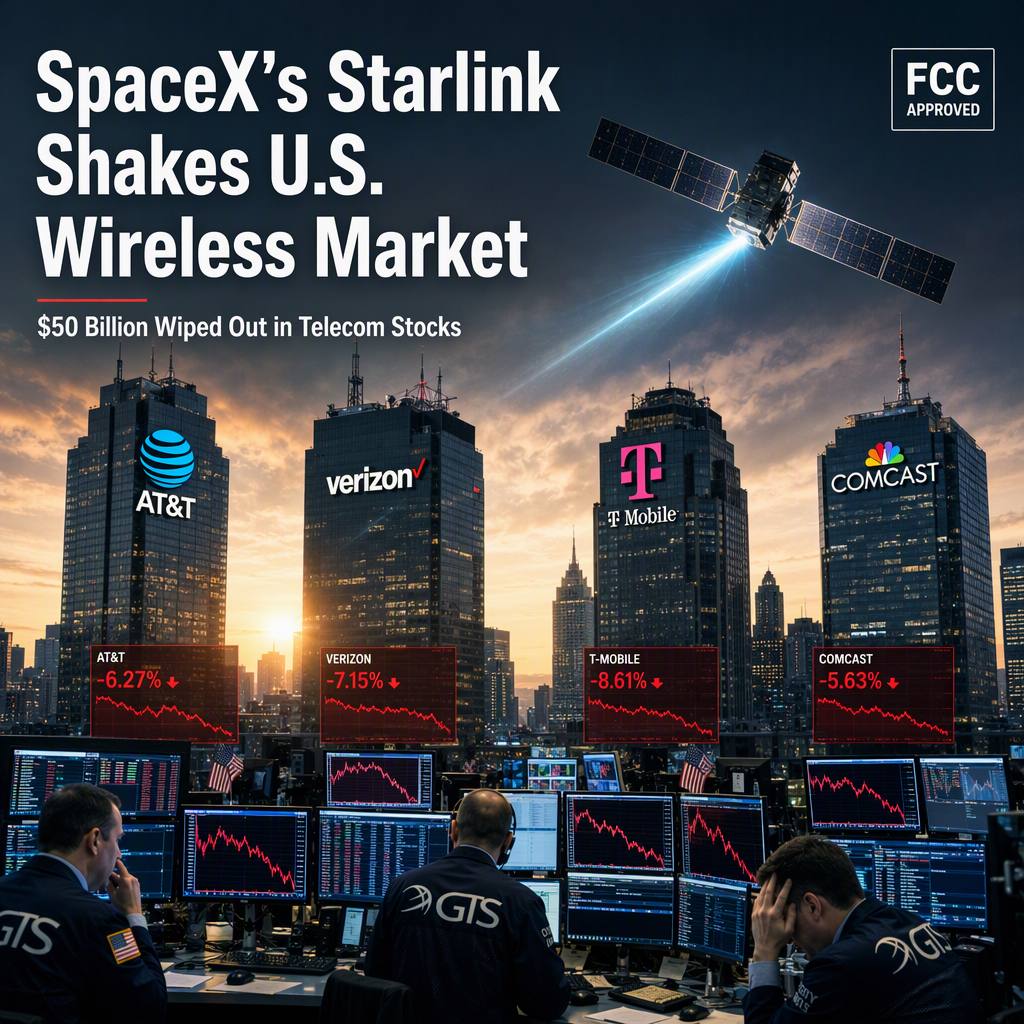
Elon Musk's SpaceX announced plans for Starlink Mobile to become a major mobile carrier in the U.S., a move that sent shockwaves through the wireless industry and triggered a massive selloff in telecom stocks on Friday [1]. The announcement, made late Thursday, detailed a flexible architecture that would combine SpaceX's satellite-to-mobile constellation with advanced terrestrial deployment, aiming to provide seamless device connectivity nationwide. The Federal Communications Commission (FCC) approved the launch of 15,000 new satellites under Starlink Mobile, marking a significant regulatory milestone for the company [1].
The market reacted sharply to SpaceX's ambitions. Shares of AT&T and Verizon each dropped 10% on Friday morning, while T-Mobile US stock plunged 14%. Charter and Comcast, which also offer wireless services using Verizon's infrastructure, saw their shares fall throughout the day. In total, more than $50 billion in market value was wiped out from the U.S. wireless sector before lunch [1].
Starlink, SpaceX's profitable high-speed internet business, was valued at $2.2 trillion as of Friday and boasts more than 12 million paying subscribers. The acquisition of spectrum was described by Musk as the 'last critical piece of the spectrum puzzle needed for SpaceX to provide complete phone coverage in America.' Favorable regulatory decisions and additional government contracts remain crucial for maintaining SpaceX's high valuation [1].
Elon Musk, whose net worth stood at about $990 billion as of Thursday, continues to expand his tech empire, which includes Tesla, X, and xAI. SpaceX's growing influence as a government contractor and Musk's political connections, including significant donations to Republican campaigns and close ties to President Donald Trump, were also highlighted in the context of the company's expansion [1].
CONCLUSION
SpaceX's announcement of Starlink Mobile's entry into the U.S. wireless market and the FCC's approval of 15,000 new satellites caused a dramatic selloff in major telecom stocks, erasing over $50 billion in market value. The market's reaction underscores the disruptive potential of SpaceX's plans and the heightened competitive pressure facing incumbent carriers.