
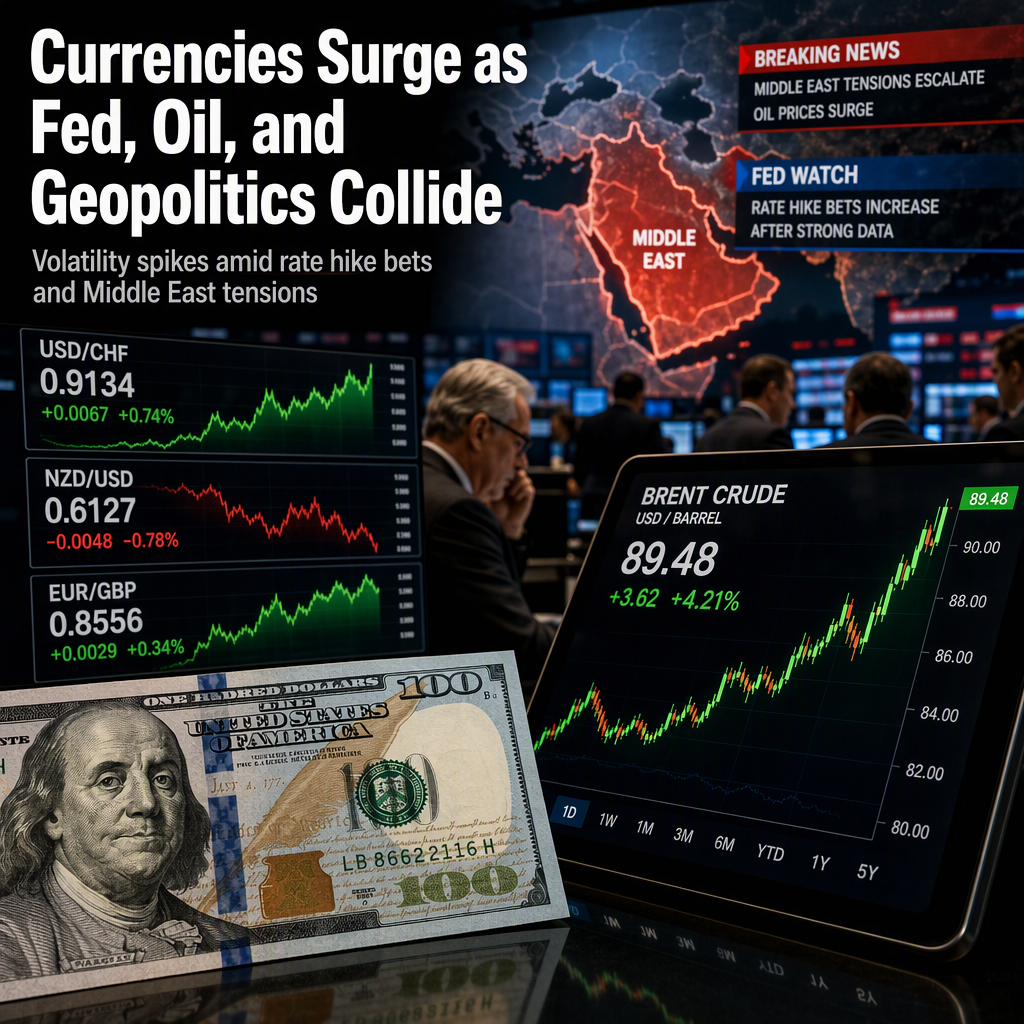
Financial markets are experiencing heightened volatility as hawkish comments from Federal Reserve officials and escalating tensions in the Middle East drive significant moves across major currency pairs and commodities. The US Dollar (USD) has strengthened notably, with USD/CHF extending gains for the fourth consecutive day and reaching a fresh 16-month high of 0.8314 during European hours on Monday, buoyed by expectations of a Federal Reserve rate hike. The CME FedWatch Tool now indicates a greater than 70% probability of a rate hike at the October Federal Reserve meeting, up from 57.6% last week and 17.7% a month ago, following remarks from Cleveland Fed President Beth Hammack and Philadelphia Fed President Anna Paulson advocating for tighter monetary policy to combat elevated prices [1][2].
Geopolitical developments are also impacting markets, as US President Donald Trump rejected Iran’s proposal to reopen the Strait of Hormuz, maintaining that Tehran overplayed its hand. Negotiations are expected to resume this week, but the conflict remains unpredictable, with President Trump signaling confidence that the situation will conclude soon while leaving open the possibility of further military actions before the midterm elections [1][2][3]. Oil prices have surged, with Brent crude trading above $98.00, up from Friday’s lows at $96.40, adding inflationary pressure to global economies [3].
The Swiss Franc (CHF) faces headwinds after the Swiss National Bank (SNB) left its key interest rate unchanged at 0% during its September meeting, citing elevated uncertainty in the Middle East and high global oil prices as reasons for its decision. OCBC strategists note that the SNB’s softened FX intervention rhetoric signals a greater tolerance for a stable or stronger CHF, which may help offset inflation risks from higher energy prices. However, the Franc is expected to remain primarily a funding currency as the central bank leans on its strength to contain imported price pressures [1].
Meanwhile, the New Zealand Dollar (NZD) has halted its three-day losing streak and is trading around 0.5660, outperforming most major currencies after Reserve Bank of New Zealand (RBNZ) Governor Anna Breman delivered hawkish remarks. Markets are pricing in a high likelihood of a third rate hike by the RBNZ in October, with odds rising from 57% to 73% for a 25bps hike to 3.00% at the October 28 meeting, as sustained oil price rises threaten to push short-term inflation above the central bank’s forecasts [2].
In Europe, the Euro (EUR) failed to break the 0.8610 resistance level against the British Pound (GBP), retreating to session lows at 0.8690. The frail market sentiment, higher oil prices, and a more hawkish stance by the Bank of England (BoE) are weighing on the common currency. BoE Governor Andrew Bailey and Deputy Governor Clare Lombardelli have signaled that it is becoming increasingly difficult to keep interest rates on hold amid rising price pressures, boosting hopes for tighter monetary policy despite weak economic momentum [3]. Technical analysis indicates fading upside momentum for EUR/GBP, with bears targeting support levels at 0.8570 and 0.8560 [3].
CONCLUSION
Hawkish central bank rhetoric, surging oil prices, and geopolitical uncertainty are driving sharp moves in currency markets, with the US Dollar and New Zealand Dollar gaining strength while the Swiss Franc and Euro face challenges. Market participants are closely watching upcoming economic data and central bank meetings for further direction, as elevated inflation risks and unpredictable Middle East developments continue to shape global financial sentiment.