
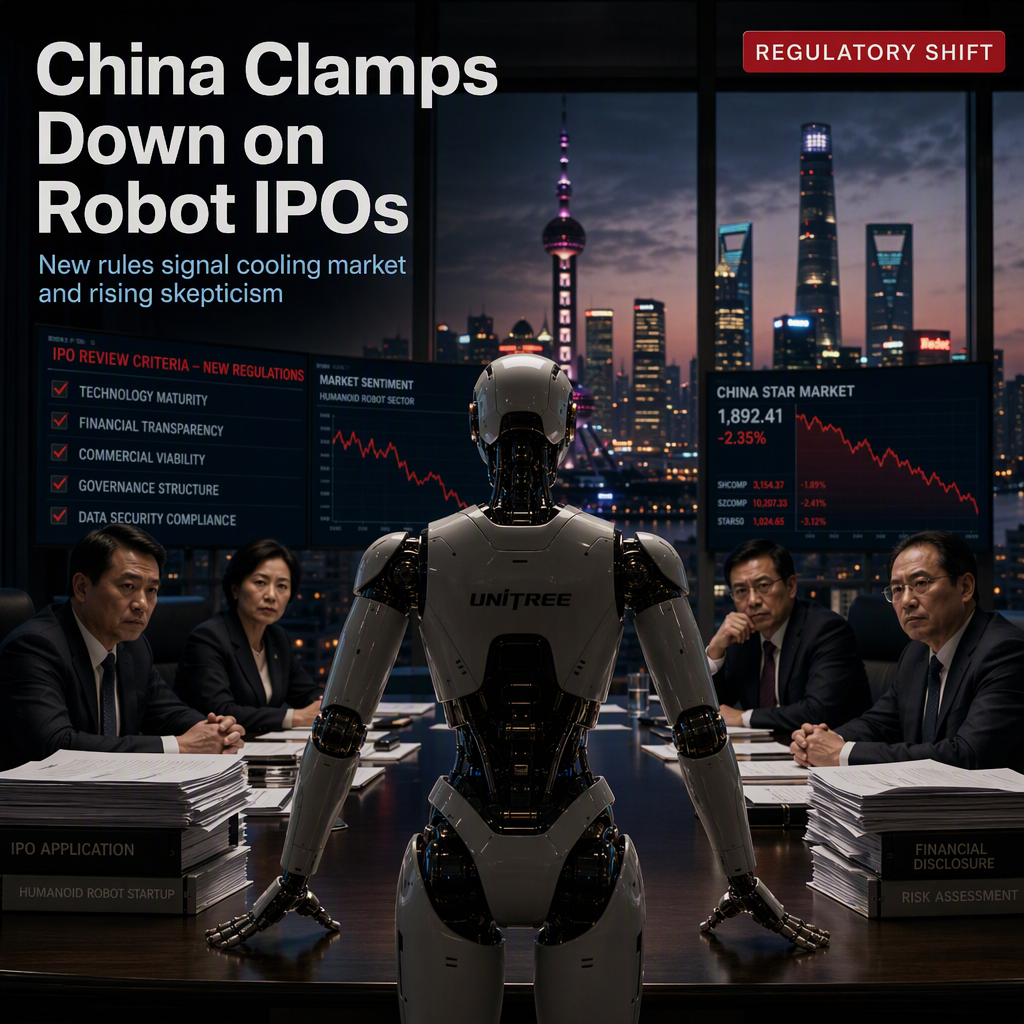
China's securities regulator has introduced three new criteria for humanoid robot startups seeking to go public, signaling a cooling in one of the country's previously hottest market sectors as global investors reassess the potential for an artificial intelligence bubble [1]. According to three sources familiar with the China Securities Regulatory Commission's (CSRC) thinking, the new 'window guidance' requires that applicants demonstrate sustainable revenue and commercial orders, show narrowing losses with a three-year forecast, and possess core technology such as a robotic brain or hands [1]. While one source indicated that meeting two out of the three criteria may suffice, it remains unclear if any startups can fulfill these requirements, leading to lowered expectations that few, if any, will make it to public markets [1].
At least two dozen humanoid-related embodied AI companies have filed to list in Hong Kong, where confidential IPO filings have been allowed since May 2025 [1]. Mainland Chinese companies seeking to list in Hong Kong also require CSRC approval, but neither the Hong Kong stock exchange nor the CSRC responded to requests for comment [1].
The scrutiny comes amid rapidly growing valuations in the sector, fueled by both government and private sector investment. Investment in humanoid robotics reached 47.09 billion yuan ($6.95 billion) in the second quarter, more than doubling from the first quarter and increasing over sixfold compared to the same period last year, according to industry data provider Xiniu [1].
Unitree, considered the industry's posterchild, received a regulatory fast-track for its Shanghai IPO on August 19, raising about 6.1 billion yuan ($905 million) [1]. Its shares soared over 460% on debut to close at 845 yuan but had nearly halved to 459 yuan as of the following Monday [1]. In a keynote speech, Unitree's founder Wang Xingxing cautioned that commercialization beyond entertainment applications like dancing robots remains years away, fueling debate about the sector's true commercial viability [1].
The Chinese government has supported the 'embodied AI' sector in recent annual work reports but has also warned of a potential bubble in the humanoid robot industry [1].
CONCLUSION
China's new IPO criteria for humanoid robot startups reflect growing regulatory caution and skepticism about the sector's commercial readiness. Despite surging investment and high-profile listings like Unitree, the tightened rules and warnings of a bubble suggest a more challenging path ahead for companies seeking public funding.