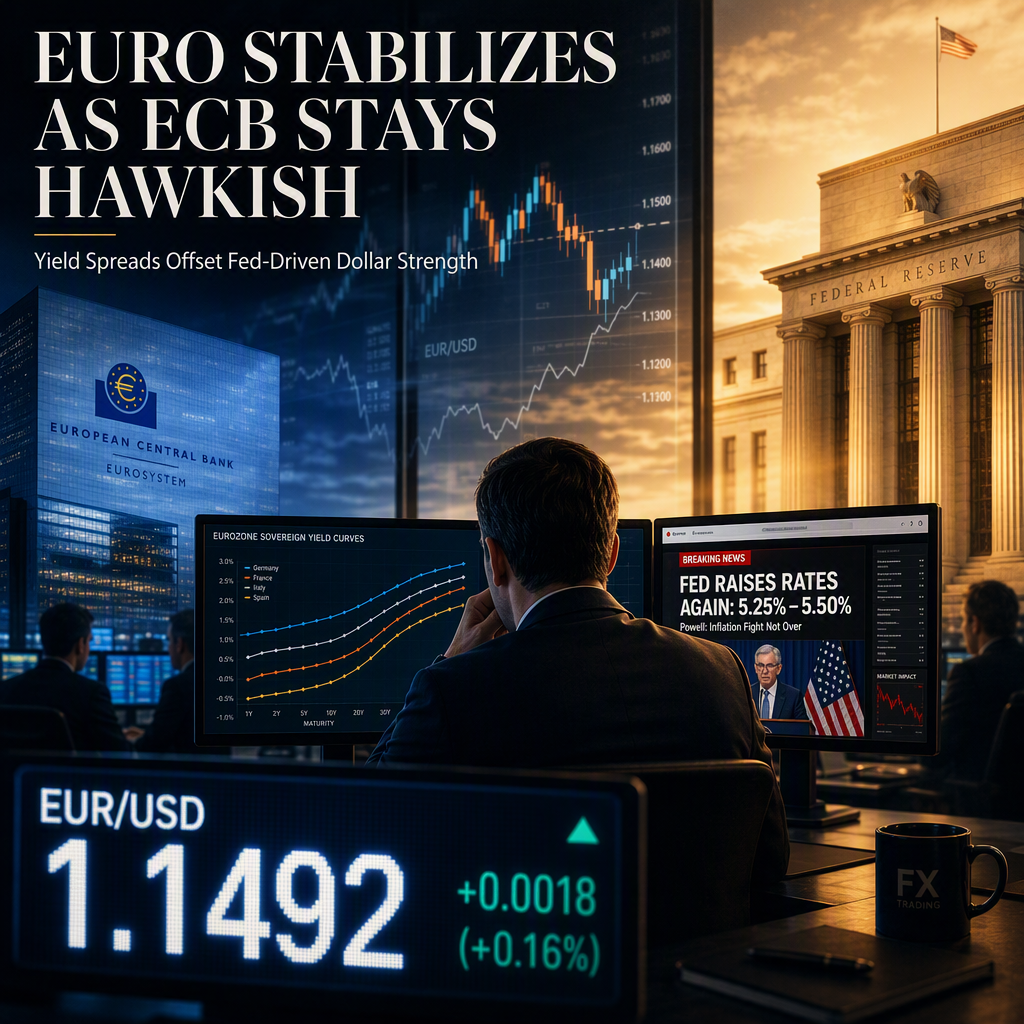
The EUR/USD currency pair is stabilizing following Wednesday's Federal Reserve decision, with the euro supported by improving Germany-US 2-year yield spreads and a hawkish stance from the European Central Bank (ECB) [1][2]. Scotiabank strategists noted a 7 basis point jump in the 2-year Germany-US yield spread, which has contributed to the euro's recovery, with the pair showing a marginal 0.1% gain as it enters Thursday's North American session [1]. The euro is finding support in the mid-1.14s and near 1.1400, with resistance limited ahead of 1.1550 [1]. At the time of reporting, EUR/USD trades around 1.1492, up 0.24% on the day and near levels last seen on July 31 [2].
The Federal Reserve unanimously raised its benchmark rate by 25 basis points to a range of 3.75%-4.00%, marking its first increase since 2023 [2][3]. Updated projections indicate that 16 of 18 Fed policymakers expect at least one more quarter-point increase by year-end [2]. According to the CME FedWatch Tool, traders see around a 50% chance of another rate hike in October [2], while another source reports an 86% chance of at least one additional hike by year-end, up from 79% before the decision [3]. This hawkish Fed outlook has limited the US Dollar's downside and capped the EUR/USD recovery, even as markets also price in further ECB tightening [2].
On the euro side, the final euro area CPI release showed headline inflation remaining in the low 3% area, with core inflation in the mid-2% range [1]. Specifically, final August inflation data revised headline HICP slightly lower to 3.2% annually, while core inflation held at 2.4% [2]. ECB Governing Council member Gabriel Makhlouf stated, “Risks to inflation remain on the upside,” and emphasized that policymakers “can’t rule out anything at future meetings” [2]. Olli Rehn described the inflation outlook as “somewhat mixed” but noted the Eurozone economy's resilience and absence of second-round effects so far [2]. Markets are pricing just over a 50% chance of an ECB hike in October, with a cumulative 36 basis points of tightening expected by December [1].
Market reaction has been mixed. The US Dollar Index (DXY) trades around 100.08 after touching an intraday high of 100.37, its strongest level since July 31 [2]. US labor market data also supported the Greenback, with Initial Jobless Claims falling to 196K from 206K, beating expectations of 208K [2][3]. Meanwhile, falling oil prices have contributed to a pullback in US Treasury yields, with the 10-year yield dropping to around 4.94% from a recent high of 5.04% [2].
Short-term technicals for EUR/USD indicate stabilization, with the pair oversold after a sharp decline but finding clear support in the mid-1.14s [1]. Resistance is seen ahead of 1.1550, while further support is expected closer to 1.1400 [1].
CONCLUSION
The EUR/USD pair is stabilizing as supportive eurozone yield spreads and a hawkish ECB offset the US Dollar's post-Fed strength. While both central banks maintain tightening biases, the market is pricing in further rate hikes from both sides, keeping the currency pair in a consolidation phase. Near-term movements will likely hinge on upcoming central bank decisions and evolving inflation data.