
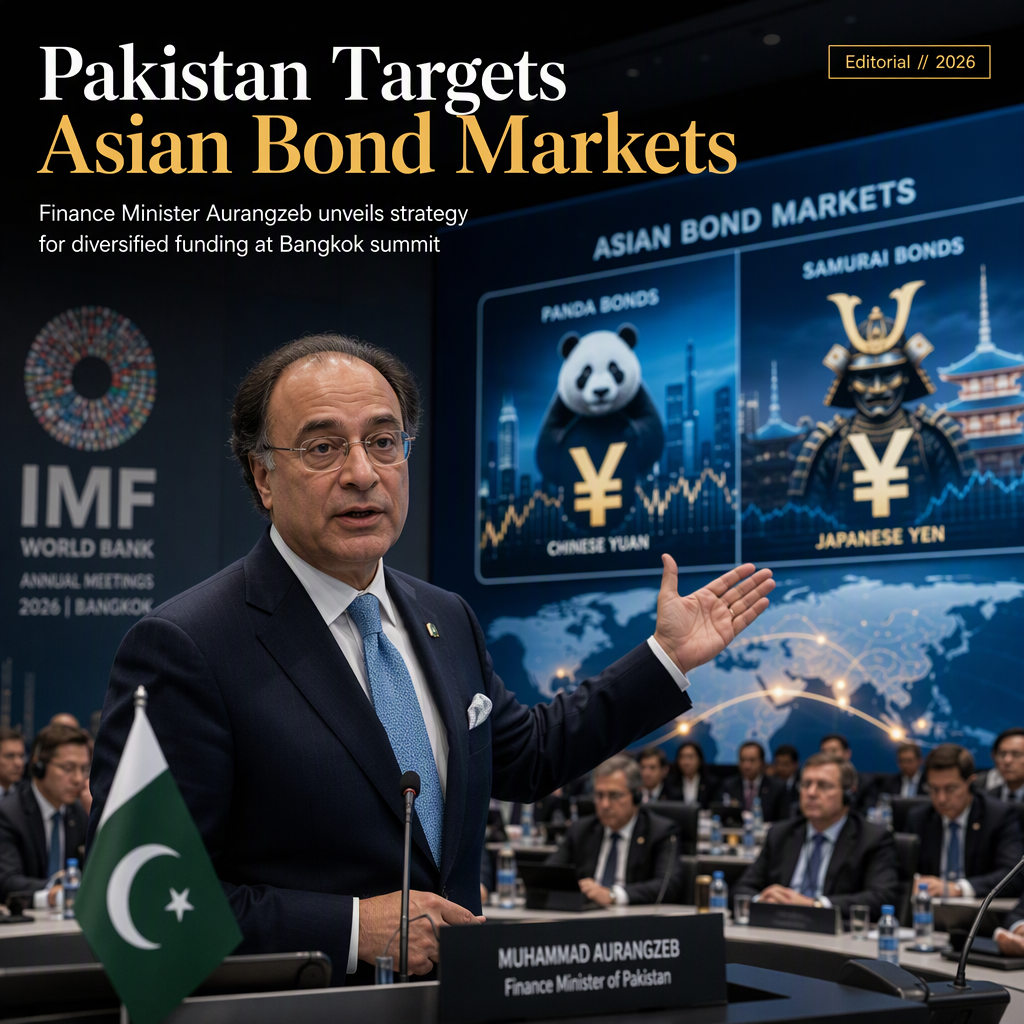
Pakistan's Finance Minister Muhammad Aurangzeb announced that the country will continue to diversify its funding sources by potentially issuing more Chinese yuan-based panda bonds and exploring samurai bond issuances in the Japanese market [1]. Speaking on October 12, 2026, during the IMF and World Bank annual meetings in Bangkok, Aurangzeb emphasized that this strategy aims to reduce Pakistan's reliance on conventional lending sources such as IMF programs and bilateral government-to-government borrowing [1].
Aurangzeb highlighted the success of Pakistan's previous $3 billion bond sale as evidence of a shift away from G2G borrowing, and noted that accessing Asian bond markets could provide cheaper and more diversified funding, especially in the context of rising global interest rates [1]. He stated, "We are looking to graduate from IMF programs and focus more on market-based funding," underscoring the importance of financial stability and resilience through diversification [1].
The finance minister confirmed ongoing discussions with Chinese authorities regarding future panda bond issuances, citing the attractiveness of the Chinese market's terms, and revealed talks with Japanese financial institutions about entering the samurai bond market, which he described as offering depth and stability [1]. While no specific price levels or expected yields were disclosed, Aurangzeb stressed the need for market confidence and transparency, aiming for competitive offerings that meet international standards [1].
Aurangzeb concluded that diversifying into Asian bond markets is key for strengthening Pakistan's financial position and boosting investor confidence, reflecting a broader policy shift within the country's financial leadership [1].
CONCLUSION
Pakistan is actively seeking to diversify its funding sources by tapping into Asian bond markets, aiming to reduce reliance on IMF programs and bilateral borrowing. The finance minister's statements signal a strategic shift toward market-based funding, with ongoing discussions for future panda and samurai bond issuances. This approach is intended to enhance financial stability and investor confidence.