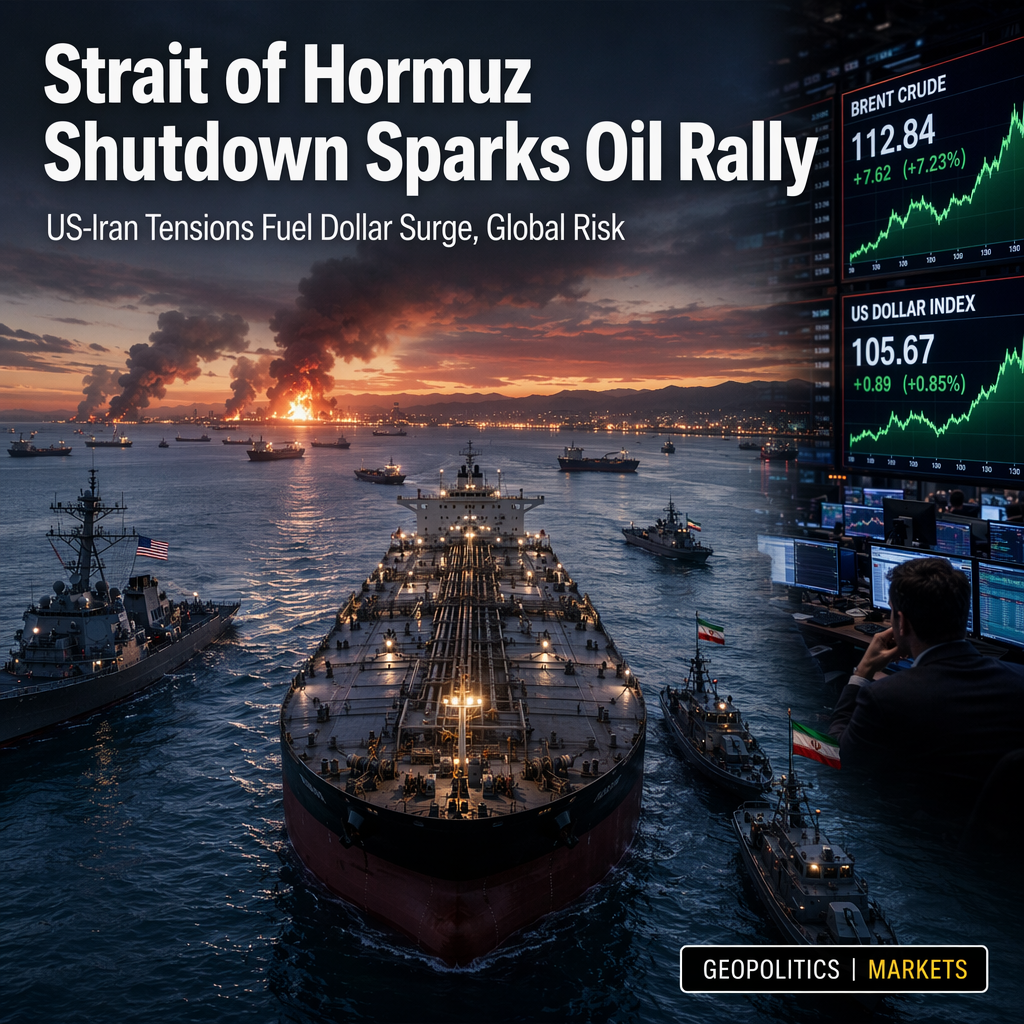
Over the weekend, tensions between the United States and Iran intensified, culminating in Iran announcing the closure of the Strait of Hormuz, a critical passage for nearly one-fifth of global energy supply [3][5][6][9]. The US Central Command (CENTCOM) launched additional airstrikes, targeting more than 300 Iranian sites over three nights, including 140 on Saturday, aiming to neutralize Iran's capability to threaten civilian vessels [2][6][9]. Iran retaliated by attacking US military bases in Kuwait, Bahrain, Oman, and Jordan, with regional reports of strikes hitting border posts and oil infrastructure [4][6][9]. The closure of the Strait and ongoing hostilities have led to a surge in oil prices, with Brent and WTI up around 4% and 3.75% respectively, Brent trading above $74.00 [3][5][6][9]. ING analysts note that despite higher prices, speculators have trimmed net long positions in ICE Brent, remaining cautious amid rising global oil inventories, which increased by 21 million barrels in June according to IEA data [5]. The IEA forecasts oil demand to recover gradually, with a year-on-year reduction easing from 4.8 million b/d in Q2 2026 to 1.7 million b/d in Q3, and returning to growth in Q4, but much depends on US-Iran developments [5].
The geopolitical turmoil has triggered risk aversion in financial markets, boosting the US Dollar as a safe-haven asset. The USD Index rose 0.12% to near 101.10, and US stock index futures fell between 0.3% and 1.4% [3][6]. Currency heat maps show the US Dollar was strongest against the Australian Dollar, while the Euro and Pound Sterling weakened against the Dollar [1][2][3][6][9]. EUR/USD traded near 1.1400 after rejection at 1.1460, with momentum indicators suggesting further downside, and UOB analysts expect EUR/USD to remain in a 1.1360–1.1450 range in the coming weeks [8][9]. The Euro also lost ground against the Pound, trading flat near 0.8520 after a 2% drop over three weeks, pressured by higher oil prices and sluggish Eurozone growth [1].
The Canadian Dollar outperformed most peers due to its status as a net energy exporter, but remained flat against the US Dollar as safe-haven flows dominated [3][7]. Commerzbank analysts attribute USD/CAD's move above 1.41 to oil price expectations and a strong US Dollar, noting that a sustained decline in USD/CAD would require repricing Fed hikes or improved US-Canada relations [7]. The New Zealand Dollar held steady near 0.5760, supported by improved domestic economic data and a hawkish Reserve Bank of New Zealand, which raised rates by 25 bps to 2.50% last week and signaled further hikes [4].
Market participants are closely watching upcoming US Consumer Price Index (CPI) data for June and Federal Reserve Chair Kevin Warsh's testimony before Congress for further direction on monetary policy [2][3][6][9]. Traders anticipate one more Fed rate hike before year-end, and the Fed's recent report highlighted persistent inflation driven by tariffs and Middle East conflict [2][6]. The Bank of England is expected to deliver at least one 25-basis-point hike by the end of 2026, which may support the Pound Sterling [2].
According to [1][9], risk aversion is likely to persist as long as the US-Iran conflict remains unresolved, with safe-haven assets such as the US Dollar, Japanese Yen, and Swiss Franc benefiting. Commodity-exporting currencies like the Canadian, Australian, and New Zealand Dollars may see support from higher commodity prices, but are also vulnerable to shifts in global risk sentiment.
CONCLUSION
The escalation of US-Iran hostilities and the closure of the Strait of Hormuz have significantly boosted oil prices and triggered broad risk aversion, strengthening the US Dollar and weighing on risk-sensitive currencies. Market focus now shifts to upcoming US inflation data and Fed testimony, which will be pivotal for monetary policy expectations. Until geopolitical tensions ease, safe-haven flows and elevated oil prices are likely to dominate market dynamics.