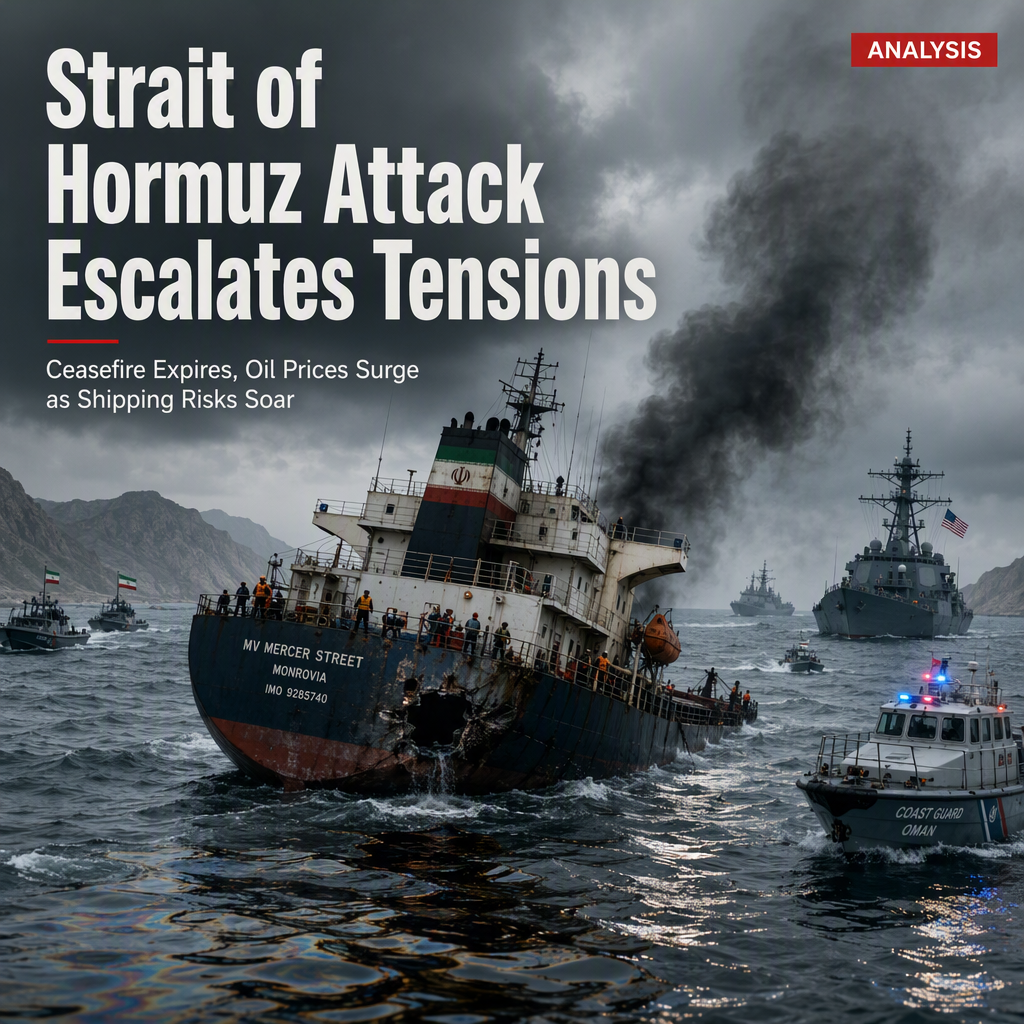
A cargo vessel was struck by a projectile while transiting the Strait of Hormuz, causing damage to its engine room and resulting in a crew casualty, according to the U.K. Maritime Trade Operations agency. The Omani Coast Guard is assisting the remaining crew members following the incident, which underscores ongoing navigation risks in the region as tensions between the U.S. and Iran escalate [1]. Iranian military officials have repeatedly threatened vessels attempting passage, with spokesperson Ebrahim Zolfaghari warning that ships will 'find several beautiful holes in their hulls' [1].
The attack comes as the 60-day negotiating ceasefire between Washington and Tehran, initiated in mid-June, expired on Monday without a formal extension. Both sides have rejected further talks, with U.S. President Donald Trump stating, 'They're not going to make the kind of deal that I feel is necessary,' and ruling out any extension of the ceasefire [1]. Analysts at Eurasia Group noted that both parties are likely to dig in for a prolonged standoff, and no peace deal is expected by September. The risk consultancy now anticipates a limited deal by year-end that could allow partial recovery of Hormuz traffic, but pressure on Washington for an immediate reopening has eased [1].
Iran's leadership reportedly intends to widen the conflict to increase costs for the U.S. and its regional allies, according to intelligence cited by the Wall Street Journal [1]. The Strait of Hormuz, previously handling about a fifth of the world's crude oil and gas, has become a central flashpoint since February, with shipping activity near a standstill and sporadic attacks on oil tankers. Only three vessels transited the strait on Sunday, based on shiptracking data from Kpler [1].
Despite the closure, success in routing oil around the Strait of Hormuz has prevented prices from spiking above $100 a barrel, and the global economy has adapted to the disruption, giving the U.S. flexibility to wait for a resolution [1]. The Bab el-Mandeb strait, also affected by regional conflict, saw a decline in commodity vessel transits, with only 49 over the weekend compared to 55 the previous week, according to Reuters [1].
CONCLUSION
The attack on a cargo vessel in the Strait of Hormuz has intensified U.S.-Iran tensions and contributed to rising oil prices, with both sides rejecting further negotiations. Shipping activity remains severely disrupted, but alternative oil routes have helped stabilize prices below $100 a barrel. Analysts expect the standoff to persist, with only a limited deal likely by year-end.