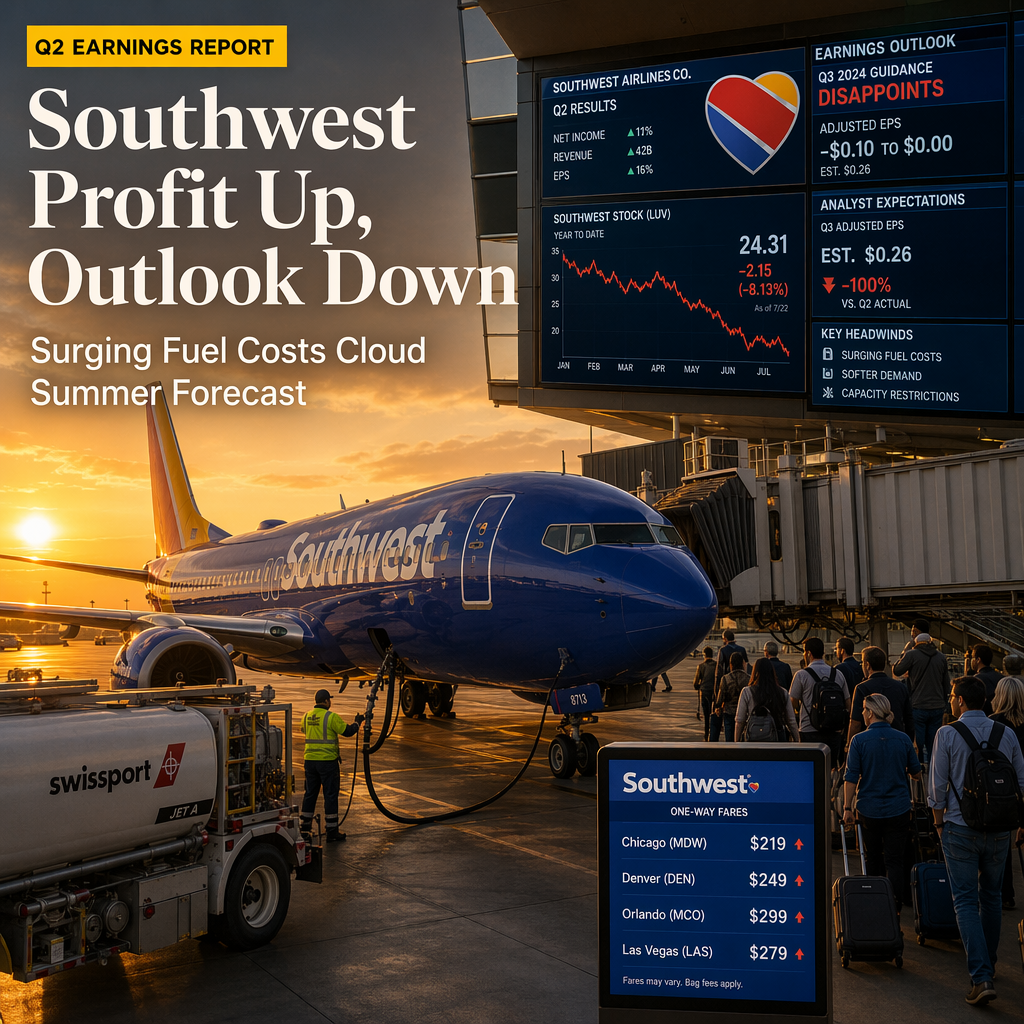
Southwest Airlines reported a more than 9% increase in second-quarter net income, reaching $233 million, or 47 cents per share, compared to $213 million, or 39 cents per share, a year earlier [1]. The airline's revenue for the second quarter rose 16.4% to $8.4 billion, though this fell short of Wall Street's expected $8.58 billion [1]. Average passenger fares increased nearly 21% to $225.61 from $186.65 a year prior, reflecting the company's efforts to boost revenue through higher fares and changes to its longstanding business model, including the end of open-seating, the introduction of basic economy fares, and the discontinuation of its free two-checked-bags policy [1].
Despite these revenue gains, Southwest's costs surged, with its fuel bill jumping 67% to $2.22 billion in the second quarter compared to the previous year [1]. The airline reported adjusted earnings per share of 94 cents, though it was not immediately clear if this figure was directly comparable to analyst expectations of 51 cents per share, according to LSEG consensus estimates [1].
Looking ahead, Southwest forecast third-quarter adjusted earnings between 50 cents and 75 cents per share, which is below the 82 cents analysts had anticipated [1]. The company projected sales growth of 17.5% to 19.5% year-over-year for the third quarter, but plans to keep capacity flat or contract it by up to 1% compared to the third quarter of 2025 [1]. The airline also noted a policy change regarding flight credits, now placing expiration dates on many ticket classes sold starting in mid-2025 [1].
The combination of higher fares and cost-cutting measures has not fully offset the impact of rising fuel costs, leading to a cautious outlook for the summer and disappointing Wall Street expectations for the upcoming quarter [1].
CONCLUSION
Southwest Airlines delivered higher second-quarter profits and revenue, but its third-quarter earnings forecast fell short of analyst expectations due to surging fuel costs. The market is likely to react negatively to the weaker outlook, despite the company's efforts to boost revenue through fare increases and policy changes.