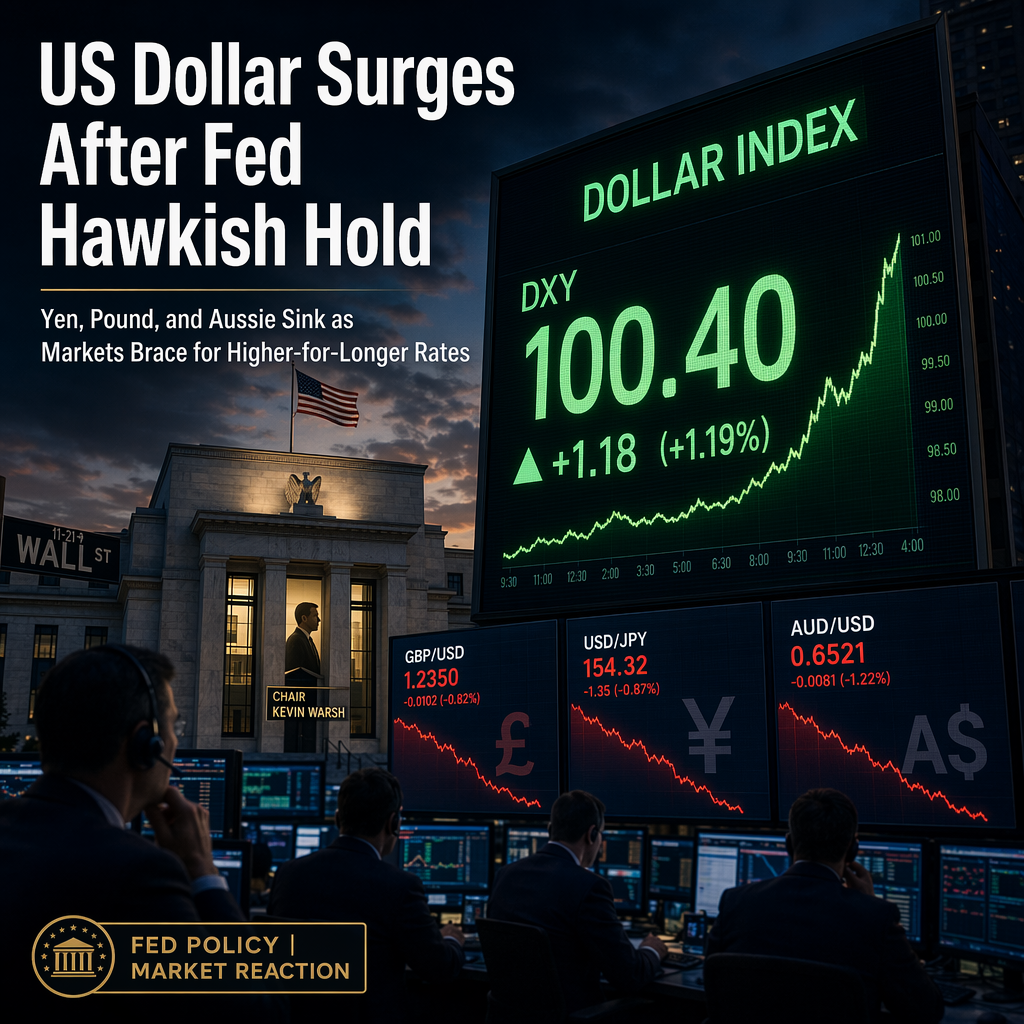
The US Dollar rallied sharply across global currency markets on Wednesday after the Federal Reserve, under new Chair Kevin Warsh, held its target range at 3.50%-3.75% but delivered a distinctly hawkish message in its June policy decision [1][2][3][4]. The Fed's Summary of Economic Projections (SEP) raised the median 2026 federal funds rate forecast to 3.8% from 3.4% in March, and the 2026 Personal Consumption Expenditures (PCE) inflation projection jumped to 3.6% from 2.7% [2][3][4]. Policymakers now see a possible rate hike by year-end, with the CME FedWatch tool showing a 25 basis point hike as the most likely outcome for September and a second hike possible by January [2][3].
Chair Warsh's first press conference signaled a sweeping overhaul of Fed communications, including the possibility of holding press conferences only when there is substantive news, and warned markets to expect changes to the SEP and central bank reporting by year-end [2][3]. Warsh also appears to have withheld his own dot from the projections, emphasizing a move away from forward guidance [1][2][3]. The Fed's statement was shortened and removed explicit forward guidance, with Warsh reiterating the Fed's commitment to achieving its 2% inflation goal and noting that inflation remains well above target [1][2][3][4].
The market reaction was swift and broad. The US Dollar Index (DXY) surged toward 100.40, with the USD gaining 1.15% against the British Pound, 0.18% against the Japanese Yen, and 0.92% against the Australian Dollar [4]. USD/JPY traded at 160.66 after bouncing off a daily low of 160.11, with the pair rallying 0.14% as rising US Treasury yields widened the interest rate differential, pressuring the Yen and raising concerns about possible Bank of Japan intervention [1][4]. GBP/USD collapsed nearly 140 pips to a two-month low near 1.3250, as softer-than-expected UK CPI data earlier in the day had already left Sterling vulnerable before the Fed's announcement [2][4]. AUD/USD fell close to 80 pips, briefly breaking below 0.7000 before recovering, as the lack of domestic data left the Aussie exposed to the Dollar's strength [3][4].
Forward-looking, the Fed's hawkish stance has shifted market expectations from rate cuts to the pace of tightening, with the next meetings expected to be holds and the focus now on the timing and number of hikes [2][3]. The Bank of England's decision on Thursday and upcoming UK labor and retail data are seen as key risks for Sterling, while the Australian Dollar faces a thin domestic calendar and remains at the mercy of global risk sentiment and Dollar momentum [2][3].
According to [1], the Fed's new framework review will include task forces on communications, the balance sheet, data sources, productivity, employment, and inflation. The Fed also noted that the US economy continues to grow strongly, with GDP expected to expand by 2.2% by the end of 2026, and the jobs market remains stable with little change in the unemployment rate [1][4].
CONCLUSION
The Federal Reserve's hawkish hold and upward revisions to rate and inflation forecasts triggered a broad-based US Dollar rally, pressuring major currencies including the Yen, Pound, and Aussie. Markets now anticipate a higher-for-longer rate environment, with the focus shifting to the timing of potential Fed hikes. The Fed's new communication approach and data-dependent stance have increased uncertainty, reinforcing Dollar strength in the near term.