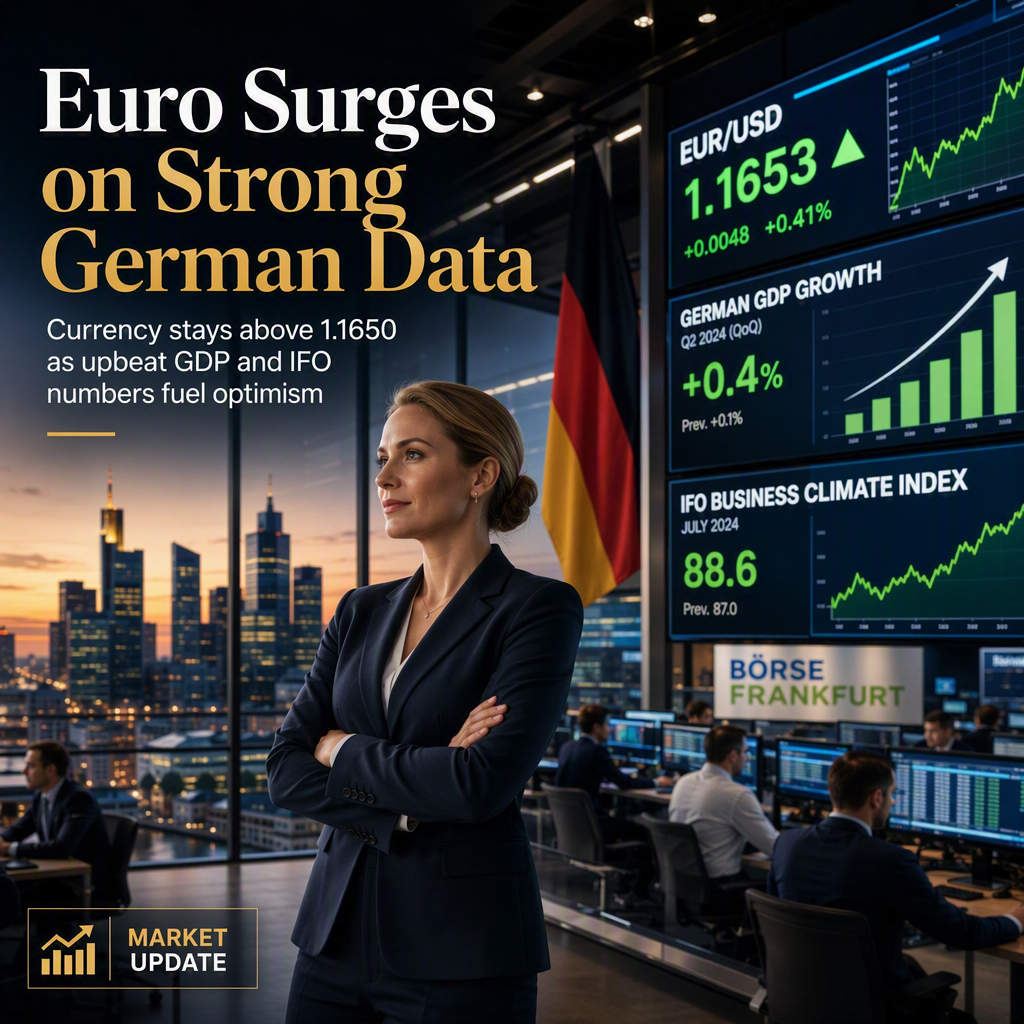
The Euro (EUR) maintained its position above 1.1650 against the US Dollar (USD) on Tuesday, trading close to the three-month high of 1.1710 reached last week. This stability is attributed to a combination of upbeat German macroeconomic data and a subdued US Dollar, which remains under pressure due to concerns about the Federal Reserve’s independence following the US Treasury’s bond buyback plans [1].
German economic indicators released on Tuesday provided significant support for the Euro. The German IFO Business Climate Index for August rose to 88.8, marking its highest level in a year and surpassing both the previous reading of 87.2 and market expectations, which also stood at 87.2. Additionally, the current economic situation index improved to 88.5 from 86.5, and the economic expectations gauge increased to 89.1 from 86.8, both exceeding consensus forecasts [1].
Further bolstering sentiment, the German Federal Statistics Office reported that Gross Domestic Product (GDP) grew by 0.3% quarter-on-quarter from April to June, outperforming the preliminary estimate of 0.2% and matching the growth rate of the first quarter. The year-over-year GDP figure was revised upward to 1% from the initial 0.9% estimate, significantly higher than the 0.4% increase recorded in the first quarter [1].
Despite these positive developments, investors remain cautious ahead of the upcoming US PCE Price Index release and, more importantly, Fed Chairman Kevin Warsh’s speech at the Jackson Hole summit. ING strategists noted that their models place the short-term fair value for EUR/USD just below 1.160, suggesting a contained risk premium on the Dollar related to last week’s US Treasury buyback announcement [1].
CONCLUSION
Stronger-than-expected German economic data has provided support for the Euro, keeping it above 1.1650 against the US Dollar. However, market participants are adopting a cautious stance ahead of key US economic releases and the Fed Chairman’s upcoming speech, which could influence future EUR/USD movements.