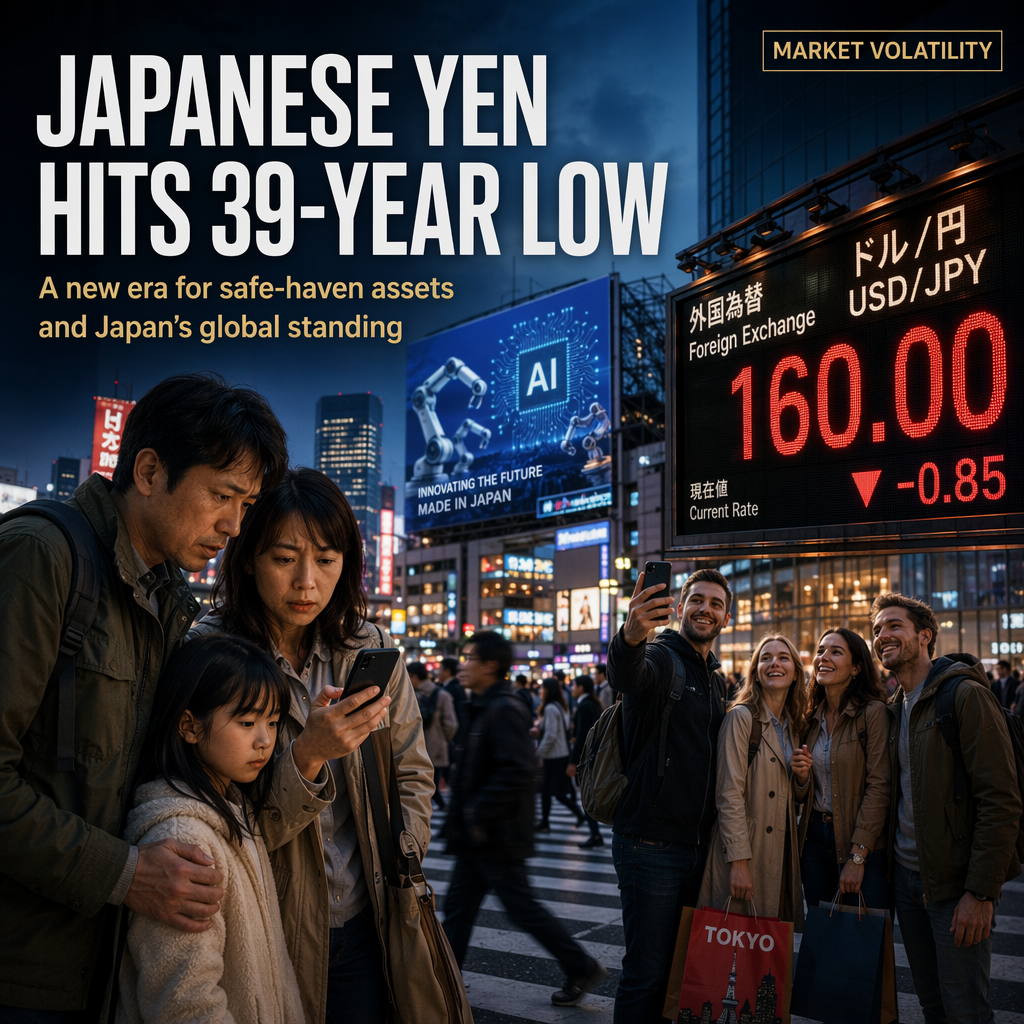
The Japanese yen has fallen to its weakest level in 39 years, with 160 yen to the dollar increasingly becoming the norm, marking a significant shift in currency markets and impacting Japanese families with children studying abroad due to the increased cost of overseas education [1]. This historic decline in the yen has made Japan a more attractive destination for foreign tourists, as the country becomes heavily discounted for visitors from Europe and North America. In response to overtourism, the Japanese government has raised visa application fees for foreign visitors fivefold, though the cost remains relatively modest in dollar terms: about $90 for a single-entry visa and $190 for a multiple-entry visa valid for repeated visits [1].
The weak yen also has broader implications for Japan's economic strategy. The government recently announced a public-private investment plan totaling 370 trillion yen through fiscal 2040, focusing on 17 sectors such as AI-powered robots, semiconductors, batteries, and autonomous driving. However, when converted to dollars, this figure amounts to just over $2 trillion, highlighting the impact of the currency's depreciation [1]. Market participants are increasingly focused on the timing of potential currency intervention by Japanese authorities as downward pressure on the yen persists [1].
According to CNBC, traditional safe-haven assets like the Japanese yen, U.S. Treasurys, and gold have struggled to provide protection during this year's market volatility. Despite geopolitical uncertainty from the Iran war, risk appetite remains strong, with investors continuing to favor AI-linked equities such as Nvidia, Intel, Samsung Electronics, SK Hynix, and Taiwan Semiconductor Manufacturing Company [2]. Treasury yields have climbed since the Iran war began, the yen has weakened to multi-decade lows, and gold has fallen sharply from its January peak [2].
Strategists attribute these unusual market dynamics to inflation fears, higher real yields, fiscal concerns, and wide interest-rate gaps, which are overpowering the usual flight-to-safety trade. Frederic Neumann, chief Asia economist at HSBC, noted that underlying risk appetite remains healthy and global financial conditions are highly accommodative, with U.S. and some Asian markets hitting record highs as investors pile into AI-related stocks [2]. Henning Potstada of DWS emphasized that EPS growth is the primary driver for equities, and forecasts are rising [2].
Bonds have not seen traditional flight-to-safety flows due to rising inflation expectations and concerns about debt sustainability, particularly in the U.S., where the federal deficit has raised worries among investors [2].
CONCLUSION
The yen's historic decline to a 39-year low is reshaping both Japan's domestic landscape and global market dynamics, as traditional safe-haven assets fail to provide expected protection amid persistent inflation and strong risk appetite. Investors are increasingly focused on AI-linked equities, while Japanese authorities face mounting pressure to address currency weakness. The situation underscores a significant shift in market behavior and policy considerations.