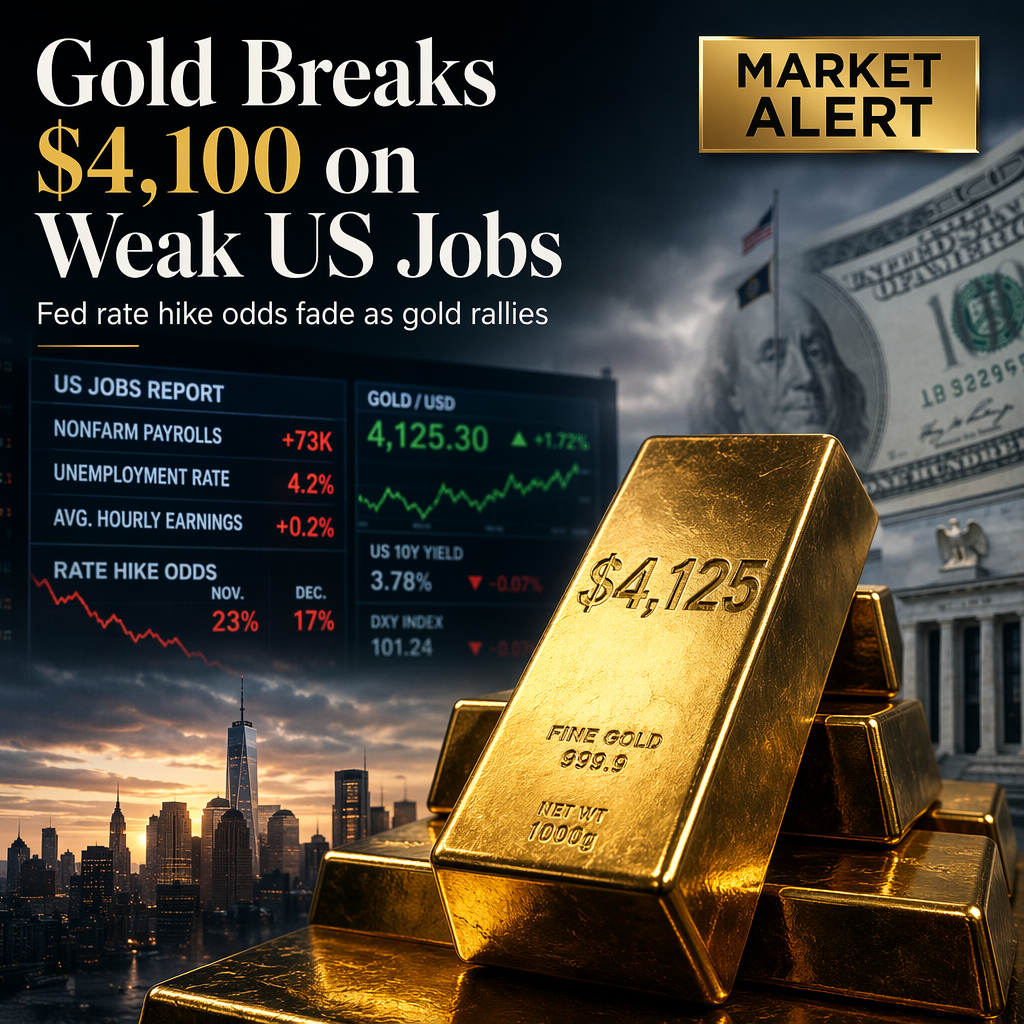
Gold prices (XAU/USD) rallied to approximately $4,125 during the early Asian session on Friday, extending gains after the release of weaker-than-expected US Nonfarm Payrolls (NFP) data. According to the US Bureau of Labor Statistics, the US economy added only 57,000 jobs in June, significantly below the market consensus of 110,000. Despite the disappointing jobs growth, the Unemployment Rate fell to 4.2% from 4.3% in May. This followed a separate report indicating that US private payrolls also increased less than anticipated in June [1].
Market participants interpreted the soft jobs data as reducing the likelihood of further Federal Reserve interest rate hikes this year. David Meger, director of metals trading at High Ridge Futures, stated, 'The lower-than-expected jobs number portends to less likelihood of potential rate hikes later this year. As we know, gold has a tendency to perform better in lower interest rate environments. Hence, we saw a significant rally in the gold market on the back of that' [1].
Additionally, geopolitical uncertainty remains a factor, as Reuters reported that recent indirect talks between the US and Iran concluded without progress toward lasting peace. Prolonged conflict in the Middle East could stoke inflation concerns, potentially prompting traders to reconsider rate hike bets, which could weigh on gold prices. However, for now, the weaker US labor data is the dominant driver [1].
Gold is widely regarded as a safe-haven asset and a hedge against inflation, with central banks—particularly those in emerging economies such as China, India, and Turkey—continuing to increase their gold reserves. The metal's inverse correlation with the US Dollar and US Treasuries further supports its appeal in the current environment [1].
CONCLUSION
Gold's rally above $4,100 was fueled by weaker-than-expected US jobs data, which has dampened expectations for further Fed rate hikes. The market response underscores gold's role as a safe-haven asset in uncertain economic conditions. Investors are likely to continue monitoring US economic data and geopolitical developments for further direction.