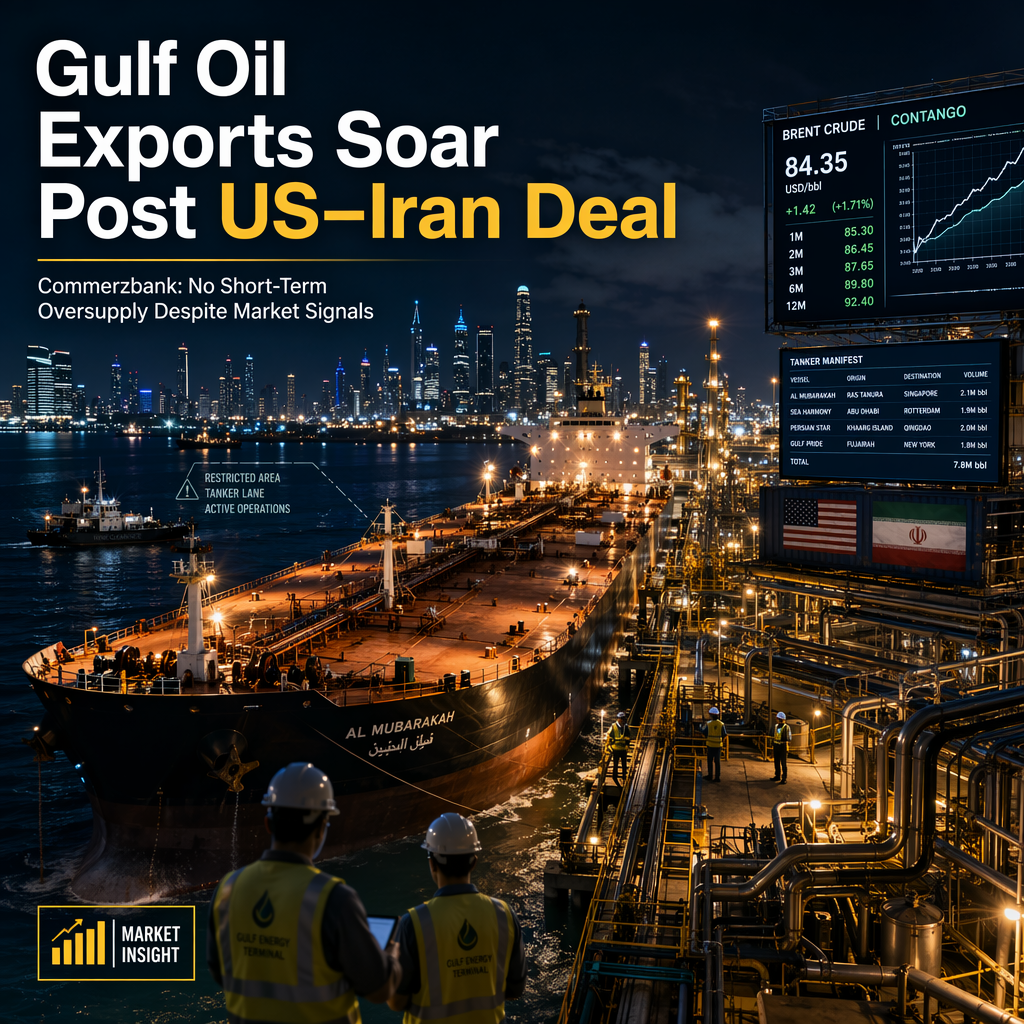
Commerzbank’s Carsten Fritsch reports a rapid recovery in Gulf oil production and exports following the recent US–Iran agreement. This rebound is evidenced by a significant increase in observed oil flows, with Bloomberg data indicating that nearly 90 million barrels, or 4.7 million barrels per day, have been exported since the agreement was signed nearly three weeks ago. On a single day, 13.8 million barrels were recorded, marking the highest supply volume since the end of February [1].
Market signals reflect this surge in supply. The Brent forward curve has moved into contango, initially affecting only the first two futures contracts but now extending to the first four, suggesting that oil supplies have risen more sharply than official data indicate. Additionally, Saudi Arabia, OPEC’s largest producer, has sharply cut its Official Selling Price (OSP) for August, offering Asian buyers a discount of USD 1.5 per barrel on Arab Light compared with the Oman/Dubai benchmark [1].
Despite these indicators of increased supply, Fritsch argues that the oil market is unlikely to face a genuine oversupply in the short term. He cites ongoing challenges such as mine clearance, restricted tanker traffic, and the need for stock replenishment. The replenishment of oil stocks is expected to absorb a considerable portion of the anticipated oversupply, with a required volume of around 450 million barrels over six months, equating to an additional demand boost of approximately 2.5 million barrels per day [1].
Fritsch remains skeptical of a near-term oversupply, despite the forward curve's pricing, and suggests that the market's focus should be on the absorption of excess supply through stock rebuilding rather than an immediate glut [1].
CONCLUSION
While Gulf oil production and exports have rebounded sharply after the US–Iran agreement, Commerzbank does not foresee a short-term oversupply due to ongoing logistical constraints and the need for significant stock replenishment. Market signals such as Brent contango and Saudi OSP cuts reflect increased supply, but these are likely to be offset by higher demand for inventory rebuilding.