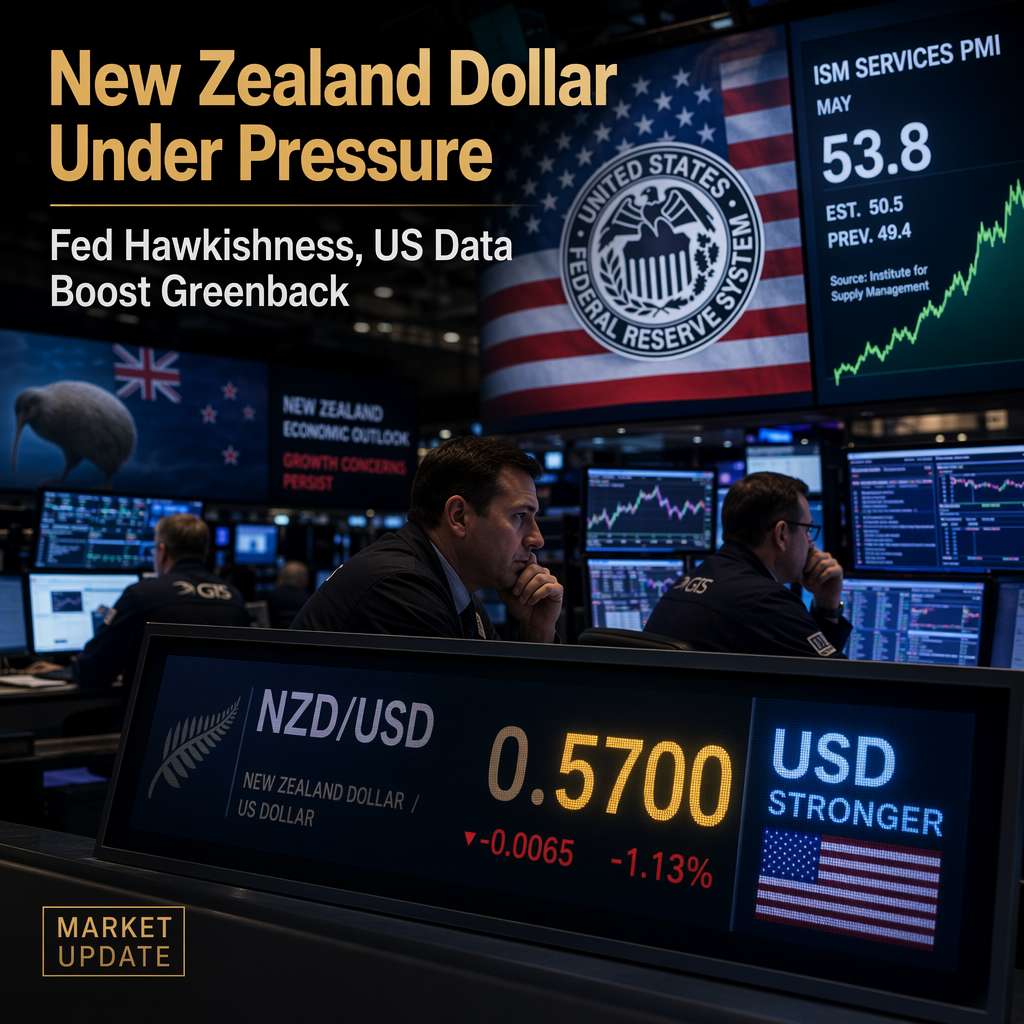
The New Zealand Dollar (NZD) traded under pressure near the 0.5700 level against the US Dollar (USD), influenced by hawkish comments from Federal Reserve (Fed) Governor Christopher Waller and resilient US services sector data [1]. Governor Waller emphasized the Fed's commitment to the 2% inflation target, describing it as a credible pledge, and noted that risks have shifted, with the labor market stabilizing and inflation accelerating. He also stated that the Fed will not keep rates low to assist US government deficit financing and expressed a preference for an inflation target range, though he warned that changing the target now would lack credibility [1].
US economic data further supported the Greenback. The ISM Services PMI for June came in at 54.0, matching expectations, while the Employment Index rose sharply to 51.2 from 47.9. However, New Orders eased to 55.1, and Prices Paid fell to 67.7, indicating that while demand and cost pressures have cooled, they remain elevated [1].
From a technical perspective, NZD/USD traded at 0.5705, showing a neutral-to-slightly-bullish tone as it remained above the 20-period Simple Moving Average (SMA) at 0.5693 but was capped by the 100-period SMA at 0.5717. The Relative Strength Index (RSI) was around 58, suggesting steady but not overextended bullish momentum. After an overnight sell-off, the New Zealand Dollar saw some recovery during the American session, though it remained lower overall for Monday [1].
Immediate resistance for NZD/USD is at the 100-period SMA near 0.5717, with further hurdles at 0.5907, 0.5930, and 0.5965. On the downside, support is seen at 0.5702, with additional levels at 0.5697, 0.5693, and 0.5684 [1].
CONCLUSION
The New Zealand Dollar remains pressured by a strong US Dollar, bolstered by hawkish Fed commentary and solid US services data. While NZD/USD saw some intraday recovery, the overall tone remains cautious, with technical resistance levels capping further gains. Market participants are likely to remain attentive to Fed policy signals and US economic data for further direction.