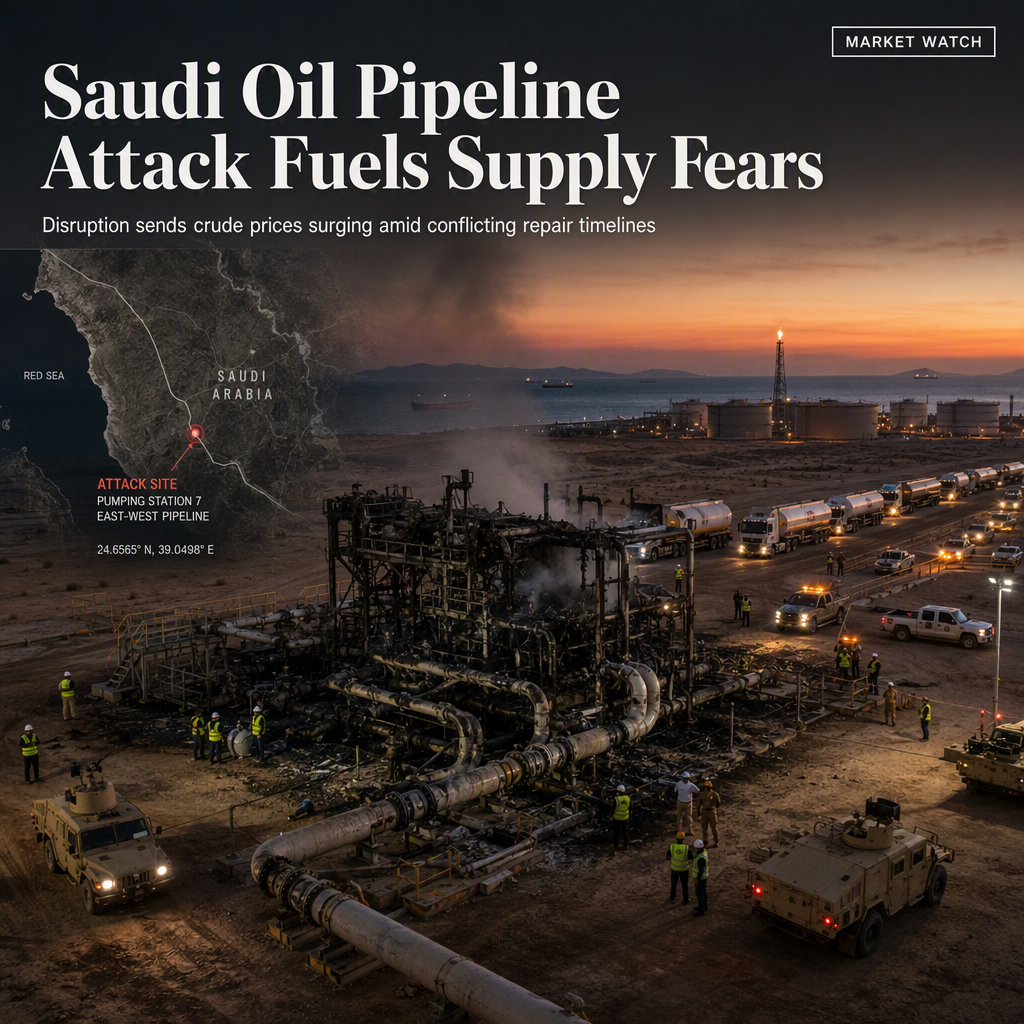
Saudi Arabia's critical East-West crude oil pipeline was closed late last week following drone attacks launched from Iraq, which U.S. Energy Secretary Chris Wright attributed to Iran-backed proxy groups [1]. Wright told CNBC that the pipeline outage would be 'brief and temporary,' estimating it would last only days, and assured that operations would resume 'very soon' [1]. During the closure, Saudi Arabia has redirected some crude exports back through the Strait of Hormuz with U.S. military support, as the pipeline is a key route for shifting exports to the Red Sea amid ongoing U.S.-Iran tensions over Hormuz [1].
Despite official statements downplaying the duration of the outage, satellite imagery reportedly shows extensive damage to one of the pipeline's pumping stations. Andy Lipow, president of Lipow Oil Associates, suggested in a Monday note that repairs could take months, contradicting the U.S. Energy Secretary's optimistic timeline [1]. Riyadh has described the closure as a 'precautionary measure,' but has not provided an official damage assessment or a definitive timeline for reopening [1].
The market has reacted strongly to the disruption, with U.S. crude oil prices rising more than 5% this week to trade above $105 per barrel, as traders assess the potential supply impact [1]. Matt Smith, director of commodity research at Kpler, estimated that if the pipeline remains closed for a month, the market could lose 120 million barrels, based on daily exports of 4.5 million barrels and 15 million barrels stored at the Yanbu terminal [1].
The discrepancy between official reassurances and analyst assessments highlights uncertainty regarding the duration and impact of the outage. While U.S. officials expect a quick resolution, market analysts warn of a potentially prolonged disruption, which could significantly affect global oil supply and prices [1].
CONCLUSION
The closure of Saudi Arabia's East-West oil pipeline has triggered a sharp rise in crude prices and heightened supply concerns, with conflicting views on the outage's duration. While U.S. officials anticipate a brief interruption, analysts warn repairs could take months, underscoring uncertainty in the oil market. The event is likely to have a significant impact on global energy dynamics until clarity emerges on the pipeline's reopening.