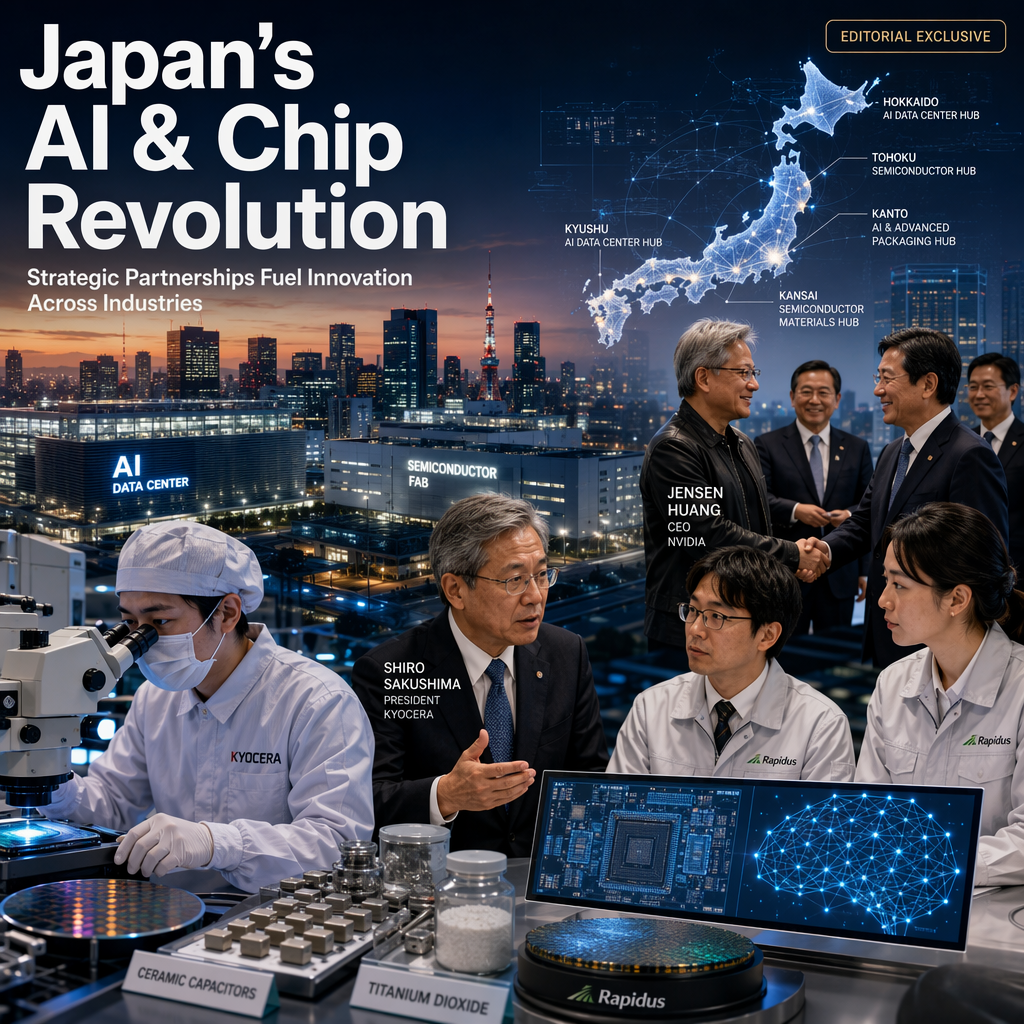
Japan's semiconductor and artificial intelligence sectors are experiencing significant momentum, driven by a series of strategic moves and partnerships among leading domestic and international players. Kyocera President and CEO Shiro Sakushima stated that demand for chipmaking components, particularly those used in advanced semiconductor equipment, is projected to remain strong at least until 2030, fueled by advances in artificial intelligence and data center investments. Kyocera's earnings have been bolstered by robust orders for ceramic components, and the company is considering further capacity investments while remaining cautious and closely monitoring market trends and customer forecasts [1].
In the materials sector, Ishihara Sangyo Kaisha announced plans to double its production capacity for titanium dioxide, a key material in ceramic capacitors essential for AI server hardware. This move aims to address the surging demand for AI applications and data center expansion, solidifying Ishihara Sangyo's position in the global supply chain for AI server components [2].
On the chip design front, Japanese chipmaker Rapidus and U.S. software company Cadence have entered a partnership to provide agentic AI tools for chip design, aiming to speed up development and reduce complexity. Rapidus is advancing toward mass production of advanced chips, recently adding Canon as a major domestic customer candidate for 2nm chips and securing $1.7 billion in funding. The Japanese government is also broadening subsidies for domestic chip production and targeting $254 billion in homemade semiconductor sales by 2040. The Rapidus-Cadence collaboration is part of Japan's broader efforts to reclaim leadership in global semiconductor manufacturing [3].
Meanwhile, Nvidia is intensifying its focus on Japan, with CEO Jensen Huang expected to promote semiconductor supplies and support for a government-backed AI developer formed by SoftBank and others. Nvidia's partnership with Japan's state-backed AI developer Noetra underscores its strategy to support sovereign AI initiatives, ensuring control over critical data and infrastructure. While no financial figures for the Japan deal were disclosed, analysts suggest that such collaborations could drive significant demand for Nvidia's high-performance GPUs and data center products, potentially impacting the company's growth and market valuation. This partnership aligns with Japan's strategy to bolster domestic innovation and reduce reliance on foreign technology in AI and semiconductors [4].
CONCLUSION
Japan's coordinated efforts across materials, chip design, and AI infrastructure signal a robust and sustained push to strengthen its position in the global semiconductor and artificial intelligence markets. Strategic partnerships, capacity expansions, and government support are expected to drive continued growth and innovation in these sectors. Market sentiment is positive, with high impact anticipated for both domestic and international stakeholders.