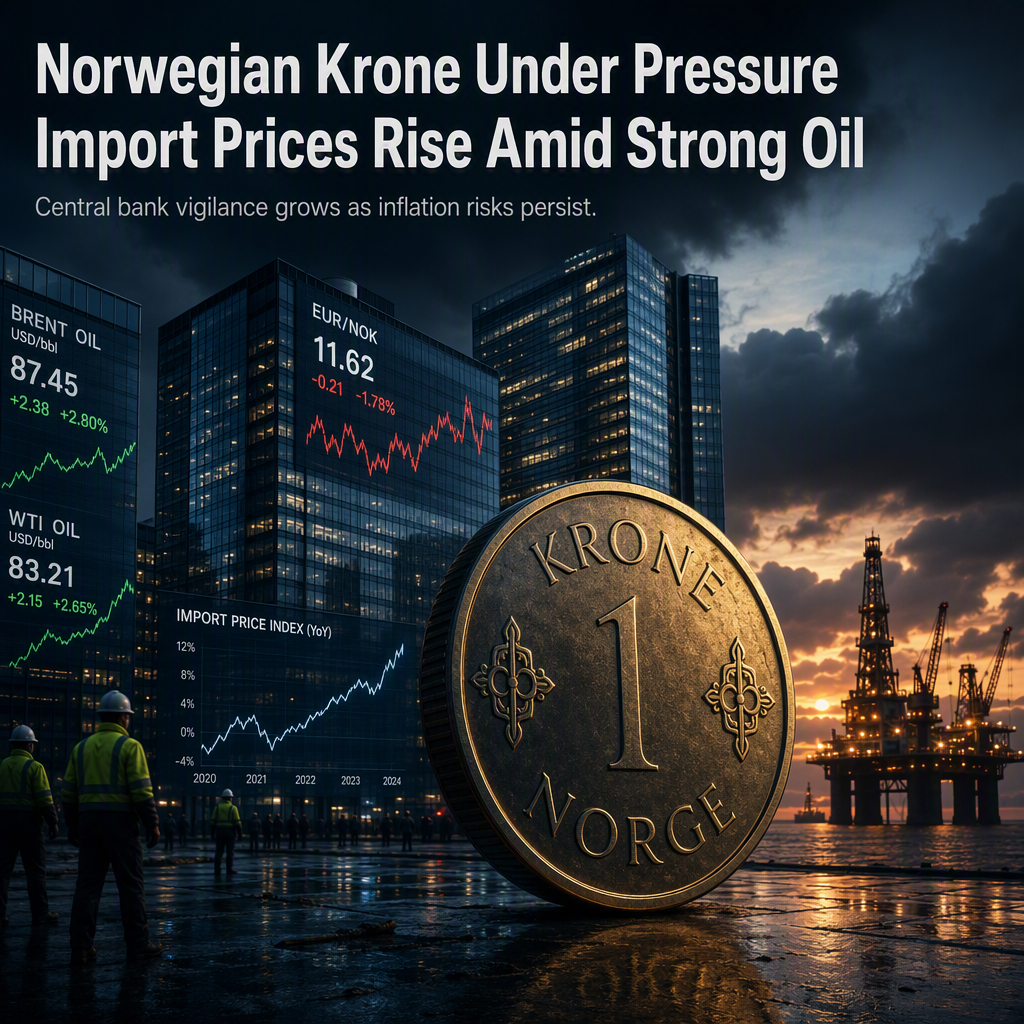
BNY’s Geoff Yu highlights that while stronger oil prices in 2024 have improved Norway’s terms of trade, the gains are not as pronounced as those seen in 2022, resulting in less support from central bank sales for the Norwegian Krone (NOK) [1]. The EUR/NOK pair strengthened significantly during Q2, which has led to a notable increase in the I-44 import price index, raising concerns about import pass-through risks [1]. Yu notes that Norwegian import prices are beginning to diverge from EUR/NOK, similar to trends observed in Sweden, which could elevate inflation risks through higher import costs [1].
Despite these headwinds, NOK’s robust performance year-to-date provides Norges Bank with a buffer against inflation figures, allowing the central bank to focus primarily on domestic factors [1]. However, Yu warns that vigilance is necessary, as elevated import prices may push up inflation expectations and trigger second-round effects that Norges Bank must address [1]. The energy-dominant nature of current supply shocks means NOK’s reaction to external factors differs from its peers, but domestic triggers, especially wage developments, are likely to have a stronger impact on the currency [1].
Yu also points out that the risk-reward profile for short EUR/NOK trades is poor, given the weaker valuation case for NOK compared to currencies like the Polish Zloty (PLN) and Swedish Krona (SEK) [1]. Additionally, data indicate that investor holdings of NOK are at very high levels relative to G10 peers, which acts as a persistent headwind against further NOK performance [1]. Transmission from import costs to labor takes longer, but historical patterns suggest Norges Bank will respond proactively to any risks arising from wage pressures [1].
CONCLUSION
The Norwegian Krone faces valuation challenges due to rising import prices and high investor holdings, despite improved terms of trade from stronger oil prices. Norges Bank is expected to focus on domestic factors, particularly wage developments, as import price pass-through risks could elevate inflation expectations. The risk-reward for short EUR/NOK trades remains unattractive, and vigilance is advised for potential second-round inflation effects.