According to Standard Chartered economists Carol Liao and Hunter Chan, China's fiscal support softened in Q2 2026 after a robust Q1, resulting in a sharp slowdown in infrastructure fixed asset investment (FAI), mirroring trends seen in the second half of 2025 [1]. In April-May 2026, overall broad government spending declined by 5.7% year-on-year, even as broad revenue growth accelerated to 2.2% year-on-year, which led to the broad deficit shrinking to a three-year low [1]. General public budget spending fell 2.4% year-on-year during the same period, despite a 6.6% year-on-year increase in revenue [1].
The slowdown in fiscal support was accompanied by a notable deceleration in local government special bond (LGSB) issuance in Q2 2026, while land sales revenue continued to deteriorate, further constraining local government spending capacity [1]. The economists note that LGSB funding could have partially offset this drag if issuance had not slowed [1].
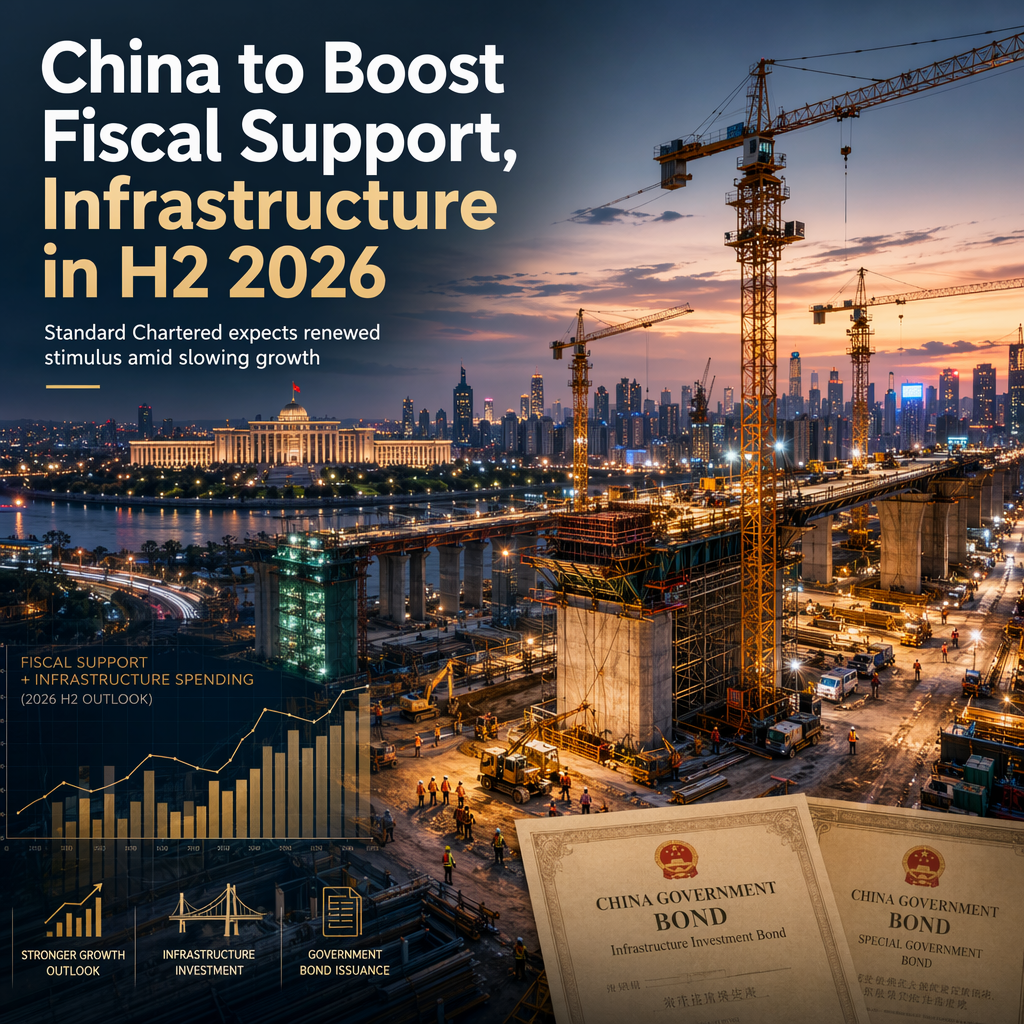
Looking ahead, Standard Chartered expects the Chinese government to re-accelerate fiscal support in the second half of 2026, particularly through increased infrastructure investment and a faster pace of LGSB issuance, utilizing the existing quota [1]. If exports weaken unexpectedly or the housing downturn intensifies, policymakers may respond by front-loading the 2027 LGSB issuance quota or authorizing additional local government bond issuance from previously unused debt quotas [1].
The report suggests that the government has comfortable fiscal room in H2 2026 and may fine-tune the pace of fiscal implementation to support growth, especially if external or property sector headwinds worsen [1].
CONCLUSION
China's fiscal support is expected to re-accelerate in the second half of 2026, with a focus on infrastructure investment and increased local government bond issuance. The government's flexible approach to fiscal policy aims to counteract potential weaknesses in exports or the housing market, providing a medium-term boost to economic activity.