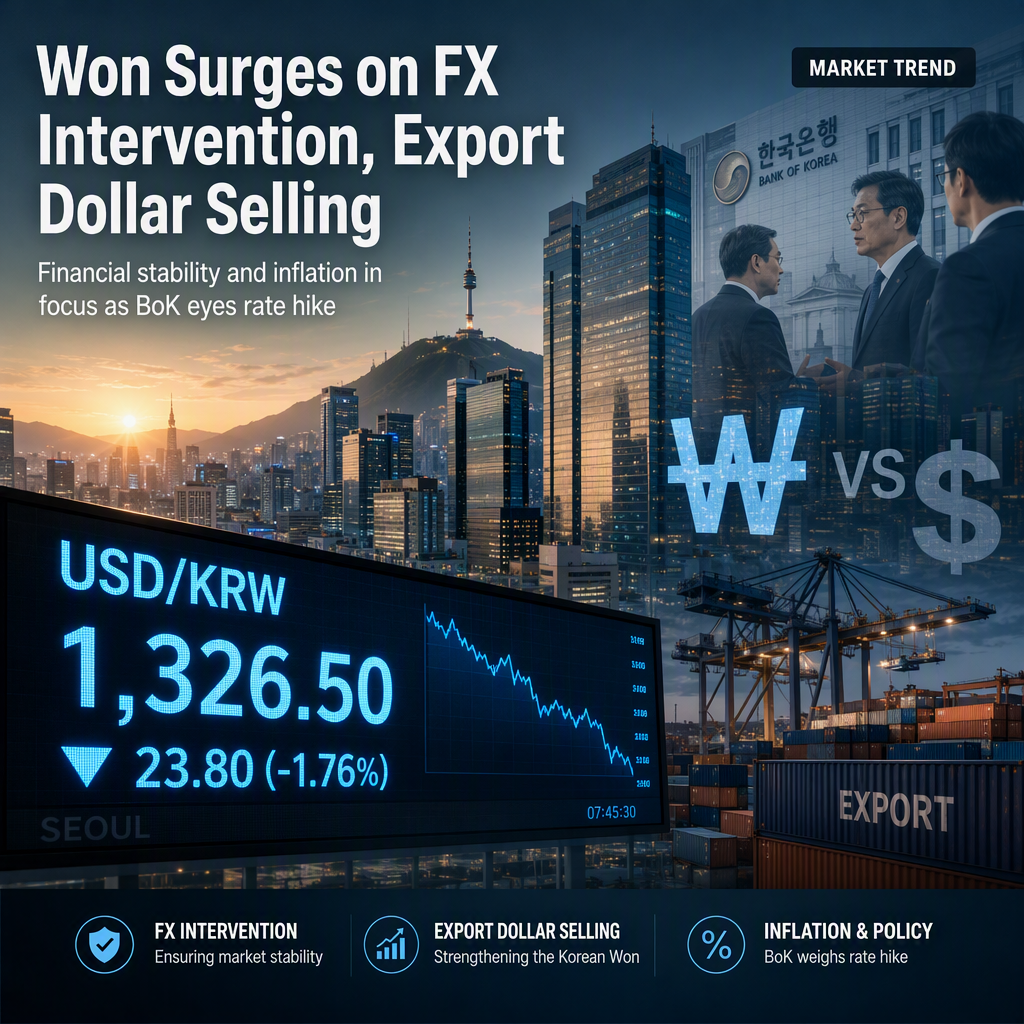
The South Korean Won (KRW) continued its appreciation against the US Dollar, with USD/KRW slipping 0.1% to 1,430, extending a 0.5% decline on Monday and a 1.3% drop last week [1]. Commerzbank economists attribute this strength to reported coordinated foreign exchange intervention by the Ministry of Economy and Finance, in collaboration with Japan, as well as sustained exporter Dollar selling, including sizeable forward sales in June [1]. Specifically, domestic corporates were net sellers of USD9.3 billion in forwards during June, further supporting the KRW [1].
On the macroeconomic front, July's Consumer Price Index (CPI) surprised to the downside, easing to 2.8% year-over-year compared to the Bloomberg consensus of 3.0% and down from 3.2% in June, marking the slowest pace in three months [1]. This moderation was largely attributed to softer energy prices. However, core CPI, which excludes volatile food and energy prices, edged up to 2.6% (Bloomberg consensus: 2.5%) from 2.5% in June, indicating that underlying price pressures are broadening beyond supply-side factors [1].
Looking ahead, Commerzbank expects inflation to pick up sharply in August due to low base effects from last year's one-off telecommunications discount programme, before easing gradually as government relief measures fade [1]. Persistent core inflation, resilient domestic demand, and spillover effects from the semiconductor boom into wages and services are likely to keep inflation above the Bank of Korea's (BoK) 2% target [1].
On monetary policy, Commerzbank anticipates the BoK will deliver one additional 25 basis point rate hike this year, raising the Base Rate to 3.0%, in line with its latest median policy rate projection [1]. The July Monetary Policy Committee (MPC) minutes reinforced the BoK's tightening bias, with members highlighting the broadening semiconductor-led recovery and warning that stronger household income, corporate investment, and domestic demand could generate more persistent inflation [1]. Policymakers also expressed concern over rising household debt, higher Seoul apartment prices, and financial market imbalances, suggesting that financial stability will remain a key consideration in future policy decisions [1].
CONCLUSION
The South Korean Won's recent strength is attributed to coordinated FX intervention and robust exporter Dollar selling. While headline inflation has moderated, persistent core inflation and resilient domestic demand are expected to keep price pressures elevated, prompting expectations of further monetary tightening by the Bank of Korea. Financial stability concerns remain central to policymakers' outlook.